
A Monument at Risk
In 2012, 730 people crowded into two “Melandra Days”, held by the Archaeological Society (GLAS). The aim was to drum up support for a bid to the Lottery for nearly £100,000 to run a 5-week “community dig” at the fort.
After the Melandra Field Group, which had watched over it since the 1960s, was disbanded in 1984, and regular digs ceased in 1998, its condition had gone steadily downhill. Only the paths and areas outside were mowed, so the centre was invaded by ankle-breaking tussock grass. The drain, installed in 1974, from the principia, the headquarters building, failed and it became waterlogged and overgrown (pics, 1980s and now). Bushes grew on the ramparts, and some became trees, with destructive roots running deep into the 1900-year-old structures.
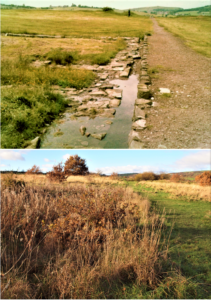
The signs went, too – the interpretation board, and two of the plaques, installed in the 1960s, which told people that it was protected as a monument of national importance. Not that this made much difference; the rare mentions in the Chronicle, which had once carried stories about exciting finds and plans for museums, were now all about vandalism.
And the view also went. In the 1970s Glossop Council had planted trees on the formerly bare hillsides around, but as they grew they blocked the panoramic views of the valley below and the hills beyond. The few visitors not only had no idea what they were looking at, but could no longer appreciate why the Romans had chosen that spot.
The hope was that a successful dig would draw attention to the fort and persuade the Council that, with better maintenance, it could become the tourist attraction envisaged in the 1970s. However, the Lottery rejected the bid – before they would fund a dig, they wanted the Council to agree an improvement plan.
The recession was biting, so the Council proposed to transfer ownership to a “community trust” which could access funds not available to local authorities. However, this made little headway. Unpaid volunteers were reluctant to take responsibility for a large insecure site which could generate no income, and with no guaranteed funding beyond “seed money” from the Council, and some potential trustees were too old to be signing a 25-year lease.
GLAS members hacked away at the smaller bushes – the bigger trees were beyond them – and persuaded the Council to flail the tussock grass. However, it all grew back within months, so they approached Historic England, which had taken the site off its “At-Risk” Register when the trust scheme was mooted, and asked that it be put back on.
The upshot, in late 2019, was an agreement between Historic England and the Council that each would contribute £20,000 over 5 years to a joint management scheme. It was due to take effect in April 2020, but Covid intervened. Discussions are now resuming, but in the meantime the site is back on the At-Risk Register as “generally unsatisfactory with major localised problems…deteriorating and in need of management.”
Even when the scheme does proceed, £40,000 will go only a small way to restoring the site to its condition when landscaped in the 1970s. Some limited improvement, though, will hopefully make it easier to get more funds to complete the job. However, without sufficient maintenance it will then quickly revert to nature.
That can be avoided only if its upkeep is seen as worthwhile, given other demands on Council funds. In 1971 the Glossop Councillors thought it could be a major tourist magnet, something which the town was (and still is) lacking, and which would have knock-on benefits for the local economy.
What they failed to appreciate, though, was that a tourist attraction and an open public park, next to a road and a large housing estate, were fundamentally in conflict. Any future vision for Melandra will need to address that dilemma.
END OF SERIES
PREVIOUS – Part 4: The Plan