
Inventor and Welfare Reformer, Benefactors and Freemen of Glossop

A Hyde Lad
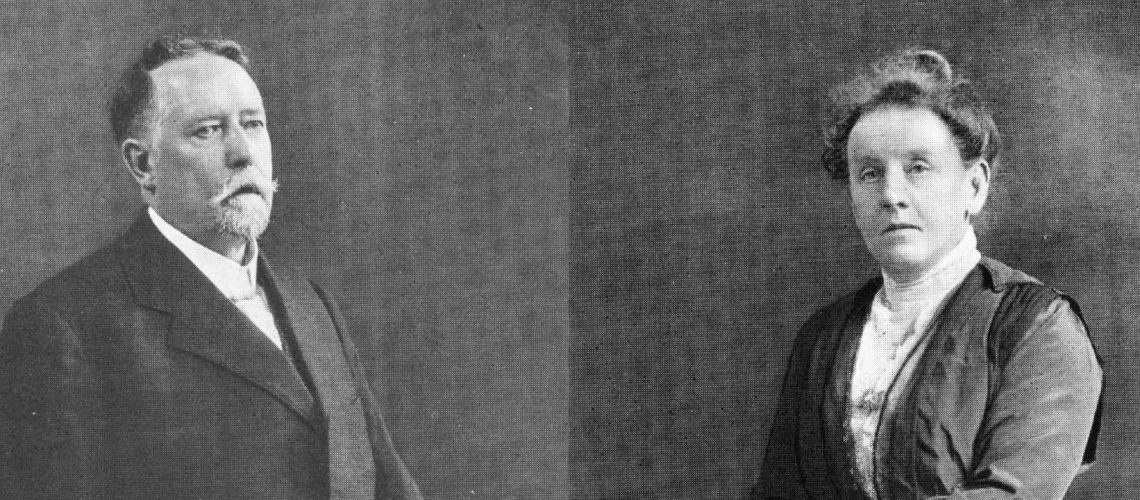
Isaac Edward Jackson was born in 1858, the youngest son of Horace and Mary Ann Jackson. His father Horace was a saddler but was also well known as a poet and Chartist. The family lived and worked in Hyde. Isaac’s two elder brothers became saddlers and later Isaac himself learnt the trade most probably from his father.
Isaac came to Glossop, a penniless youth, in the early 1870s. In 1878 he married Harriet Martin at St Mary’s Church in Stockport. Harriet was also from Hyde. She was born in 1857, the daughter of Thomas and Hannah Martin. Thomas was a coal miner but later worked as a common carrier with one horse. Harriet also started work at a young age. In 1871 she was working as a hat trimmer, a common occupation in the Hyde area.
A Good Wife – That Greatest of All Life’s Treasures
The newly married couple made Glossop their home and worked together to build up their business. Isaac worked hard maintaining his saddlery business but made his fortune through his inventions.
At this time the belts that ran machinery in mills and factories were held together with leather thongs. This would cause significant delays when they broke. Isaac began experimenting to create a solution that would fix the belts together quickly and with minimum skill. He registered many patents for belt fasteners including the famous “Jackson’s Patent Belt Fastener”. This was a metal plate that clipped together with a button from underneath.
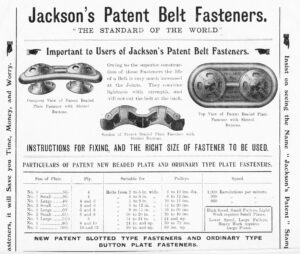
He travelled around the world sharing his invention and built up a very successful international business. Isaac put Glossop on the map. He remained loyal to the town in which he had made his fortune and in 1905 he opened the new and modern works at Hawkshead, Old Glossop.
It was not an easy journey by all accounts and he struggled against much adversity. His “indomitable pluck, dogged perseverance and tremendous will power” won through to bring him the fame and fortune he achieved in the business world.
Throughout his life he was heard to say that “he owed his success to the unswerving loyalty and business acumen of his wife”. At many points when Isaac was on his journeys Harriet would be running the business and their young household. Isaac and Harriet had five children, Elizabeth, James, Herbert, Frances, and Beatrice.
No More Generous Benefactor
“The Borough of Glossop has known no more generous benefactor…” claimed Isaac’s obituary in the Glossop Chronicle. Isaac had avowed to help others when he made his fortune. He also held much love and admiration for the town he and Harriet had adopted as their home.
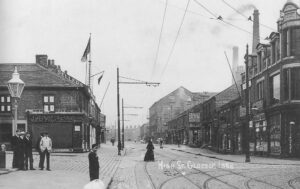
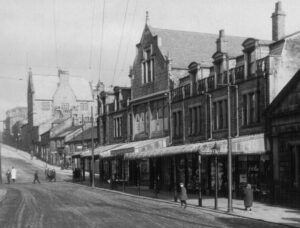
After he had moved his works to Norfolk Street, Isaac renovated his buildings on the corner of High Street East and Victoria Street that had formerly been his home and workshop. He converted the “old and unsightly buildings” into “palatial business premises” that Glossop could be proud of. The fine row of shops had all the modern requirements and were renamed Jacksons Buildings. He later added a verandah like the Victorian canopies found in Southport earning it the name Jackson’s Arcade.
He made other gifts to improve Glossop for all its inhabitants, such as seating to be placed around the town in 1908. These caused debate at the Council over how to prevent improper use, after a workman was reported to have had been seen standing on them.
He made contributions to sports clubs and teams, provided use of his land for events and celebrations and made gifts to churches. Mrs Jackson gifted a carved oak lectern in the shape of an eagle to the Unitarian Church on Fitzalan Street, where their son was married.
Isaac was very involved with the Freemasons being a member of the Devonshire Lodge in Glossop. He paid the whole costs of the improvements and redecoration to the Masonic Hall on Henry Street in 1913.
During World War One he gave welcome gifts to Belgian refugees, treats for the wounded soldiers at the Partington Home and purchased a new motor ambulance for the Borough Council in 1918.
Magnificent Gift in Memory of Fallen Heroes
What may be seen as his greatest gift to Glossop was the purchase money for Glossop Borough Council to acquire the Town Hall, market and manorial rights from Lord Howard in 1919.
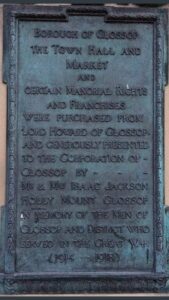
Isaac had made significant profits from the manufacture of munitions in World War One. This gift was made in the memory of all those local men that had lost their lives in the War.
The deeds to the Town Hall were handed over in a ceremony on the weekend of 19 July 1919 as part of the grand peace celebrations that were happening across the Borough.
Freeman of the Borough
In 1920 the Borough showed its appreciation of the generosity Isaac and Harriet had shown to the town by making Isaac a Freeman of the Borough of Glossop. He was presented with the casket in a ceremony on 5th May 1921.
The solid silver gilt casket was fashioned in a renaissance design. The centre panel had the photos of the recipient and his wife in rich enamel, with panels on each side depicting the The Town Hall of Glossop and Jackson’s Buildings. The lid had an enamel panel with the monogram “I.J.” and was surmounted by the Mural Crown Emblems of Civic Authority.
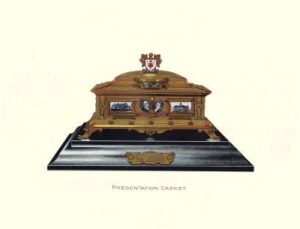
On top of the lid stood the full Coat of Arms with Crest and Motto of the Town, which had been executed in correct heraldic colours. On the reverse of the casket was an enamel panel showing a High Explosive Shell in the centre, to the left a Hammer Forging, and on the right the completed Hammer.
The engraving on each side of the panel read “The success of the 106 Fuse used so effectively in the High Explosive Shells during the Great War as largely contributed to by the Hammer Forging invented and patented by Isaac Jackson, Esq.”. The base, of the casket was ebonised wood which had an artistic plate with the following inscription, “This casket contains the Scroll commemorative of the conferring of the Honorary Freedom of the Borough on Isaac Jackson, Esquire, of Holly Mount, Glossop, on the 2nd of December, 1920”.
The Passing of a Noble Citizen
After being ill for some time Isaac sadly passed away on 18th March 1922; bringing “…to an honoured close a very strenuous, useful, and valuable life which has been wonderfully devoted to industrial enterprise and public-spirited work in the interests of the whole community”.
A Generous Friend of the Town and its People
After Isaac’s death Harriet continued their charitable work.
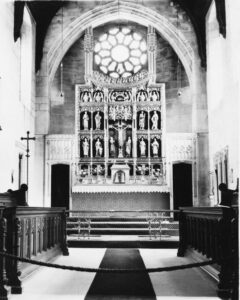
In 1923 the foundation stone was laid for a new Chancel of All Saints Parish Church in Old Glossop. Isaac and Harriet had commissioned the Chancel before Isaac’s death. When it was completed in 1924 Harriet dedicated it as a memorial to her late husband.
Harriet worked hard for the people of the town in her own right. She served for many years as a Guardian of the Poor. One of her biggest achievements was the setting up of the maternity and child welfare work of the town. The schemes she founded contributed to a significant reduction in the infant death rate.
For her welfare work Harriet was presented with the Freedom of the Borough on 9th November 1929. She was presented with a casket containing the resolution in a ceremony in the Council Chamber in the municipal buildings in February 1930.
On 19th June 1938, Harriet passed away at the age of 80, after a long illness. On this day Glossop lost “a generous friend of the town and its people”.
Isaac and Harriet Jackson Trust
Throughout their life Isaac and Harriet had always given generous help to the poor and those in need.
In his will Isaac established the “Isaac and Harriet Jackson Trust”. The fund was set up for the benefit of people in Glossop and to help and support those in need. The funds for the Trust came from the business and for many years it made contributions to national organisations as well as funding people and projects in Glossop.
Even though the business has now closed and the factory demolished the “Isaac and Harriet Jackson Trust” still exists to provide help for the young, disabled, elderly and general charitable purposes in the Glossopdale area. It remains one of the many generous legacies that Isaac and Harriet have left to the town they loved.