

This article was written by E. Paul Beckmann, a great grandson of Isaac and Harriet Jackson, in commemoration of the 100th anniversary of the death of Isaac Jackson.
On 18th March 2022 it will be the 100th anniversary of the death of Isaac Jackson. Isaac Edward Jackson was a saddler based in Glossop who, with his wife Harriet, ran a small business. Harriet was an extremely astute businessperson; Isaac was an inventor of some skill and he began to experiment with mechanical belt fasteners.
At the time, most of the drive belts for the machinery in the Glossop and district cotton mills were made of leather or heavy fabric and the joints would have to be sown together in situ, causing lengthy delays to the machines, very many of which would be powered by the same drive shaft. After some years and some failures, Isaac finally perfected a very successful working solution and the Isaac Jackson belt fastener was born.
Within a relatively brief period the fasteners were used for other uses, such as for conveyor belts and Isaac and Harriet Jackson launched their company Isaac Jackson and Sons Ltd. The profits were used to expand their business and Jacksons Buildings was commissioned at the lower end of Victoria Street.
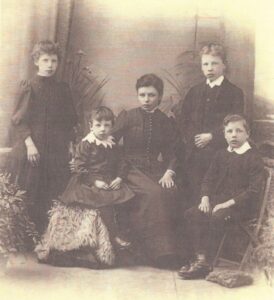
Not long after this, Isaac and Harriet moved to Holly Mount, the property standing in the angle between Ellison Street and Norfolk Street where Isaac extended the property to the rear to accommodate his growing manufacturing staff numbers.
By 1905 they realized that further expansion at the Holly Mount premises was no longer feasible and they bought Hawkshead Mills in Old Glossop a then largely derelict former cotton mill. Hawkshead Mills became an extremely busy factory producing belt fasteners as well as nuts and bolts. The work force was very well regarded and there were a number of highly skilled engineers among them.
When WW1 came, there was a high demand for the Hawkshead products, but Isaac also took on work for the Ministry of Munitions. When the ‘shell crisis’ of 1915 came, Isaac looked at ways in which he could accelerate production of munitions. His first target was the Type 106 artillery fuse, where he saw that if he could ‘cold forge’ the detonator pin (in other words ‘stamp’ it out using a massive press) rather than cast the pin in molten steel as other factories did, he could produce the pins far faster. Unfortunately, cold forging changes the metallic structure of steel, so Isaac built furnaces at Glossop Gas Works (Arundel Street) to experiment with annealing – changing the crystalline structure of the steel. He was successful and the detonator was produced in vast quantities although it is probable that his health suffered in consequence.
Isaac went on to produce more munitions, including the firing pin and the shell for the Stokes mortar and other specialized components. It would seem that Isaac Jacksons were paid per piece and the result was that they made substantial profits. Isaac and Harriet did not want to appear as profiteers (as several American munitions manufacturers did) and so began a number of charitable gifts to the people of Glossop. In 1917, Isaac bought seed potatoes for the whole Glossop population to help them through the wartime rationing. In 1918 he bought a motorised ambulance for the local hospital (Shire Hill) presumably replacing the previous horse-drawn access system.
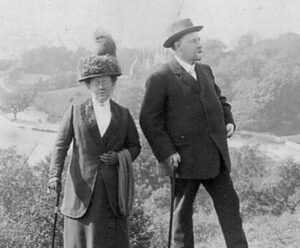
Isaac and Harriet also decided to provide a new chancel for the Church of All Saints, Old Glossop, although this was not completed until after Isaac’s death. In 1919, Isaac bought the Town Hall and Market rights from Lord Howard as a gift to the people of Glossop, dedicating it to the memory of those who died in the war. Finally, he and Harriet set up ‘The Isaac Jackson Trust’ for the benefit of the people of Glossop.
Isaac was made a Freeman of the Borough of Glossop in December 1920 in recognition of his work on the Type 106 fuse and his gifts to the town. Harriet survived Isaac by several years and it is a measure of her character that she took over the post of Managing Director at Hawkshead following the 1918 passing of the Representation of the People Act, which allowed women over the age of 30 who met a property qualification to vote. This was followed by the Sex Disqualification (Removal) Act of 1919, (the first part of which effectively removed any barriers for women to act in professional roles). At the age of sixty-five, Harriet was still game to run the firm, as she had very effectively done previously and which she continued to do for some years.

On 20th March 2022, several of Isaac and Harriet’s Glossop born great-grandchildren, together with their own grandchildren will meet at the graveside of Isaac and Harriet for a few minutes prayer and reflection before visiting All Saints Church nearby. They will also visit the site of the recently demolished Hawkshead Mills, Jacksons Buildings, Holly Mount and Glossop Town Hall.
E. Paul Beckmann