
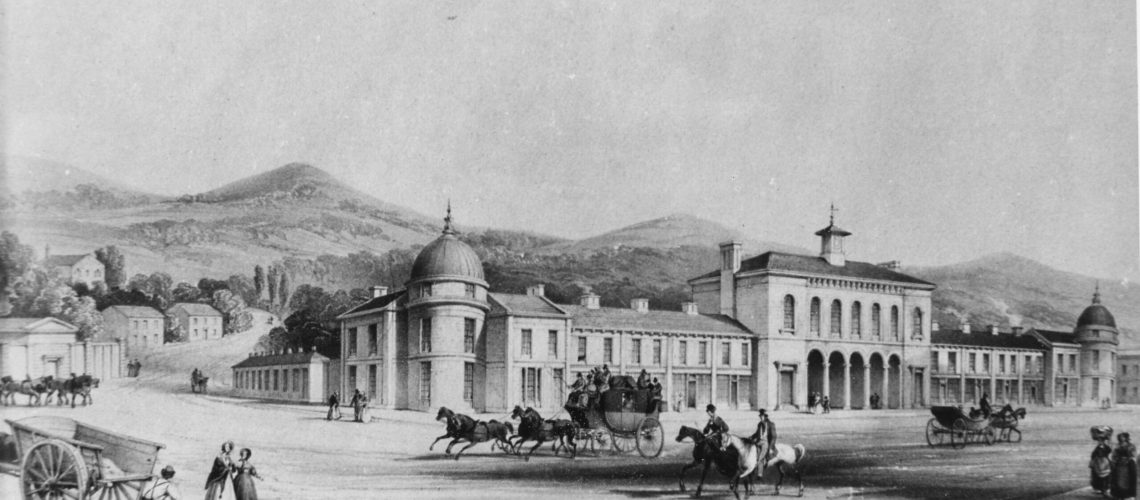
Victoria Bridge
On the ascension of Queen Victoria to the throne in 1837, a newly completed bridge over Glossop Brook was named Victoria Bridge in her honour. The road the bridge stood on, previously named ‘Little Moor’, was renamed Victoria Street.
Coronation Celebrations
On the Coronation Day of Queen Victoria, 28 June 1838, Glossop saw a most memorable day. The foundations were laid for the most important building in the town we now call Glossop.
A Committee of local gentry and mill owners had arranged the proceedings of the day. On Coronation Day all the manufactories were to be closed and the day declared a holiday.
The morning began with a firing of canons and ringing of bells at All Saints Parish Church.
At 11.30 am a procession assembled at Howard Town on the bowling green and gardens next to the Norfolk Arms. The area was a mass of people wearing white and red rosettes.
At noon cannons, which had been set on a private battery, fired a royal salute and bands played the national anthem. This signalled the start of the procession.
Procession
Mr Preston led the procession on horseback as “fugleman”. He was followed by the constables, Glossop band, head constables, clergymen and church wardens and magistrates in two phaetons.
The gentry of the town followed on foot with a banner saying “Success to Glossop Dale”. Behind them was the Steward of the Lord of the Manor, Thomas Ellison, and the architect of the new building, Matthew Ellison Hadfield. They were followed by the masons, oddfellows and other friendly societies.
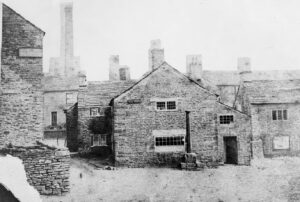
Finally there were children of the Primitive Methodist Society from Green Vale, whose chapel was near the Globe Inn on High Street West. Later accounts say that more children from other Sunday Schools were to be involved but it could not be decided between the Church, Roman Catholics and Independents who should go first in the procession.
The procession moved along the new road to the Market Cross at Glossop (now Old Glossop). Finely adorned women were waving from the windows along the route. At the Cross the band played the national anthem again and gave three cheers. The procession then moved to Rose Green where the coronation anthem was played, and three cheers were raised.
The procession then arrived again at Howard Town.
New Town Hall
The procession gathered round a site that had been marked out on a field called ‘The Flatts’. Bernard Edward Howard, 12th Duke of Norfolk had chosen this site at the crossroads, opposite the Norfolk Arms, to be the centrepiece of his new town, Howard Town.
He had commissioned an architect, Matthew Ellison Hadfield, the nephew of his late steward Matthew Ellison, to design a grand Town Hall. An Italian Renaissance style building was planned complete with a row of shops and domed buildings at either end.
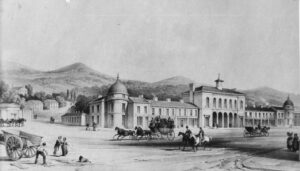
The Duke of Norfolk could not be at the celebration as he was Earl Marshal and required to fulfil duties at the Coronation. After the procession had gather round the site the band played ‘Rule Britannia’. The foundation stone was then laid by the Duke’s Steward, Thomas Ellison.
New Fangled Party Version
The day was nearly ruined by the “despicable conduct” of Glossop Church Choir who had been chosen to sing the national anthem at the end of the ceremony. There were some complaints the choir had been instigated to sing a “new fangled party version” of God Save the Queen, “which was got up by the tories during the heat of canvas for a contested election, and which was, to say the least of it, a very insulting proceeding to their dissenting brethren now assembled”. This may have been a reference to the line “scatter her enemies” as non-conformist religions such as Methodists and Independents would also be considered enemies of the Queen as they did not follow the Church of England.
Despite the insult and upset, a row was not started so as not to spoil the harmony of the day. Three cheers were raised and the cannons fired another royal salute. The procession then dispersed.
The masons then went to inns for food and the children went to their Sunday Schools for tea parties.
Dinner and an Invention
In the evening up to 90 gentlemen dined at the Norfolk Arms. In the chair was Thomas Ellison supported by Robert Ashton, George Andrew and Robert Shepley, Jun. The room was tastefully decorated and there was a band and glee singers providing excellent entertainments.
After the dinner, speeches and toasts took place to many including the Queen, the Royal Family, the army and navy, magistrates of the county and the town and trade of Glossop.
A surprise performance was made on the night by John Shaw of Milltown upon a new instrument (or rather an old instrument in a new form) he had invented. This was a new type of trombone, but no more details could be said about it as Mr Shaw wished to secure a patent on it.
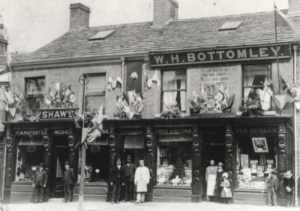
John Shaw was a farmer from Milltown, who by the 1840s was working as a brass maker. For over 20 years he had been working on improvements to brass instruments. He had invented a series of valves that would lengthen and shorten the tubes on brass instruments. This enabled the player to move to any key with ease. These changed the way brass instruments were used and in his day John was famous for his inventions. After working as gas fitter, John and his son Edwin ran a music warehouse on High Street East for many years.
The rest of the evening entertainments included a firework display that was provided by Mr Hadfield of Sheffield.
It was agreed that the whole proceedings of the day had been enjoyed by thousands.