Coronation festivities were debated after a heated discussion about finances at a Council meeting in February 1902.
The Mayor, Samuel Hill Wood, informed the Council of his plans. He proposed to give a treat to the day school children across the Borough and give them a commemorative medal. A Committee was then formed to decide on the rest of the festivities.
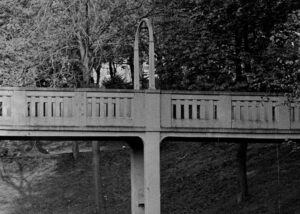
The meeting ended with the Town Clerk reading a letter from Lord Howard describing his intentions to present to the Council a foot bridge over Glossop Brook at George Street to Sandholes. This came with certain conditions that the Council would be responsible for transferring the bridge from the railway trucks at Glossop Station to George Street when it arrived. Also that the Council would construct two stone abutments for the bridge to be place upon, for which Lord Howard would supply the stone.
The proposed bridge would be 40 feet long and 3 feet wide and would have latticed girders and a wooden floor. The gift was accepted and thanks sent to Lord Howard.
The bridge would have been of great benefit to the people of the town. At this time the only way to cross this bit of the brook was across stepping stones. Robert Hamnett said other bridges had been built across the brook in the past but had been washed away.
Coronation Programme
On 6 June the full Coronation programme was published in “The Chronicle”. There was to be processions, teas, gatherings, bands, medals and fireworks in both Glossop and Hadfield and a huge bonfire on Mouselow.
One interesting question that was on people’s minds was “Is the new bridge at George Street going to finished by and opened on Coronation Day? – Push on chaps!”
Coronation Postponed
Two days before the Coronation, Glossop was busy decorating the town ready for the celebrations. Telephonic messages were being received from Manchester with rumours that the King was seriously ill, but these were treated as hoaxes. The evening papers confirmed the King had been rushed into an emergency operation and the Coronation postponed.
The Glossop Coronation Committee met on the Wednesday morning. The decision was made that it was too late to cancel all the prearranged gatherings as preparations and food had been made. The King had wished for the country to continue with the Coronation festivities. It was decided to go ahead with all the festivities except the bonfire which was to be lit at Mouselow.
The next days’ festivities would be of a much more subdued character.
Old Folks’ Treat
The Coronations festivities began with the old folks’ treat in Glossop and Hadfield on Wednesday evening. All old people over the age of 60 had been invited to the events that had been provided by Mrs Samuel Wood (Anne Kershaw Wood) of Moorfield, the mother of the Mayor.
The Glossop party was held at the Victoria Hall. A first-class sandwich tea was enjoyed by about 1000 people. Afterwards many strolled around the hall and chatted together. The Mayor, Samuel Hill Wood, one of the owners of Howardtown Mills, gave a speech about the national sorrow and the condition of the King. He called on everyone to rise to sing the National Anthem and accompanied by the band the first verse was sung.
In a change to the joyous celebrations that had been planned. A selection of pieces was afterwards played by the Whitfield String Band before the guests dispersed.
At the same time in Hadfield there was a large attendance at the old folks’ treat at St Andrew’s Schoolroom. This had again been donated by Mrs S. Wood. After the tea, a homely address was made by the Vicar and Rural Dean, Mr J. Hadfield. This was followed by a programme of entertainments.
Superb Decorations
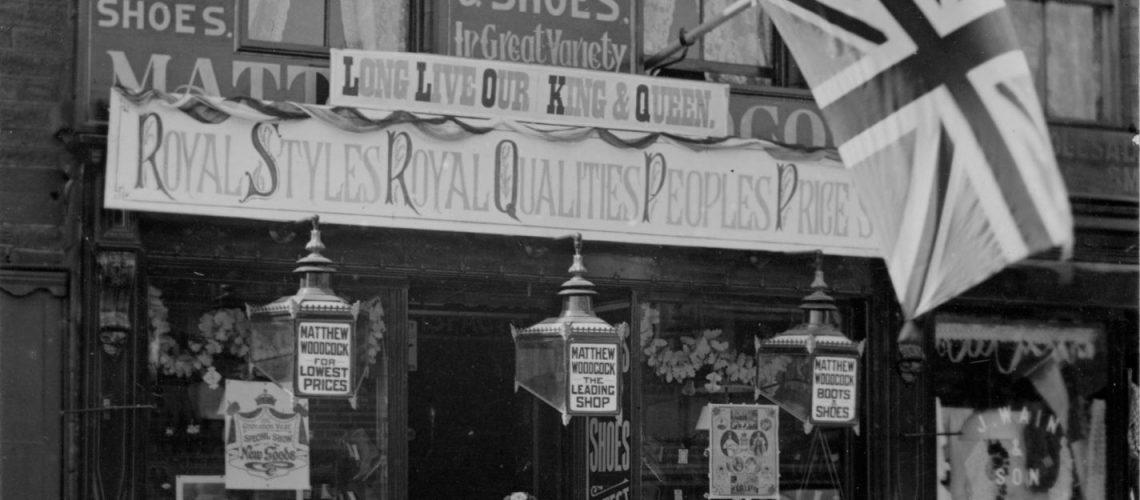
Despite the subdued celebrations the decorating of the town had still gone ahead. The High Street was an avenue of colour with bunting, flags and banners strung across the road. Shopkeepers had decorated their shops with flags, plants, banners, mottoes and fairy lamps.
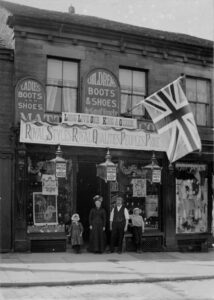
Norfolk Square was awash with poles entwined with the national colours. Opposite on the Town Hall was a large motto “one flag, one throne, one empire”.
The Conservative Club was finely decorated with purple draping, flags, patriotic emblems, plants and flowers. A large motto “Long Live the King” was surmounted by a massive crown that was illuminated at night.
In Old Glossop, a temporary structure had been built at the entrance to the church gates and covered with crimson cloth, evergreens and flags by Mr F. Hadfield. The old Cross was decorated with bunting that was attached to nearby buildings; the cross having been moved to its current position in 1900. In the evening the area was lit with fairy lamps that were supplied with electric light from Lord Howard’s Plant.

There were many beautiful floral displays at Glossop Park (Howard Park) that had been the work of the head gardener, Mr P. Rowbottom. The many visitors to the park were charmed by the music of Mr Albert Sidebottom’s orchestral band.
Coronation Day
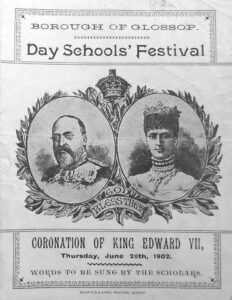
On Thursday 26 June the festivities began at noon with the Glossop Day Scholars’ Festival. Day School children from all over Glossop gathered on North Road Football Ground (Glossop Cricket Club).
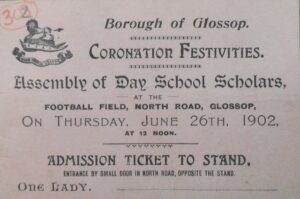
Thousands of spectators lined the ground to watch the procession of children arrive. On a decorated stand stood the Mayor and other gentry of the Borough.
The conductor, Mr W. P. Fairclough, began proceedings and the programme of “God save the King”, “God bless the Prince of Wales”, “Home Sweet Home” and “Auld Land Syne” was sung. The Glossop Old Band accompanied the singing.
Afterwards the scholars returned to their schools where they were entertained with a tea that had been provided at the expense of the Mayor, Samuel Hill Wood.
The Day School scholars at Hadfield performed their own demonstration. They gathered in the Station Yard at Hadfield Station wearing medals that had been provided by the Mayor. In the yard they sang the same songs as Glossop in front of a large audience accompanied by The Royal George Band, Greenfield. They then returned to their schools to enjoy a tea and entertainments provided by the Mayor.
Change to the Programme
One of the highlights of the day was to be the distribution of medals to the Regulars and Volunteers that were involved in the South African campaign, the Boer War. This was postponed as the War Office had ordered that no Volunteer parades were to happen due to the King’s illness. The medals were distributed in a ceremony in Norfolk Square in February 1903.
Friendly Societies
At two o’clock a magnificent gathering of members of Glossop Friendly Societies was held in Norfolk Square. The societies assembled in the Market Ground then moved through the Market Hall on to High Street West then across to Norfolk Square.
Sightseers who had gathered in the Square were entertained by Glossop Old Prize Band and St. Mary’s Drum and Fife Band. The societies made an impressive display with their regalia and costumes.
On a stand in front of the Town Hall was the Mayor and Mayoress and other Council Officials and local gentry. The gathering then sang the National Anthem, which was followed with cheers for the King and Queen, the Mayor and Mayoress and Captain and Mrs Partington.
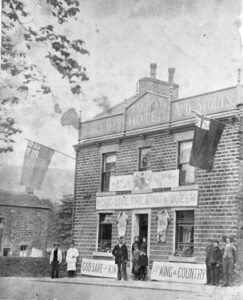
A procession of the Mayor, Council Officials and all the different courts of friendly societies, with their banners, made their way up High Street East. They came to a stop filling the road between the drinking fountain at the Turn O’ the Lane and Corn Mill Bridge. The National Anthem was sung and the members of the societies then dispersed to their lodges where they had a tea provided by Captain Edward Partington, one of the owners of Olive and Partington Paper Mills.
The Friendly Society lodges were housed in inns and taverns across the district and all had been decorated for the purpose. Captain Partington had allowed 2s. 6d. per head for the members and their wives and sweethearts. It was estimated that about 6,000 people would be attending these entertainments.
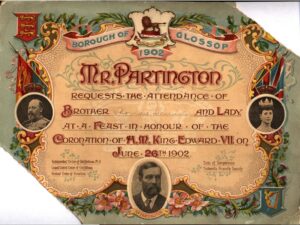
Souvenir Cards were issued by Captain Partington as a pretty and artistic memento of the day. They had a photo of the King and Queen and the donor of the treat.
In the Workhouse a dinner was provided by the Guardians for the inmates. This consisted of beef, mutton, pudding, fruit pies, beer, coffee and tobacco and oranges. The following day other donors provided a sandwich tea and entertainments.
Illuminations
In the evening the whole town was alight with fairy lamps and electric lit illuminations. The Town Hall, Victoria Hall, Technical School, Conservative Club and Glossop Co-operative Stores were all lit up.
Lord Howard illuminated Norfolk Square and at ten o’clock a large crowd gathered on the Market Ground to see the firework display he had provided.
In Hadfield a firework display was provided in Mr Swift’s field, near Mr Eastham’s house on Park Road.
Coronation Ox
One of the highlights of the Coronation festivities was the roasting of the Coronation Ox. This had been idea of Brook Furniss of the Albion Inn, Victoria Street. He had wished to revive this old custom and after mentioning it to a few friends, he came up with a scheme.
He started a subscription fund of half a crown and a committee was formed to make arrangements. The scheme was very popular and most of the funds needed were collected through the subscription. This enabled a fine ox to be purchased – “a real fit’ un’”.
On the Market Ground in front of the fish market a large roasting fireplace was constructed. The materials were provided by Mr Charles Fielding and the iron works for cooking by Glossop Ironworks Co.
At midnight on Wednesday the fire was lit. The ox was slaughtered by Messrs Thornley and Patchett and transported on a lorry provided by Councillor Herbert Partington. On Thursday Morning it was placed in front of the fire and the long slow job of revolving it was begun. This was ably performed by Mr John Bradbury of Princess Street assisted by Mr Fred Redfern. “Pluckily as “true Britishers” they undertook the onerous duty when weaker hearts quailed at the task and were afraid of failure and, in common jargon, of “making a mess of it””.
During the whole Coronation Day people came to view the ox between the other festivities. At midnight on Thursday the fire was allowed to burn down and a sheet thrown over the ox until carving time.
At one o’clock on Friday a very large crowd had gathered. There was a great demand for the roast. The committee decided each subscriber would be allowed six tickets and the public could purchase tickets at 2d. each.
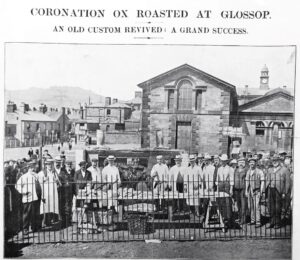
The “Knights of the cleaver” after responding to several photocalls began to carve the ox from the spit. The carvers, Mr Pemberton, Mr Patchett, Mr Bradbury and Mr Platt, placed juicy ox between 200 loaves of bread and 200 cakes all afternoon. The poor were not forgotten and the Chief Constable submitted a list of poorer families that should have a chance of tasting the Coronation Ox.
On receiving their ox each man had part of his ticket returned which entitled him to half a pint of beer which was being served in the fish market.
Despite predictions of failure the Coronation Ox was a grand success.
Sunday School Scholars
On Friday and Saturday the Sunday School scholars of Glossop and Hadfield were entertained by a tea provided by Councillor Herbert Partington, the son of Captain Edward Partington. Hundreds of scholars enjoyed a sandwich tea and entertainments. Commemorative medals were also provided to each child by the Mayor.
Votes of thanks were given to Councillor Partington and the Mayor for their generosity and Councillor Partington visited many of the schools.
The day school children of Hadfield and Padfield enjoyed another treat provided by Mrs E. Platt of Mersey Bank, Hadfield. Over 1,000 children and their teachers walked in procession to Mersey Bank where they sang several songs accompanied by Hollingworth Prize Band.
Afterwards they dispersed to their schools where they enjoyed a tea and entertainment. Each child received a Coronation mug and a parcel of sweets, nuts and orange that had been gifted by Mrs Platt.
Coronation Bridge
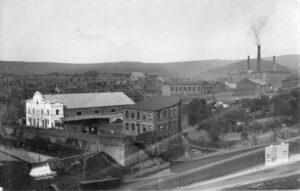
The Coronation Bridge, gifted by Lord Howard, was finally nearing completion on the actual Coronation Day on 9 August. It was opened later in the year with no formal ceremony. The bridge was very well used and “a real boon to some members of the public”.
The Coronation Bridge was replaced with current bridge around 1928 as part of the redevelopment of the Sandholes area.