
At Council meeting in February 1911, the Mayor, J. Malkin, stated that at the last coronation a sub-committee has been appointed in February to decided on the “necessary arrangements”. He suggested that this course of action should be repeated.
A sub-committee was then appointed to prepare the programme including the Mayor, Deputy Mayor F. G. Knowles, Ald. Brook Furniss, Couns. H. Partington, T. Braddock, W. Newton, W. White and E. Collier.
A report to a Council meeting in April showed preparations were well under way. There was to be assemblies of school children, old folks’ treats, bonfires and illuminations. The highlight was to be a Grand Coronation Fete in the park given by Edward Partington as Honorary Freeman of the Borough.
Further details came in May. The Great Central Railway Company would provide a special train to transport people from Hadfield to Glossop for the Fete. There was to be bands, teas, and Lord Howard would provide fireworks and illuminations.
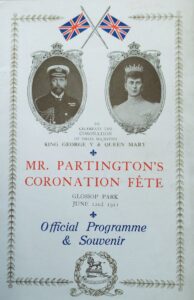
The final programme was published in the Glossop-dale Chronicle and North Derbyshire Reporter at the beginning of June. The programme involved five days of events. Lord Howard had also offered a gift of land near the Spinners’ Arms in Hadfield.
Old Folk’s Treat
On the evening of Wednesday 21st June the old folks’ treats were held in Glossop and Hadfield. The treats were provided by Mrs Ann Kershaw Wood, the wife of Samuel Wood and mother of Samuel Hill Wood, the owner of Howardtown Mills.
Invitations were sent out to 1,200 people over the age of 60 in Glossop and 500 in Hadfield. The tea in Glossop was held on Wednesday afternoon at the Victoria Hall. The hall was decorated with national colours, red, white and blue. Five sittings were necessary to cope with all the guests.
An excellent sandwich tea was provided. Afterwards the guests adjourned to the reading room. The lecture room was laid out with pipes and tobacco for the smokers.
A musical programme was provided in the evening including “nice selections” from Whitfield String Band. Mrs Wood attended and made a few remarks before the entertainments began.
In Hadfield the tea and entertainments were held at St Andrew’s schoolroom. “Dainty and pictureseque” decorations, including portraits of the King and Queen, covered the room. Councillor Lee’s String Band played during the sandwich tea.
Afterwards, Dr. White gave an interesting address and thanks to Mrs Wood for her generosity. This was followed by a packed programme of entertainments.
Coronation Day
On the morning of Coronation Day, Thursday 22 June, a peal of bells rang out of Glossop, Whitfield and Dinting Parish Churches.
The town was a kaleidoscope of colour. Festoons were strung across the street and flags were displayed on almost every home. All the principal buildings were decorated in a fine patriotic show.
A Gift of Land
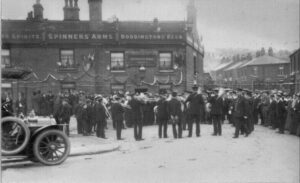
The first events of the day took place in Hadfield. At 10.45am Lord Howard’s gift of a piece of open space in Hadfield was made. The land was just outside the Spinners’ Arms and had just been cleared of some derelict houses. A crowd had gathered at the site to see Mr C. A. Abraham, Lord Howard’s agent hand over the deeds of the land to the Mayor, J. Malkin, who was one of the owners of the Corn Mill in Glossop.
Day School Festivities
At the same time Day School scholars in Glossop and Hadfield received commemorative medals that had been gifted by Lord Howard of Glossop. From their schools the children then made there way to the Day School assemblies.
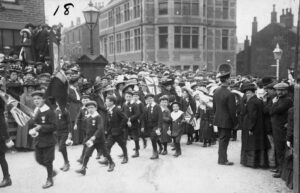
In Glossop the assembly was taking place at the Football Field on North Road and in Hadfield at the Railway Station Yard. A large crowd had gathered at both sites.
The programme was “Home Sweet Home”, “Auld Lang Syne”, “God Bless the Prince of Wales” and “God Save the King”. At Glossop proceedings were under the conductorship of Mr Fairclough, the organist and choirmaster at Whitfield Parish Church. In Hadfield the music and singing was conducted by Rev J. Hadfield.
The children then returned to their schools where they enjoyed a tea of ham and tongue sandwiches, slab cake, chocolates and lemonade that had been provided by Samuel Hill Wood. The children in Hadfield enjoyed cakes and milks that had been provided by Mr and Mrs G. B. Heywood, the son in law and daughter of the millowner Edward Platt.
A Grand Fete
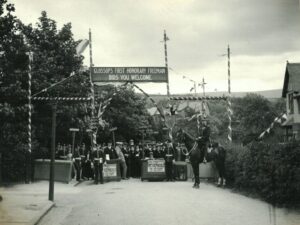
The highlight of the day was a Grand Fete given by Edward Partington, the first Honorary Freeman of the Borough. He had invited the Burgesses (citizens) of the Borough and their wives along with Day School Scholars and old people of the Borough.
The fete was held in Glossop Park (Howard Park) and some splendid entertainments had been arranged. The invited guests arrived with their tickets, which on admittance were exchanged for cheques to spend in the park. Two shillings for the males and eighteen pence for the females.
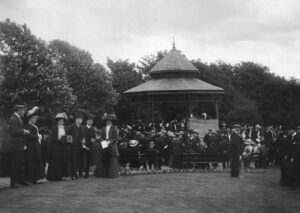
The crowds overflowed into the surrounding fields where marquees had been set up. Music was playing all around the park and in the band stand by Glossop Old Prize Band and Mr Albert Sidebottom’s Orchestral Band.
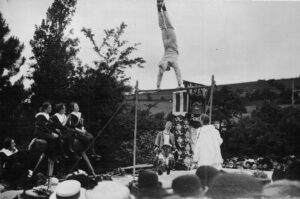
There were four platforms around the grounds with a variety of entertainments staging drama and comedy, lady gymnasts, Punch and Judy, musical clowns, conjurors, ventriloquists and jugglers. Also the Spangelettes – a performing pony and unrideable donkey.
Marquees of food and drink supplied the guests in exchange for their cheques and thousands picnicked on the grass. The baths had been transformed into a public tea room, the swimming pool having been covered over.
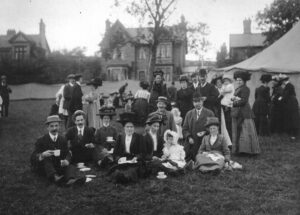
A large crowd of onlookers watched Captain Partington plant an oak tree in the park to commemorate the Coronation. He received a silver spade as a memento of the occasion.
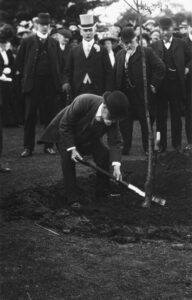
It was estimated that the majority of the 9,000 invitations had been used and the fete was a grand success.
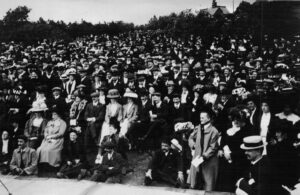
Bands entertained people in the town throughout the day. Glossop Old Prize Band played at the Football Field on North Road and Glossop Public Reed Band played a selection in Norfolk Square. Hollingworth Brass Band played tunes around Hadfield.
Illuminations and Fireworks
In the evening the Council had put on lovely displays on the Victoria Hall, Technical School, Whitfield Library and Hadfield Hall. The town was alight with fairy lamps and other illuminations. Glossop Gas Company’s Offices had a lively display with 500 fairy lamps, star burners and devices with portraits of the King and Queen and patriotic mottoes.

Lord Howard had paid for the Town Hall to be decorated and illuminated. The Electric Supply Co., who had been entrusted with the work created “a picturesque and patriotic scene” with a large, illuminated motto. He also put on a display of fireworks at the Old Cricket Ground in Norfolk Street.
The Mayor sent up a detonating rocket from the Old Cricket Ground at 9.55pm to draw people’s attention to the huge bonfire on Coombes Edge. A Magnesium Star Rocket was sent up in reply by boys from Glossop and District Boy Scouts’ Association. They had charge of guarding and lighting the bonfire.
The bonfire had taken three weeks to construct and many local businesses had gifted materials. It was built at an altitude of 1,331 feet meaning it could be seen for miles around, even as far as the South East District of Manchester.
Psalm of the Coronation Ox
After the success of the ox roast at the Coronation in 1902, it was decided to repeat the custom. A committee was gathered, and Brook Furniss of the Albion Hotel was elected as Chairman. Preparations were advancing in early June. The public subscription had been started and a deputation had been sent to Lord Howard to ask permission for the roasting to take place on the Market Ground.
The chosen ox would be on view before slaughter, and it was planned to drive it through the streets of the town for everyone to see.
The distribution of the roasted ox was planned for Friday 23 June. The events of the day were reported in a two-column article in the Glossop-Dale Chronicle and North Derbyshire Reporter entitled “The Psalms of the Coronation Ox”.
The story related how the “elders” had come together to roast “a great ox – an ox with horns eleven feet long, and having much juicy fat”. A suitable ox was purchased at the Great Market and “brought home to the hills of bonny Derbyshire”.
The mighty ox was bedecked with ribbons and put on display to be admired. The ox was killed and placed in a great furnace erected in the Market Place so common people might view the “Roasting”.
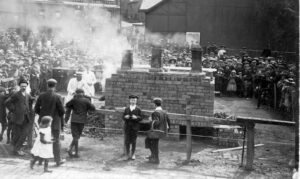
“But they were warded off with strong stakes and ropes, so that they should not partake of the Feast before it was full ready. And lo, the Chief Elders were seen to assemble on the scene and were “phottygraphed” with much expansion of ye chests.”
The fire was lit. “But great Guns of Mars!!! Then were the Heavens rent with the voice of many thunders, and there was great running to and fro on the earth and much confusion of the people and the ambulance did arrive speedily, as is its wont.” “Top’s off! Blown up!”. It was quickly dismissed by the elders and top of the furnace patched up.
“Finally there went forth the word to the waiting peoples, “It is DONE”” and they gathered in the Market Place with the tickets.” “Ye frizzled bullock” was carried into the Hall of the Territorials (Drill Hall next to the Market Hall) to be carved. Here there was much bread, little beer, and no buttermilk.
The carving began and the first slices handed to the “Special Elders”. “But then a noisome vapour, the like of which is seldom known on land or sea, began to arise upon the earth, and two of the Elders coughed and did even expectorate, saying “It is nothing”…” “It’s humming” cried an elder. “Yea, verily, not ‘arf” said a Chief Carver.
Yet some took away great lumps to their homes and were ordered, by their wives, to bury it or put it out for the dogs, before “thrice disinfecting” their homes “with strong carbolic”.
The further into the ox they carved they “began to stir up a smell compared with which the sewage works is as a lovely rose bower!!”
“Meanwhile the beefy smell – the all pervading smell, had…gone through the “royal Borough” so much so that ye public traffic was delayed at Woolley Bridge; for many people would not venture further, fearing that the sewage outfall works had overflowed their banks.”
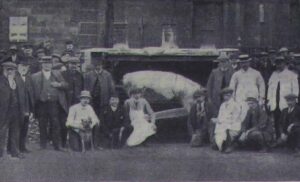
“Yea, verily, ye noble carvers did of their BEST (see picture post-cards) in giving great feasts to the people.
And ye Hall of Territorial fame, ‘tis said, has since been thrice well disinfected so that the “patriots” may assemble there once more and shoot and shout, “God save the King and all his people!””
Hadfield Scholars
On Saturday afternoon Mr and Mrs Edward Platt had invited Day School Scholars for entertainments at their home, Mersey Bank. The incessant rain caused a change of plans. The children instead gathered at their schools and enjoyed a splendid tea of ham, tongue, pork pies and “all kinds of delectable confectionery”. Mrs Platt and other donors of the treat then visited each school and handed out gifts of Coronation mugs, fruits and sweets.
Mayoral Procession and Divine Service
On Sunday morning a procession formed in front of the Town Hall at 10.15am. In the lead was Mr J. G. Hodgson, the Chief Constable. He was followed by the mounted police, band, cadets, police and fire brigade. Then came the gentleman of the Borough and Council Officials, Councillors and Justices. Finally were church wardens, the Deputy Mayor, Mayor and the Town Clerk followed by the police and representatives of friendly societies.
The Mayor was in his Mayoral robe and chain, the Town Clerk in wig and gown. The procession made its way in the cold wind to Glossop Parish Church. The service was “particularly hearty” and one that all could join in with “real feeling and fervour”. After the service the procession returned to the Town Hall, via Norfolk Street, accompanied by Glossop Old Band.
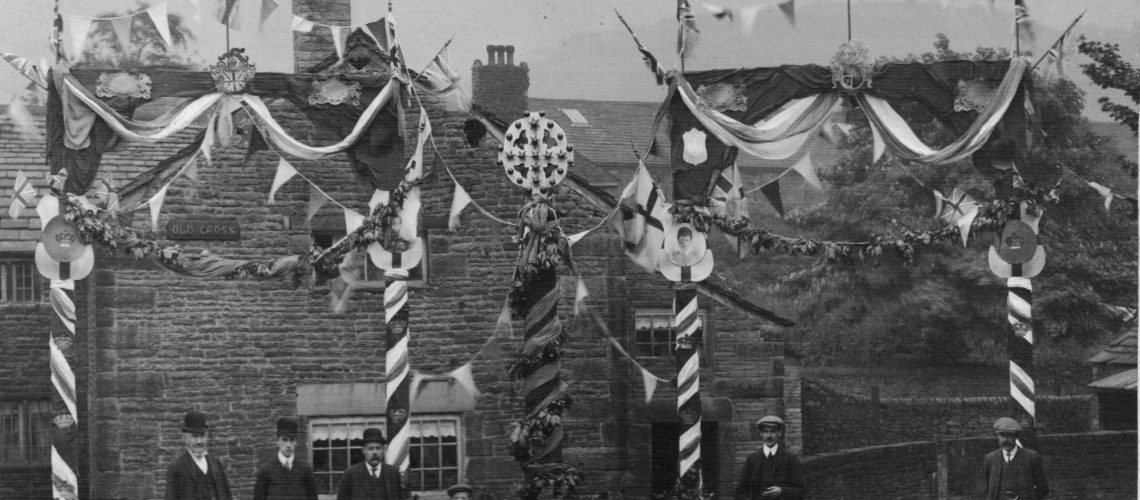
The area around the Old Cross had been finely decorated. Bunting and flags hung from almost every house. The Old Cross had been entwined with red and purple material and trailing sprigs of oak. At the base were ferns and other greenery. On top of the Cross, which did not yet have the stone cross we see today, was an arrangement of electric lights on a cross shaped board.
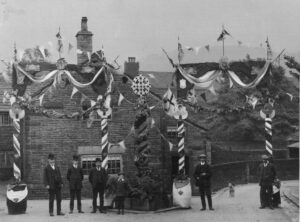
A triumphal arch of coloured and decorative material stood each side of the Cross. On these were Royal emblems and coloured electric lights that made an effective display when lit up.
The decorations had been provided by public subscription from those that lived locally. “Old Glossopians, if history belieth them not, were a robust, thorough, jovial-going lot…” and with a reference to Friday’s proceedings: “we’ll bet a barrel they could roast an ox in those days and roast it well. It is a pity that the descendants of some of the “old ‘uns” have not retained the secret. Have the local archives been searched? Possibly they contain some priceless information on this vital point, and, by the Sacred Bull, it should be unearthed before the next Coronation!”