
Jubilee Gifts to Glossop
It was announced in November 1886 that the Wood family, the owners of Howardtown Mills in Glossop, would be making generous gifts to the town in celebration of the Golden Jubilee of Queen Victoria in 1887.
Daniel Wood made the gift of £25,000 for a hospital and Samuel and Anne Kershaw Wood gave £15,000 for baths and a park. Lord Howard donated the land for all three projects. This was in addition to the gift of a free library and public hall that had been donated by Herbert Rhodes and Edward Partington.
On 30th July 1887, there was a day of celebration in Glossop. A grand procession of 4000 people paraded through the streets of Glossop and to the sites of the new buildings. Stone laying and tree planting ceremonies took place at the hospital, baths and in the park before moving on to the library site.
Victoria Park
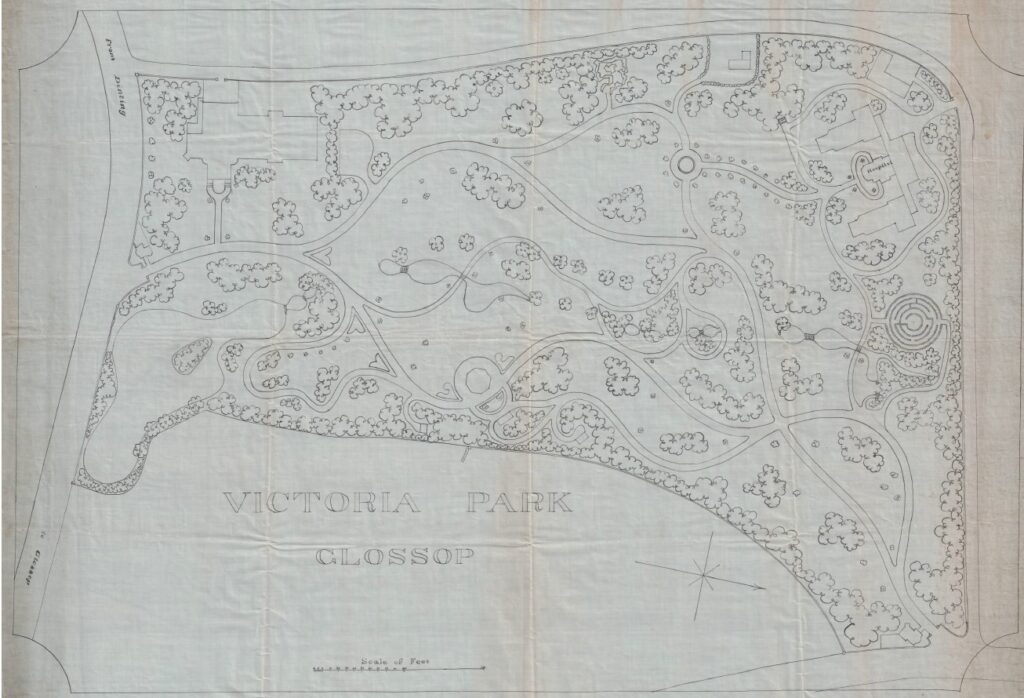
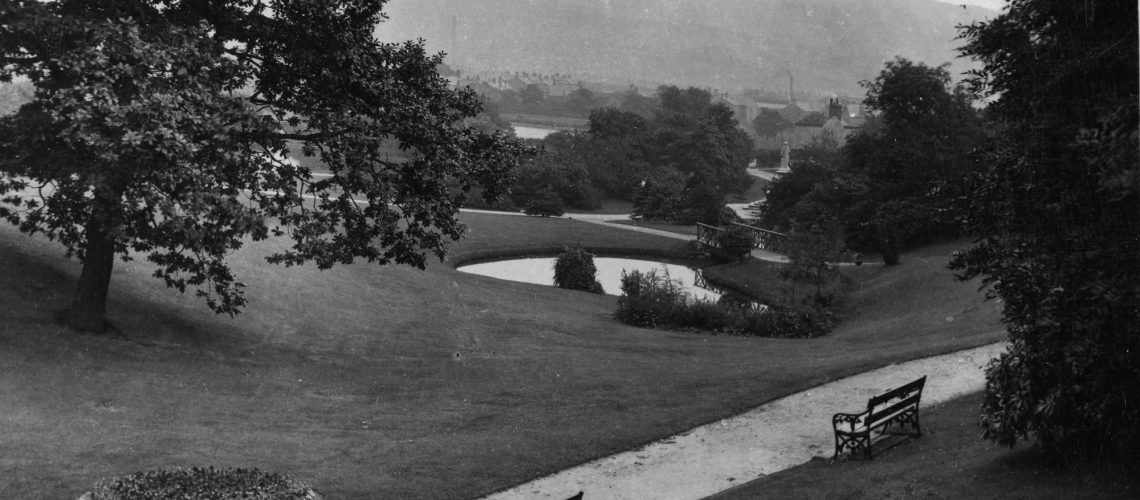
The Wood family had planned to call the complex, “Victoria Park” in honour of the Queen. Shortly after the opening of the park in June 1888, it was announced that a private agreement had been made between Anne Kershaw Wood and Lord Howard that the park was to be called “Howard Park” in recognition of the donation of land that Lord Howard had made.
This was a controversial decision and the Glossop Chronicle were inundated with letters of complaint. Someone even penned an eleven verse poem about the matter. On this being announced Herbert Rhodes then announced the new public hall and free library would be named “Victoria Hall” in honour of the Queen.
Howard Park was also known as “Glossop Park”, as it was the only park in Glossop until Manor Park opened in 1927.
Walk Map
This is a circular walk. You can start anywhere on the map. The page starts at the lower lodge on Dinting Road.
DIRECTIONS – The walk starts at the entrance gates by the south lodge.
Lodge
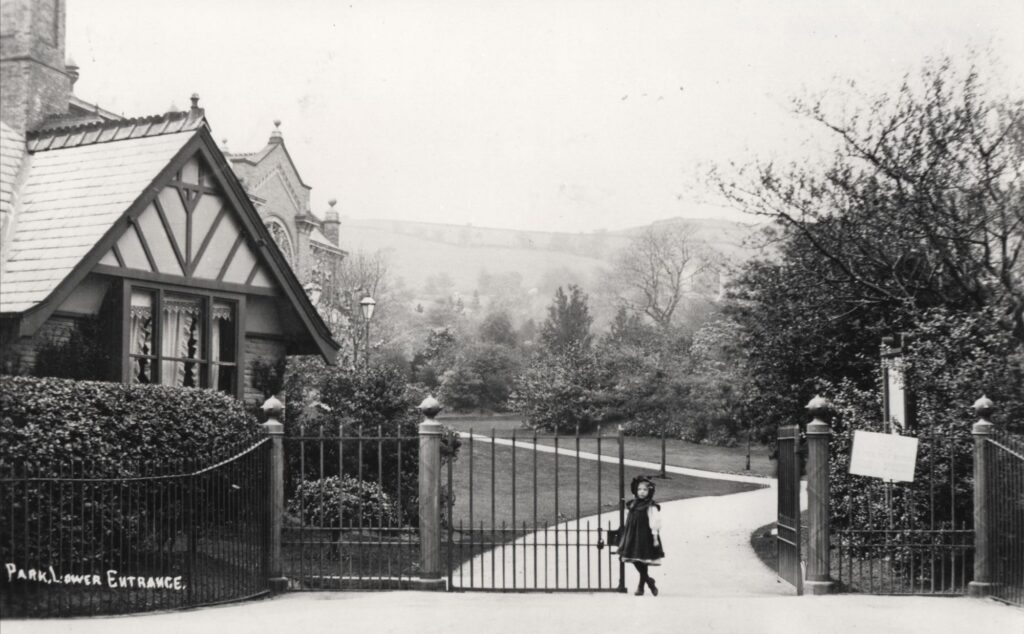
There is a lodge at the north and south entrances to the park. The lodges were designed by Mr Murgatroyd from the architects Mills and Murgatroyd of Manchester. Mr Murgatroyd was the nephew of Daniel and Samuel Wood. He also designed the hospital and the baths. The lodges were built by Mr Ingham of Glossop.
DIRECTIONS – Follow the path into the park. In front of you are two lions in the bushes.
Lions
The lions arrived at the park in 1905. Mr Hilton of Oxford Road, Manchester (and the Monumental Works, Chorlton-on-Medlock) made an offer to Glossop Borough Council in June 1905. He wished to present the Council with two marble lions from the fountain at Milan, Italy. A sub-committee was formed to decide whether the Council wished to accept the offer.

After some months of discussion and delay due to a ‘hitch’, it was decided to make a home for the lions in Glossop. They were to be placed on ‘substantial mounds on each side of the walk near the lower entrance’ of the park. There were many suggestions by locals for the names of the lions, but none were revealed.
DIRECTIONS – On your left is Glossop Swimming Pool, with our Blue Plaque celebrating the day of the foundation stone laying on 30th July 1887. Look up at the roof of the swimming pool and you may spot more lions.
Woods Baths (Glossop Swimming Pool)
The baths were the gift of Samuel Wood, one of the owners of Howardtown Mills, and his wife, Anne Kershaw Wood. They were designed by Mr James Murgatroyd of Mills and Murgatroyd.

The baths were built in an Italian style and consisted of a swimming bath, vapour baths and a set of Turkish baths (all for males only) and private baths for males and females. The ventilation tower, which was needed for the vapour baths was 100 feet high.
The baths were opened on 4th February 1889. The baths and park were run by a private committee to begin with. In 1895 they were transferred to Glossop Borough Council. They are now owned by High Peak Borough Council.
DIRECTIONS – Follow the path straight ahead. In front of you is Woods Memorial.
Woods Memorial
Woods Memorial was erected in 1889 to Daniel and Samuel Wood, the donors of the park, baths and hospital, who both sadly passed away before the buildings were completed.
Daniel passed away on 7 February 1888 and his brother, Samuel a few months later on 8 April 1888. It was decided to raise a public subscription to build a memorial to the brothers in honour of their very generous gifts to the town.
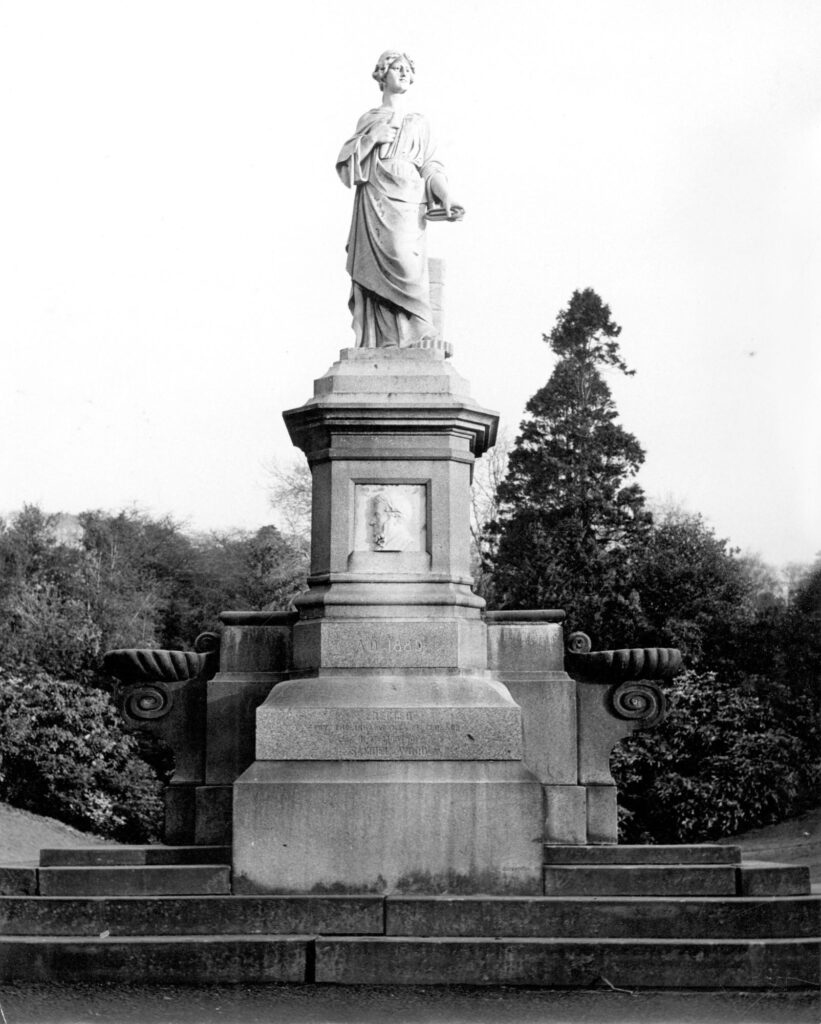
The memorial was designed by J. Bonehill & Co. The statue on the top is an allegory of Commerce. She is sitting on top of a bale of cotton and holding a spindle and cogs to reflect the Wood brothers being cotton manufacturers. The memorial had drinking fountains that fed into bowls at each end.
Flowerbeds

Just behind the Woods Memorial there used to be a large flowerbed laid out with artistic displays of flowers for different occasions.
DIRECTIONS – Turn right and follow the path past the lake and up towards the playground.
American Garden

By the side of the lake was the American garden, so called because all the plants were indigenous to American soil. There is no mention of the American garden after the 1890s.
Some changes were made to the plants in the park over the years, as many did not thrive in local conditions.
DIRECTIONS – Walk up to the playground. This used to be the site of the bandstand and shelter.
Band Stand
Where the playground now stands was a large bandstand and shelter, both of which were of rustic design in harmony with the bridges in the park. They were built by Mr Thomas Inman of Stretford.
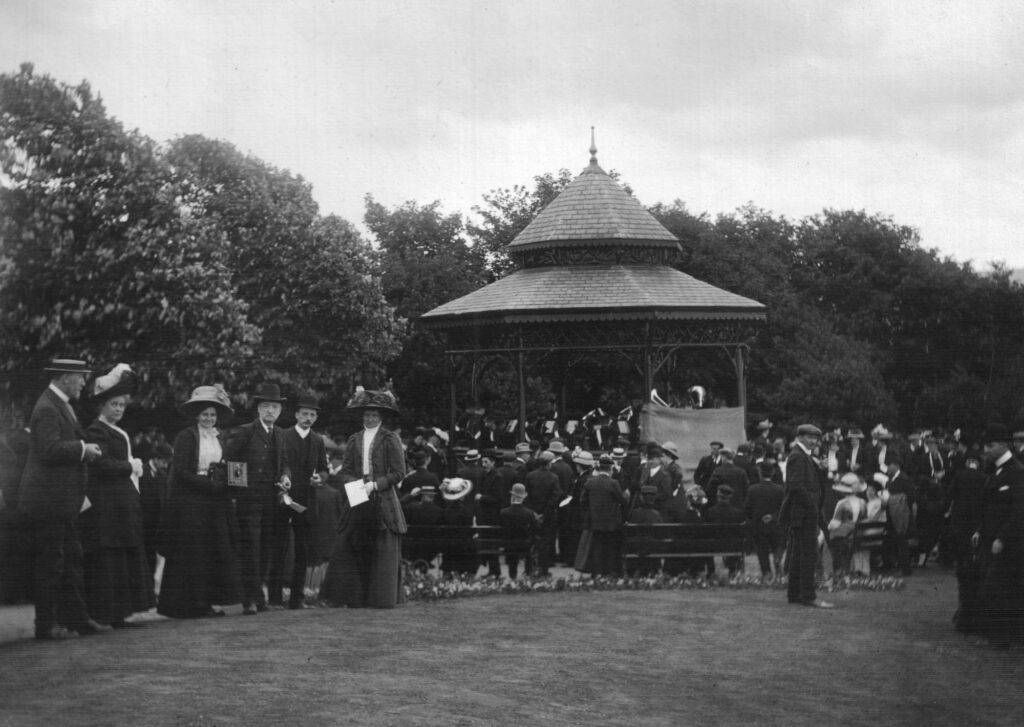
Glossop Old Band played a concert during the opening of the park in the band stand. Over the years many bands played open air concerts for many different occasions including hospital fundraising events and Coronations.
DIRECTIONS – Follow the path to your left through the playground and up the steps onto the wooded path.
Bridges and Waterfalls
Howard Park was designed in 1887 by Henry Ernest Milner, Landscape Gardener of Crystal Palace. He was strongly influenced by his father, Edward Milner, who had worked with Joseph Paxton to create Crystal Palace gardens and the Pavilion Gardens, Buxton.

The land on which the park was built was called ‘Robin Hood’s Gutter’ and ‘Barber Clough’. A gully ran through the middle of the site and it had a steep sided ravine with water running through it, into a reservoir at the bottom, now the lake.
Mr Milner skilfully incorporated the gully into the park with bridges and waterfalls. He referred to Howard Park in ‘The Art and Practice of Landscape Gardening’ (1890), describing the need to integrate the three elements of hospital, baths, and park into a single design, and the methods used to take advantage of the natural ravine while unifying the park.
DIRECTIONS – Follow the path ahead. On right through the trees is a building that is now private residences, but used to be the Partington Convalescent Home.
Partington Convalescent Home
The Partington Convalescent Home was opened in 1908. It was the gift of Edward Partington, the owner of Olive and Partington Paper Mills. He donated £30,000 to Glossop Borough Council for the building after suffering a period of illness.
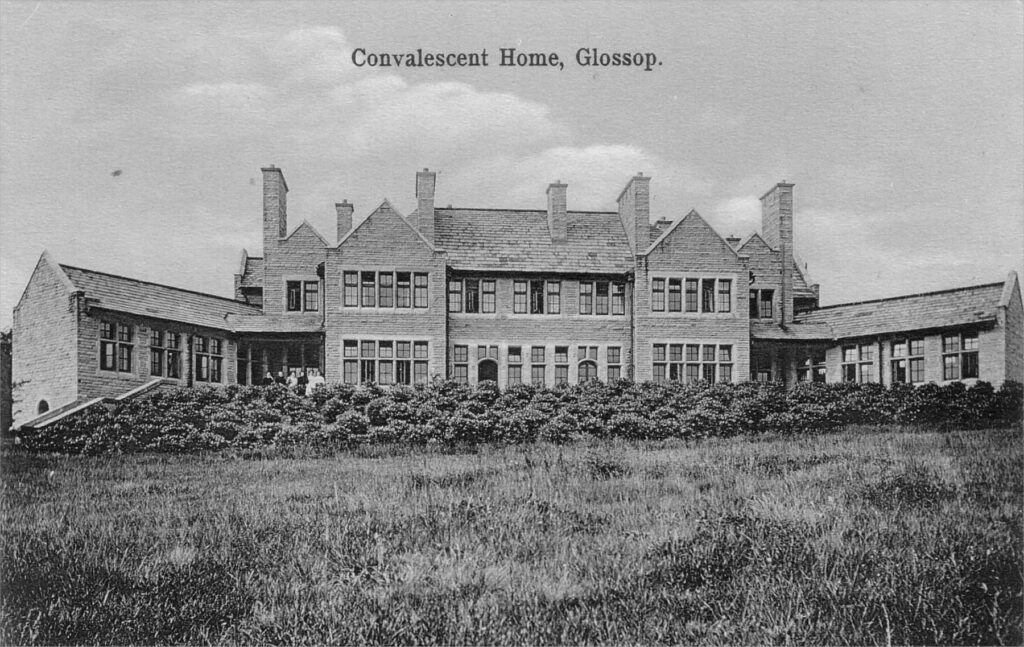
It was intended to be a convalescent and nurses’ home and as well as treating the sick, it housed the district nurses who visited people in their homes. During the First World War the convalescent home was used for wounded soldiers.
In 1920s the building began to be used as a Maternity Home. It later became just the Partington Maternity Home and many babies from the surrounding area were born here, including the late Dame Vivienne Westwood. The Partington Maternity Home closed in the mid 1970’s, then later becoming a Care Home, which closed in 2011. The building has now been converted into private residences.
DIRECTIONS – Follow the path a bit further. In front of you is the upper lodge. Turn left and walk past the waterfall. To your right is the former Woods Hospital, now Reuben’s Retreat.
Woods Hospital (Reuben’s Retreat)
Daniel Wood, one of the owners of Howardtown Mills, announced his gift of a hospital, as part of the jubilee gifts for the Golden Jubilee of Queen Victoria. He gave £25,000 to Glossop Borough Council to build and run the hospital.
The architect was Mr James Murgatroyd of Mills and Murgatroyd, Manchester. Woods hospital was built to the “best possible quality and brought up to the greatest pitch of perfection, which recent sanitary authorities have laid down as essential”.

The hospital had male and female wards with fireplaces and bathrooms. There was an administrative block with matron’s apartments, servants and nurses’ rooms, kitchen, dispensary, operating room and rooms for visiting surgeons.
The hospital opened in February 1889 and could accommodate 16 patients in comfortable surroundings.
In 1948 it became part of the NHS. It was later closed and reopened as a hospital for the elderly. This closed around 2009. The building was then purchased by the charity, Reuben’s Retreat, in 2014, who are lovingly restoring it.
Boulder
At the side of the path in front of the hospital is a large stone boulder. This was unearthed during the construction of the park in 1887 and left there on display as an interesting feature. It is just one of the glacial boulders that have been found in the area, known as a ‘glacial erratic’. It had traveled hundreds of miles to get here, being transported in an ice glacier as it flowed south and then deposited in to the boulder clay when the ice melted 9000 years ago. The grooves in the boulder were made by the ice.
DIRECTIONS – Follow the path ahead until you reach the ornate flowerbed that used to be a fountain.
Fountain
The fountain basin is a central point of the park with walks branching from it in every direction. The design is a large circular basin. The fountain was gravity fed from the reservoirs in the fields higher up from the park.

In 1956 it was decided the fountain was to be filled in and turned into a flowerbed. Later five urns were added around the flowerbed in memory of those who lost their lives in World War One.
DIRECTIONS – From the fountain look ahead at the small shed. This was the site of the greenhouses.
Greenhouses
The greenhouses in Howard Park were used to grow all the plants needed in the park and the public areas of the town. It later supplied the plants for Manor Park and Bankswood Park.
In 1956 there were complaints that the three large greenhouses in Howard Park were in very poor condition and not large enough. It was estimated that the greenhouses were used to propagate 40,000 bedding plants in 1955, but this was still not enough to supply the needs of the town.
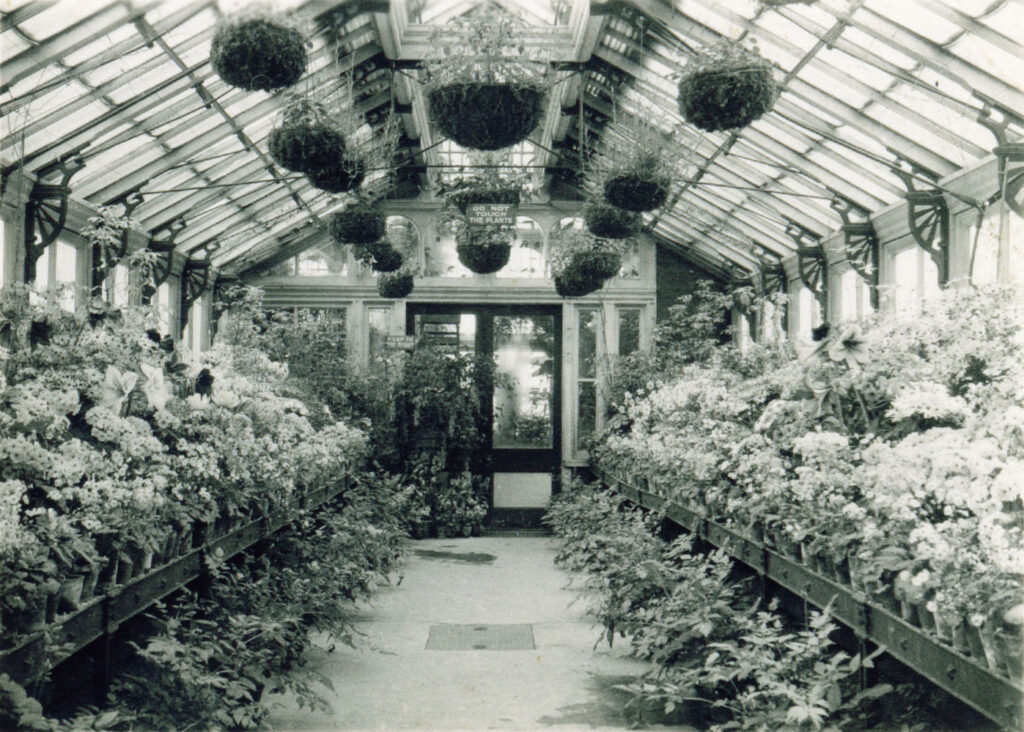
Two of the greenhouses were the original houses constructed in 1887. The three houses were repaired and brought up to standard and a new greenhouse was built at a cost of £2,200.
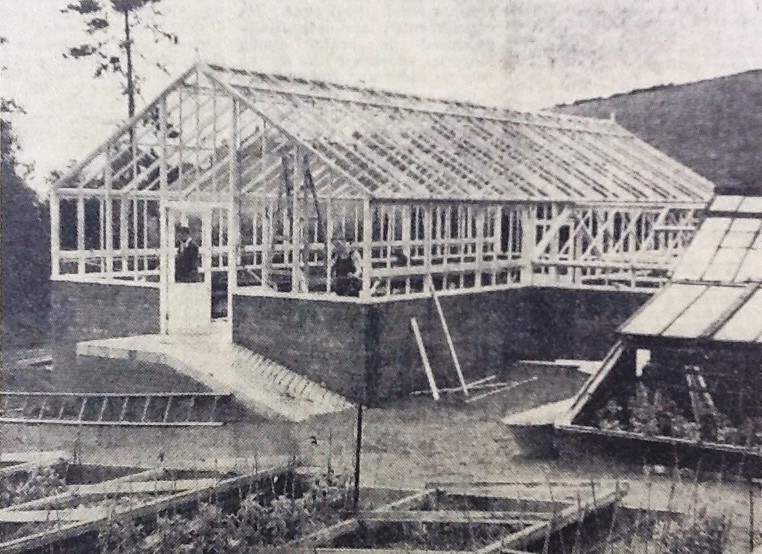
In 1976 it was decided that the greenhouses should be closed and removed. The decision was made because it was then “cheaper to buy plants from commercial growers”. The glasshouses were sold and the equipment moved to Buxton.
DIRECTIONS – Turn left and follow the path back down towards the baths. On your right was the site of the fernery.
Fernery
The fernery, also called the rockery, was artificially built with a waterfall, bridge and pool and was a “hidden gem” within the park. It was designed by Henry Ernest Milner as feature of the original park. He designed a similar grotto at Moorfield for Anne Kershaw Wood.

The fernery was removed some years later around the mid 20th Century.
DIRECTIONS – Continue following the path towards the baths.
Lawns and Flowerbeds

In the centre of the park is a sloping lawn with flowerbeds. In past times many local people complained they could not enjoy the park as they wanted because of the strict instructions to keep off the lawn. There were benches on the pathway that looked out over the impressive view of Glossop and the surrounding hills.
DIRECTIONS – Keep on the path towards the baths. On your right is the car park.
WW1 Tank
After Word War One, Glossop was gifted a tank by the Government for their efforts buying War Bonds and War Savings Certificates. The tank arrived at the train station in March 1920 and was driven to Howard Park to be put on display (where the car park is now). The tank was removed before the end of WW2 probably for scrap iron.
END OF WALK
We hope you enjoyed the walk. Please consider supporting us to help us preserve and share more of Glossop’s stories and history.