
Coronation Walk
Please enjoy a walk around Old Glossop, Glossop and Hadfield looking at the sites of past festivities from the Coronation of Queen Victoria to Queen Elizabeth II. You can pick sections of the walk to do – Old Glossop, Glossop or Hadfield or take a stroll from the comfort of your armchair at home.
If you wish to discover more about the events and festivities of past Coronations and Jubilees in Glossop you will find a series of articles here.
Old Glossop
Old Cross, Old Glossop

The Old Market Cross has been a place of gatherings and celebration for the people of Glossop for hundreds of years. On the Coronation Day of Queen Victoria, a procession was made to the Old Cross and the national anthem was played.
By 1902 when her son Edward VII was crowned, the Old Cross had been moved to its current position from against a building nearby. It was decorated with bunting that was attached to nearby buildings. In the evening the area was lit with fairy lamps that were supplied with electric light from Lord Howard’s Plant.
At King George V’s Coronation in 1911 a public subscription was raised to decorate it. The Old Cross was entwined with red and purple material and trailing sprigs of oak. At the base were ferns and other greenery. On top of the Cross, which did not yet have the stone cross we see today, was an arrangement of electric lights on a cross shaped board. A triumphal arch of coloured and decorative material stood each side of the Cross. On these were Royal emblems and coloured electric lights that made an effective display when lit up.
All Saints Parish Church, Old Glossop

The morning of the Coronation of Queen Victoria was ushered in by the firing of cannon and the ringing of bells. In 1838 the town of Glossop was what we now know as Old Glossop and All Saints Parish Church was the only Parish Church in the area. A peal of bells has rung out for all successive monarchs and will do again on 6th May.
On several Coronation days a procession of local dignitaries – the Mayor, Council Officials, Police and others has made their way from the Town Hall to attend Divine Service at All Saints.
This was not always the caase, in 1902 the Council turned down the invitation to attend a Service on Coronation Day as they felt they would “not be able to attend owing to their many duties and great amount of work on that day.”.
Talbot Inn, Manor Park Road
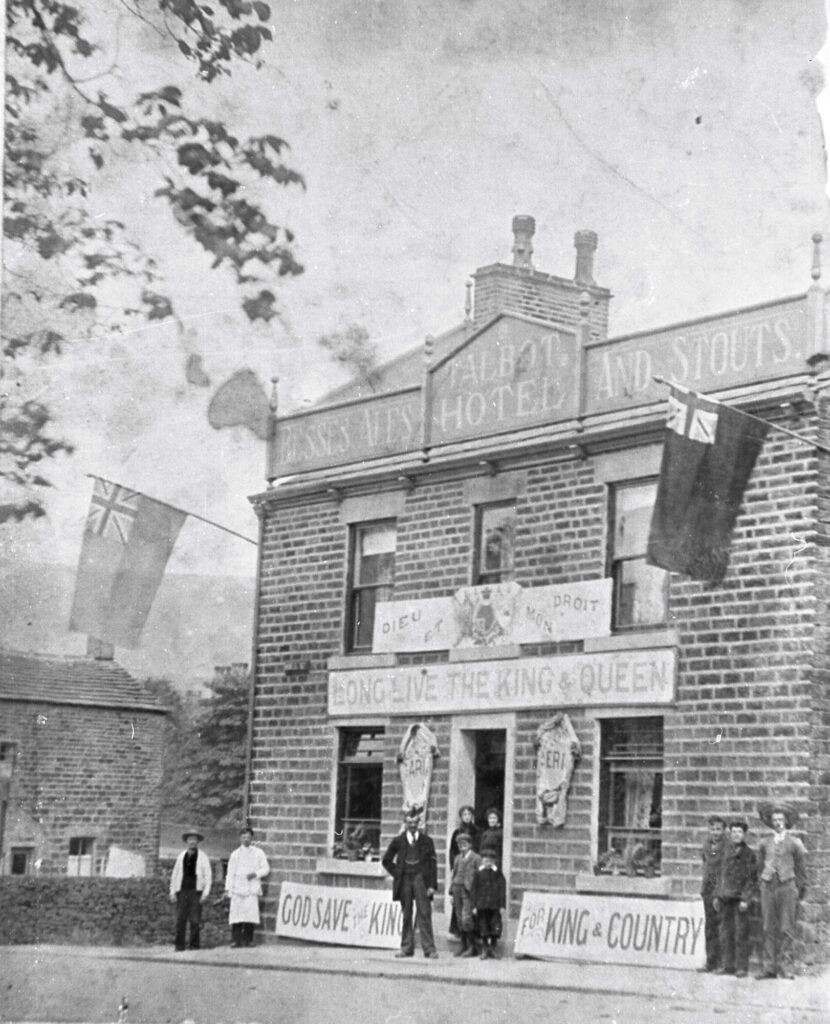
Mr Waterhouse of the Talbot Inn had a reputation as “the premier decorator of the town”. He had decorated his own inn with a large motto in blue letters on a white background and flags at the Coronation of King Edward VII and Queen Alexandra in 1902.
Just before the Coronation, Mr Waterhouse placed an advert in the Glossop-Dale Chronicle and North Derbyshire Reporter offering “a large stock of suitable material for external and internal decorations and is prepared to execute and furnish designs and estimates for decorations of any magnitude. Mottoes with customers own speciality.”. No doubt many a building in Glossop was decorated by Mr Waterhouse.
Manor Park
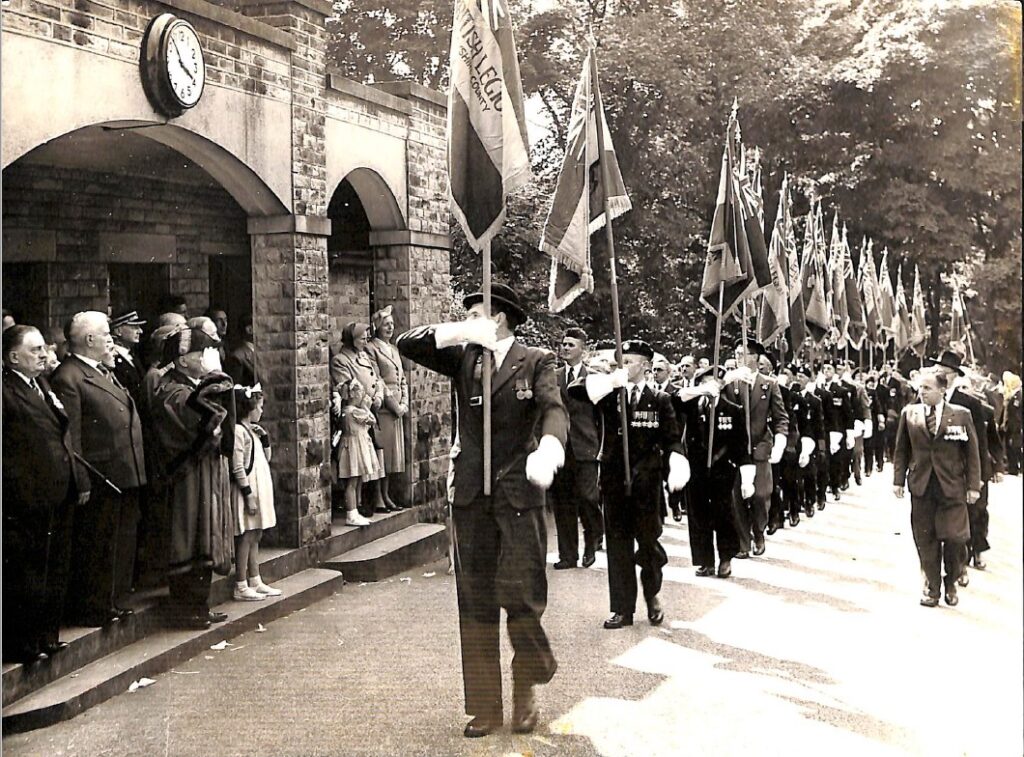
Glossop Borough Council opened Manor Park in 1927 after they purchased the land, which was the site of Glossop Hall and its grounds, from the sale of the Glossop-Dale Estate. It became a new focus for civic celebrations.
At the Silver Jubilee of King George V in 1935, the Park had been gifted new gates on the Manor Park Road entrance. A commemorative oak was planted by the lower bowling green, as part of the Coronation celebrations of King George VI in 1937.
A week of Coronation celebrations for Queen Elizabeth II began and ended in Manor Park. On Saturday 30 May 1953 the Mayor, Alderman Beckmann made speeches at the Park and accepted the gift of an electric clock for the pavilion from the Glossop Townswomen’s Guild. The week culminated in a procession from Hadfield to Glossop that ended at Manor Park. Once the procession had arrived entertainments were laid on including a dance troupe, cookery demonstrations and free ice cream.
Glossop
Shops, 9-11 High Street East

This picture shows Shaw’s Music Warehouse at 9 High Street East decorated for the Golden Jubilee of Queen Victoria in 1887. Edwin Shaw had run the music warehouse elsewhere on High Street East with his father, John Shaw.
John had been a brass maker who was internationally famous for inventing new valves for brass instruments. He revealed one of these new inventions during evening celebrations at the Coronation of Queen Victoria in 1838.
Norfolk Square
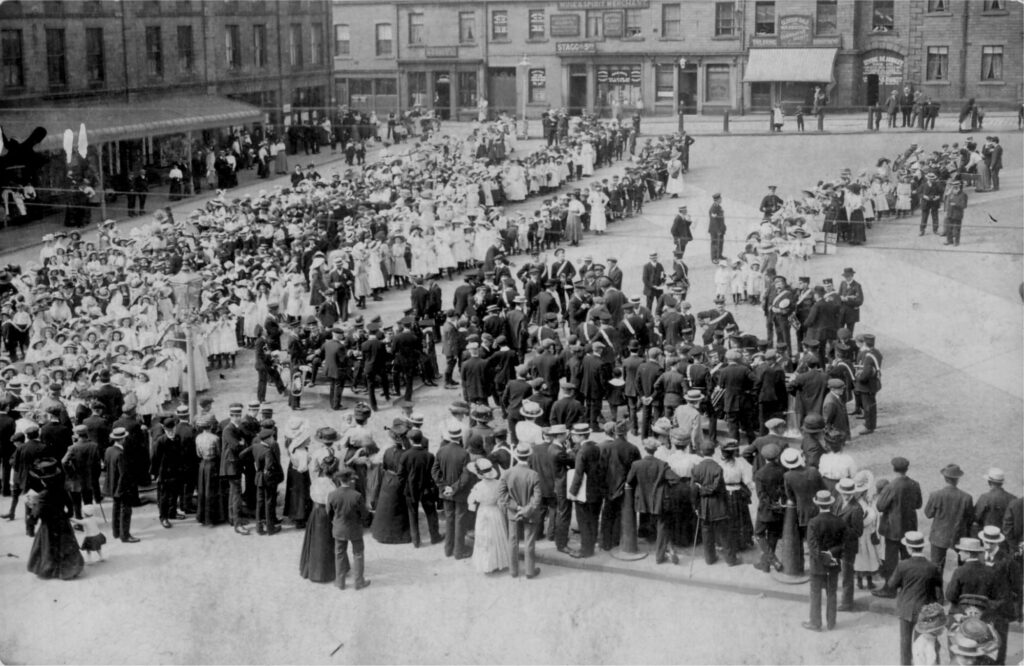
Norfolk Square has always been the gathering place at the heart of Glossop for proclamations, Coronations and other major civic events.
At the Coronation of Queen Victoria in 1838 this area was yet to be christened Norfolk Square and was part of the bowling green and gardens next to the Norfolk Arms in Howard Town. It was here that people gathered before joining a procession to the Cross in Old Glossop and witnessing the laying of the foundation stone of the Town Hall.
In 1902 a magnificent gathering of Glossop Friendly Societies was held in Norfolk Square for the Coronation of King Edward VII. Members of the Societies made a colourful display in their regalia and costumes. Spectators were entertained by Glossop Old Prize Band and St Mary’s Drum and Fife Band. The National Anthem was sung before a grand procession took place up High Street East to Corn Mill Bridge.
Town Hall

On the Coronation Day of Queen Victoria in 1838 one of the highlights of the day was the laying of the foundation stone of Glossop Town Hall. The building had been commissioned by the 12th Duke of Norfolk and designed by Matthew Ellison Hadfield. It was to be the centrepiece of his new town, Howard Town. However, he was not there to lay the stone, as he had to perform the duties of Earl Marshal at the Coronation, as the current Duke of Norfolk will do for King Charles III.
At Queen Victoria’s Diamond Jubilee in 1897, Lord Howard gifted a new clock tower with a cupola top and a new clock for the Town Hall.
Lord Howard had paid for the Town Hall to be decorated and illuminated in 1911. He entrusted the work to The Electric Supply Co. and we can see from the picture it included a large illuminated motto to the King and Queen.
At later Coronations, Glossop Borough Council provided decorations and floodlighting on all public buildings.
Market Ground
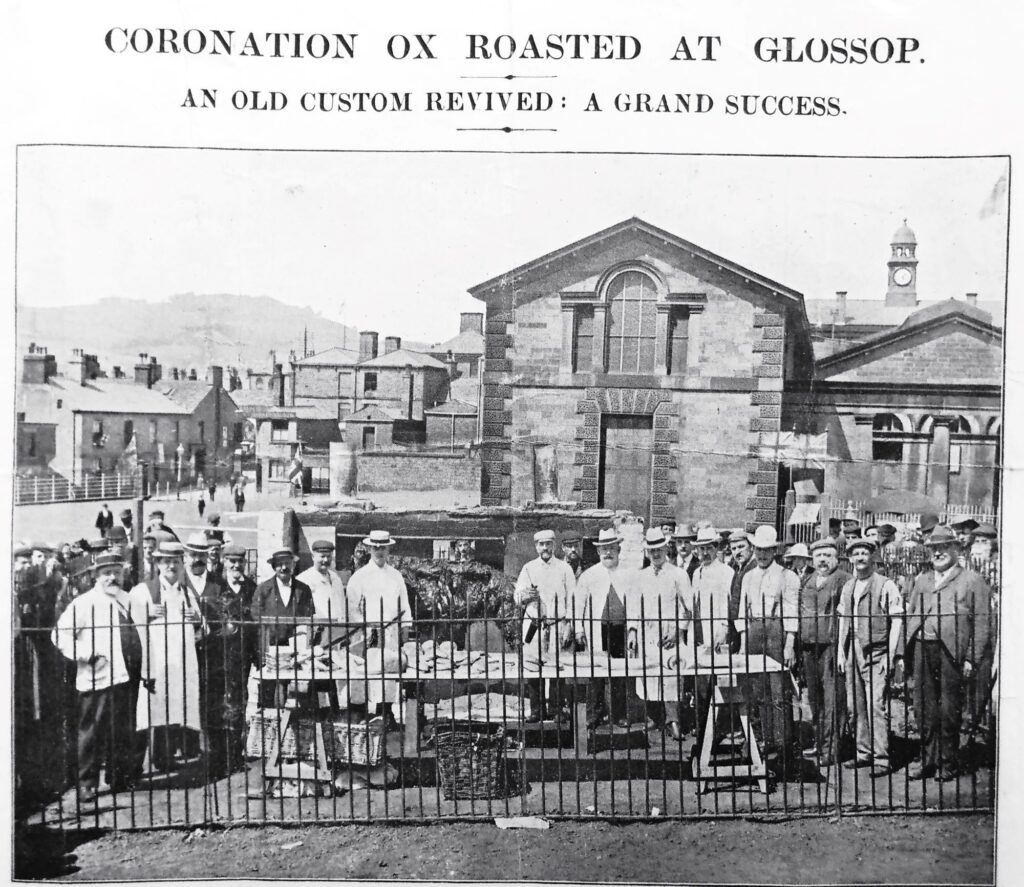
One of the highlights of the 1902 Coronation was a private event. The reviving of the tradition of roasting a Coronation Ox had been the idea of Brook Furniss of the Albion Inn, Victoria Street.
A public subscription was raised and a fine ox purchased. A roasting fireplace was constructed in front of the fish market and the ox roasted for the whole of Friday. On Saturday the ox was carved and distributed to ticket holders between bread or cakes. It was a huge success.
In 1911 it was decided to repeat the popular event. Things got off to a shaky start after the fire was lit and the top of the furnace blew off. It was patched up and the roasting continued. The effectiveness of the repair was revealed when the ox was removed for carving and foul vapour travelled right through the “Royal Borough”. The custom was not repeated at the Coronation of King George VI in 1937.
Coronation Bridge, George Street/Sandholes
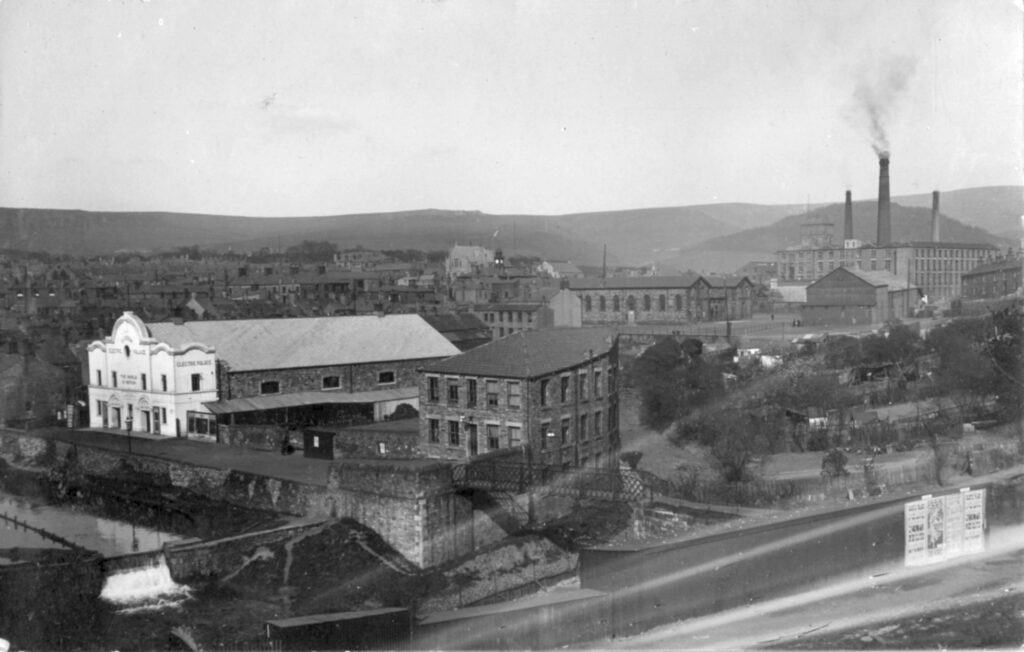
At a Glossop Borough Council meeting in February 1902 Lord Howard offered a gift of a foot bridge to be placed over Glossop Brook at George Street. This offer came with two conditions: “That the Council would undertake to transfer the said bridge from the railway trucks at Glossop Station… and to erect two stone abutments for the bridge to be placed thereupon.”
The bridge arrived a few months later and a portion of it made a “sort of triumphal possession” through the town before being lowered into place. The Coronation Bridge was not ready at the official Coronation day in June or the postponed day in August. By October the bridge had finally been opened for use with no ceremony, but very well received by locals.
The Coronation Bridge was replaced by the current bridge in 1928, when the Sandholes area was renovated.
Shop, 57 High Street West

Matthew Woodcock’s boot and shoe shop decorated for the Coronation of King Edward VII and Queen Alexandra in 1902. Maybe it was decorated by Mr Waterhouse of the Talbot Inn?
Empire Cinema, 60-64 High Street West
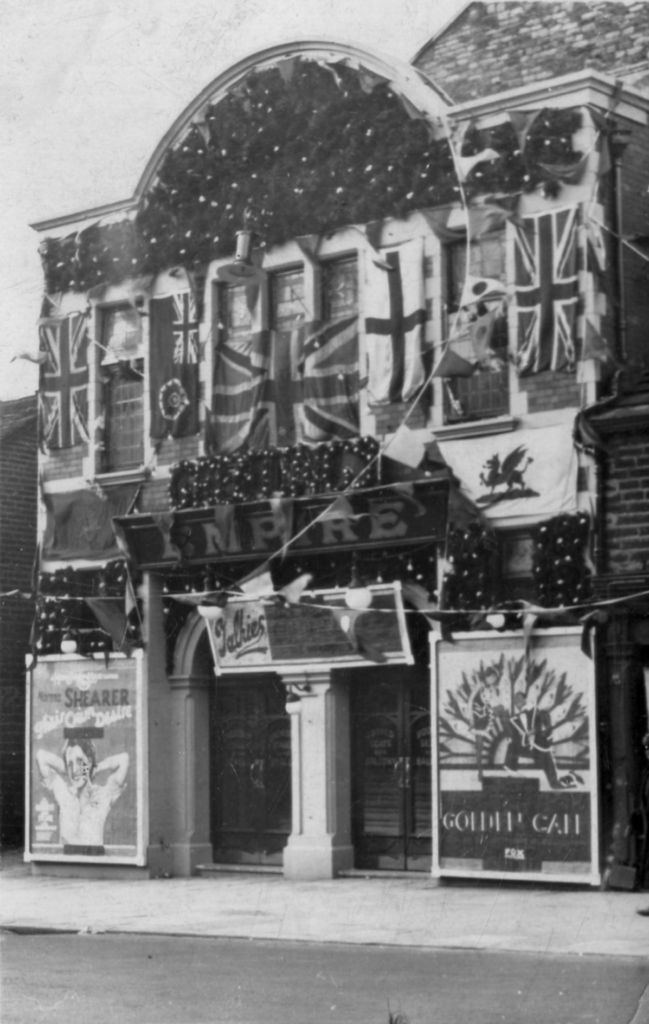
The Empire Cinema was opened in 1921 and in its early days was licensed for stage plays as well as film. Many had watched the Coronation of Queen Elizabeth II in 1953 on their television sets at home. At the end of June nearly 12,000 people, including over 3,000 children from local schools, came to the Empire to watch the full-length Technicolor Coronation film “A Queen is Crowned”. The Empire Cinema was demolished in 1963 and replaced with the current building.
Bernard Street and Edward Street

At the Coronation in 1953 a best decorated street competition was held. Bernard Street and Edward Street had traditionally won these competitions at other major events such as the peace celebrations in 1919. They were renowned for their spectacular displays, which were funded by the residents of the street. They did not disappoint, and Edward Street won first prize. Bernard and Edward Street were demolished in 1964 as part of Glossop Borough Council’s slum clearance programme.
Victoria Hall, Talbot Street/Fauvel Road

Victoria Hall had been built in 1887 and was one of the Jubilee Gifts to Glossop to celebrate the Golden Jubilee of Queen Victoria.
The Coronation festivities for King Edward VII in 1902 began with the old folks’ treat in Victoria Hall. The treat had been provided by Anne Kershaw Wood, wife of Samuel Wood, one of the owners of Howardtown Mills. The King’s illness and the postponement of the Coronation meant a more subdued celebration, but about 1,000 people enjoyed a first-class sandwich tea followed by a selection of pieces by the Whitfield String Band.
In 1911 Anne Kershaw Wood again provided a tea for the old folks, who were aged over 60. Five sittings were needed to cope with all the guests. The evening entertainments included a musical programme by the Whitfield String Band.
At the Coronation of King George VI in 1937 an old folks’ treat was provided to those aged over 65 years, blind persons and disabled ex-servicemen from WW1. Victoria Hall was also used for a Commemorative Ball held on the eve of the Coronation from 8pm to 3am on Coronation Day.
Victoria Hall was used for many celebrations during the week of festivities for the Coronation of Queen Elizabeth II in 1953. The Mayor held a Coronation Ball until 3am the next morning on Coronation Day. A Coronation Dance was held at the beginning and end of the week. On the Friday evening Glossop Townswomen’s Guild held an Elizabethan evening with songs and a playlet.
Cricket and Football Ground, North Road (Glossop Cricket and Bowling Club)

On the Coronation Day of King Edward VII in 1902 a procession of children made their way to the Football Field on North Road (now Glossop Cricket and Bowling Club). Thousands of spectators lined the route. Those with tickets came to watch the children gather and sing a selection of songs including “God Save The King” and “Auld Land Syne” accompanied by Glossop Old Band.
In 1911 the Day Scholars gathered again. They sang a programme of songs under the conductorship of Mr Fairclough of Whitfield Parish Church. The children then returned to their schools and enjoyed a tea of ham and tongue sandwiches, slab cake, chocolates and lemonade that had been donated by Samuel Hill Wood of Howardtown Mills.
The tradition was repeated at the Coronation of King George VI in 1937 with a selection of songs this time followed by a display of country dancing, physical training and gymnastics displays.
Howard Park
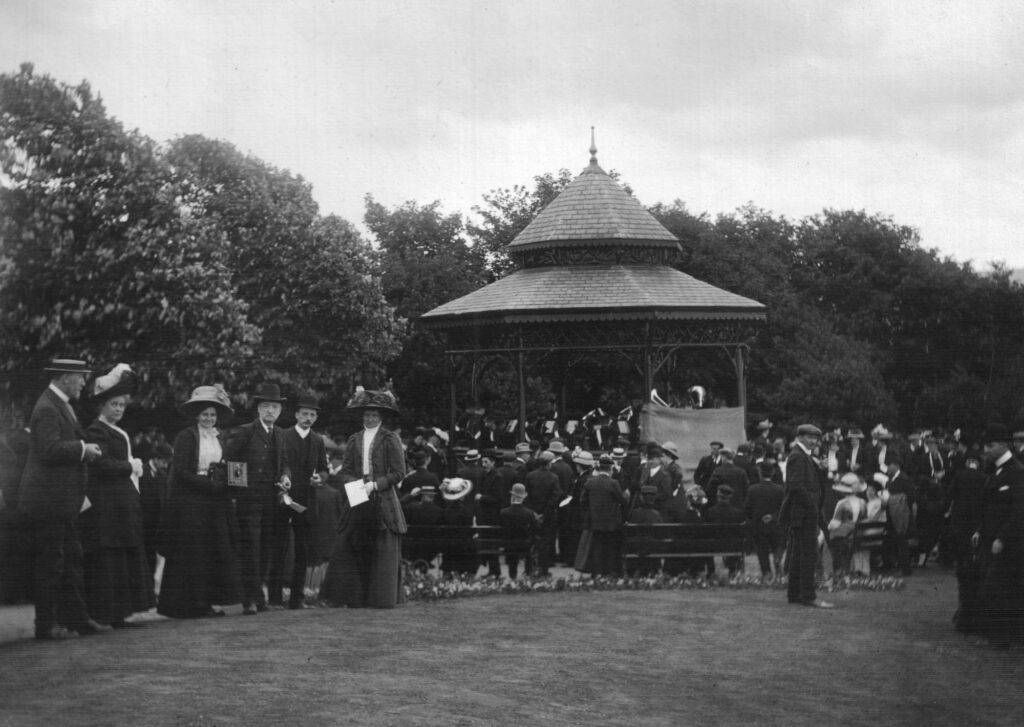
Howard Park, Wood’s Baths and Wood’s Hospital were all gifts that had been made in celebration of the Golden Jubilee of Queen Victoria in 1887. Until 1927 Howard Park was the only park in Glossop.
On the Coronation Day of King George V in 1911 a grand fete was held in Howard Park. This was a gift from Edward Partington, one of the owners of Olive and Partington Paper mills and the first Honorary Freeman of the Borough. 9,000 invitations were issued to the Citizens of the Borough. There were splendid entertainments including bands, gymnasts, Punch and Judy, clowns and jugglers. Marquees were erected supplying food and drink and the baths transformed into a public tea room.
Hadfield
Railway Yard
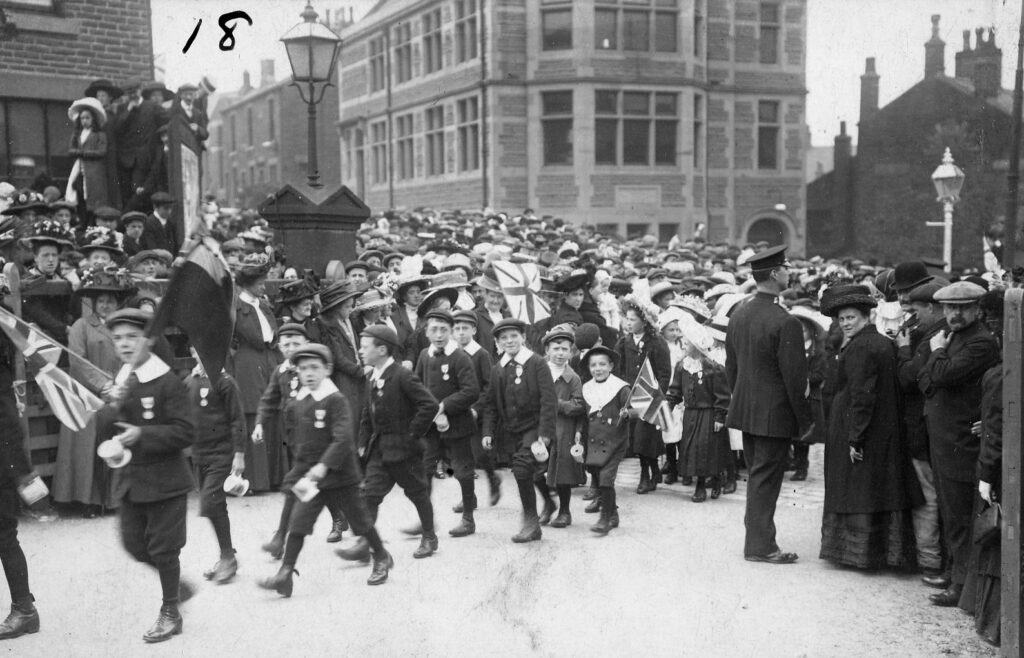
On Coronation Day 1902, Day Scholars gathered in Railway Yard to sing songs in front of a large crowd, accompanied by The Royal George Band, Greenfield. The arrangements were carried out in a “capital style”. After the gathering and a tea in their respective schools the children spent a pleasant afternoon of entertainments in the late Mr Warrington’s field on Green Lane.
In 1911 Day School Scholars gathered in the Railway Yard for an assembly of day schools. The music and hymns were conducted by Rev J. Hadfield. The scholars had received commemorative medals that had been gifted by Lord Howard of Glossop. The children can be seen wearing the medals in the picture.
Bankswood Park
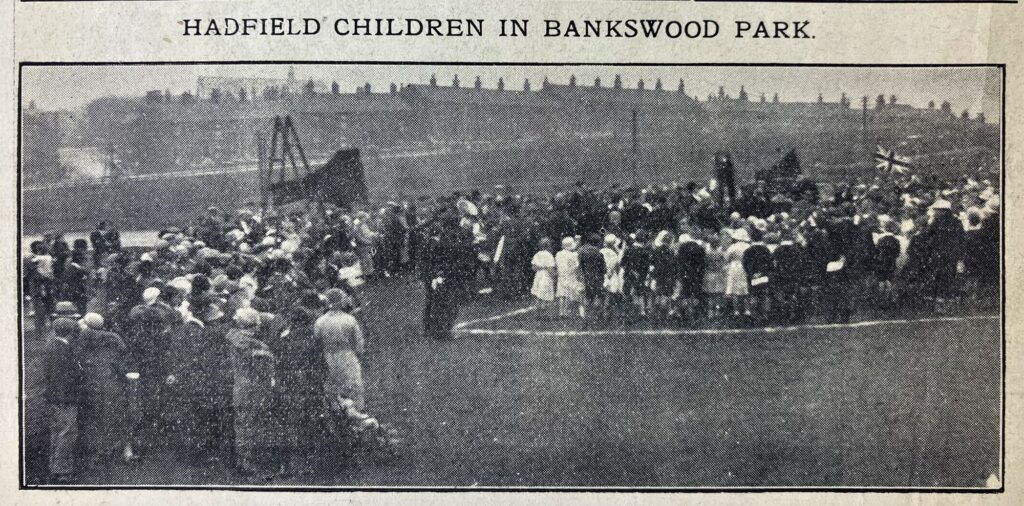
Bankswood Park was a parcel of land that was part of the Glossop-Dale Estate sale in 1925 and purchased by Glossop Borough Council.
The Council turned the land into a park for the people of Hadfield and it became a new place of gathering for events. At the Coronation of King George VI in 1937 the gathering of Day School children was held here. There was a selection of songs and gymnastics displays and a sports competition. In the evening people were entertained by musical selections by Glossop Old Prize Band.
St Andrews School, Railway Street

In 1902 there was a large attendance at the old folks’ treat at St Andrew’s Schoolroom, Hadfield. The treat was provided by Anne Kershaw Wood, the wife of Samuel Wood of Howartown Mills, for those aged over 60 years old. Those invited enjoyed a grand tea accompanied by a selection of music. It was agreed the gathering was about the “best of this kind ever held in Hadfield”.
In 1911 a tea was again given by Anne Kershaw Wood. The room was decorated with portraits of the King and Queen. Over 500 invitations were sent out. Councillor Lee’s String Band played during the sandwich tea. A packed programme of entertainments then played into the evening.
Sparrow Park, Hadfield Road

For the Coronation of King George V in 1911, Lord Howard had offered a gift of a small piece of land in Hadfield to Glossop Borough Council.
The piece of land was in front of the Spinners Arms on Hadfield Road. A row of houses that occupied the land had recently been demolished.
Crowds and a band had gathered outside the Spinners Arms on the morning of Coronation Day to witness the Mayor, J. Malkin, receive the deed to the land from C. A. Abraham, Lord Howard’s agent.
The land was laid out with railings and trees. It was later locally named ‘Sparrow Park’ due to the sparrows that roosted in the trees at night.
Mersey Bank, The Carriage Drive
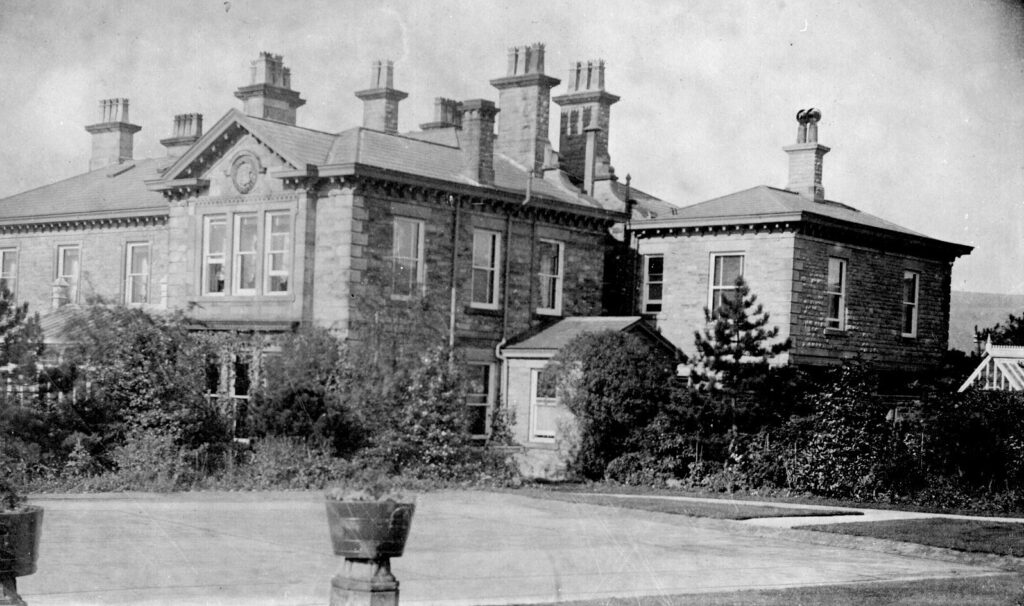
Mr and Mrs Edward Platt invited Day School Scholars to their home at Mersey Bank as part of the Coronation celebrations in 1902. Edward Platt was the owner of Station Mills in Hadfield.
Over 1,000 children walked in procession to a paddock near Mersey Bank where they sang Coronation Hymns accompanied by Hollingworth Prize Band. They afterwards returned to their schools for a tea of pies, ham, tongue and beef sandwiches and spice bread. They then returned to Mersey Bank for an afternoon of merry games and amusements until dusk.
Mr and Mrs Platt kindly planned the same for the Coronation in 1911, however, the incessant rain caused a change of plan. The scholars did not go to Mersey Bank but enjoyed a splendid tea in their respective schools. Mrs Platt then toured around the schools with others who had donated the treat and handed out Coronation mugs, fruit and sweets.
The Nab, Simmondley
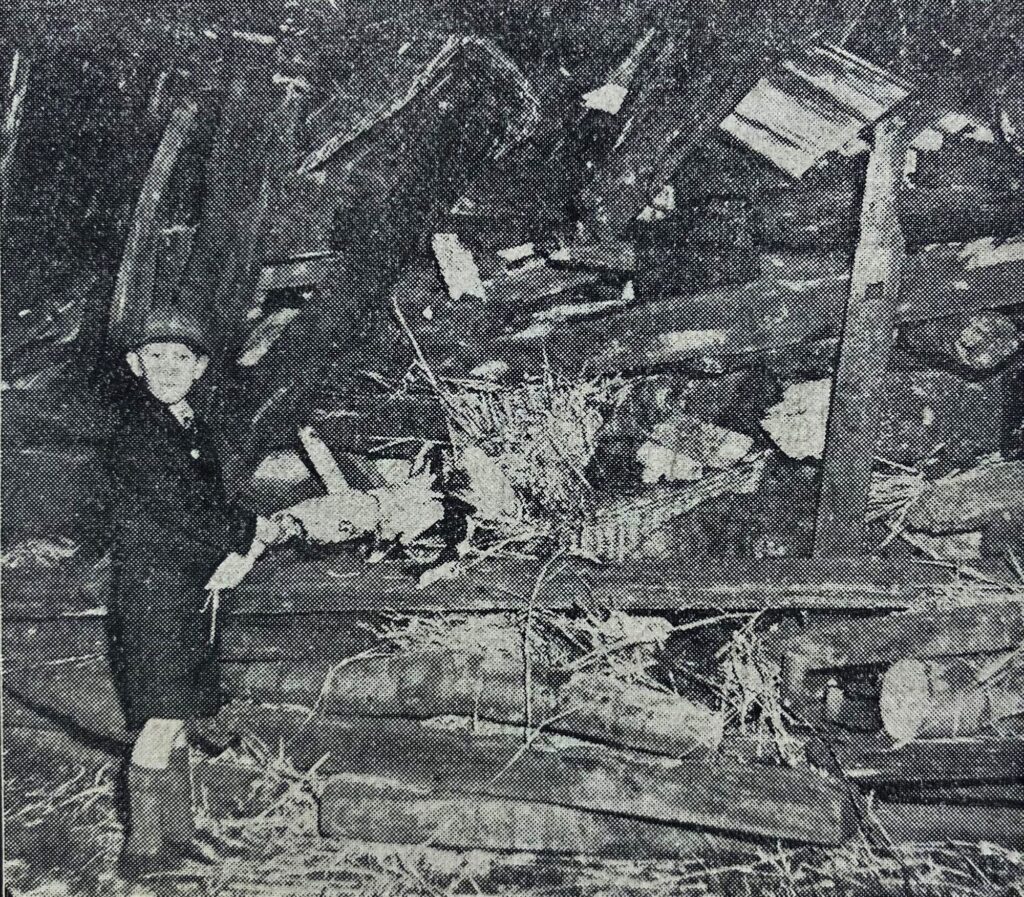
It had taken three weeks to construct the huge bonfire on Coombes Edge in 1911. On the evening of the Coronation, the Mayor detonated a rocket from the Old Cricket Ground on Norfolk Street to signal to the boys from Glossop and District Boy Scouts’ Association to light the bonfire.
In 1937 Local Boy Scouts and Rovers had constructed a beacon on the Nab, which they lit on the evening of the Coronation. At the Coronation of Queen Elizabeth II in 1953 the local scouts had prepared another huge beacon on the Nab. This was lit after the Mayor had sent up a rocket from Victoria Hall as a signal.
We hope you have enjoyed this wonder around the sites of Coronation festivities in Glossop. If you want to find out about the celebrations at each Coronation and Jubilee from Queen Victoria in 1838 to Queen Elizabeth II in 1953, you will find more articles here.