
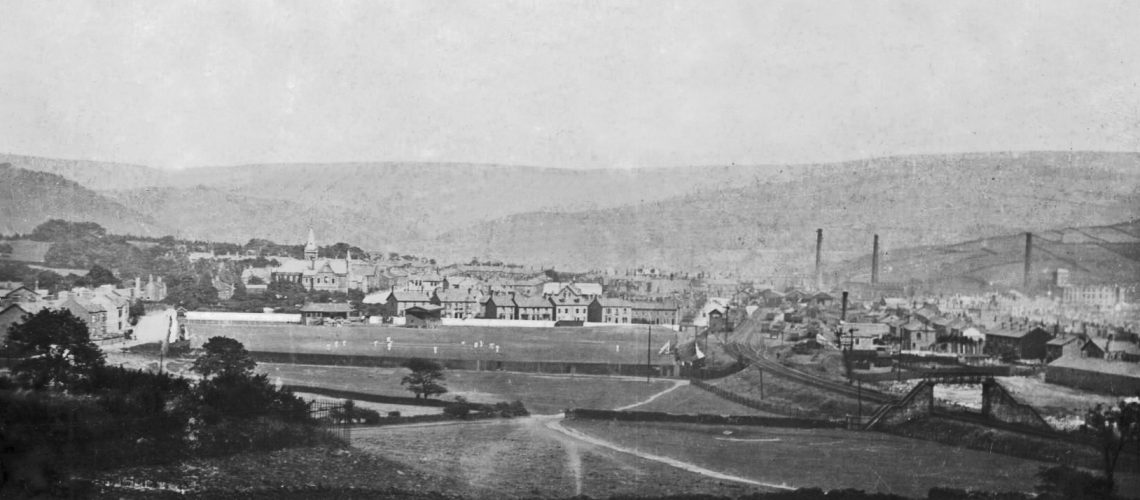
Glossop Dale Cricket Club
The Manchester Guardian reported on the first cricket match played by Glossop Dale Cricket Club on 30th April 1833. It was played at the junction of Edward Street and Bernard Street, which at this time was a field by the Norfolk Arms in Howardtown. The President of the new club was T. M. Ellison, an agent of the Duke of Norfolk and mill owner.
Other members included:
Francis Sumner, the owner of Wren Nest Mill
J. Shepley, the owner of Shepley Mills, Brookfield
John Hill Wood and Samuel Wood, sons of John Wood of Howardtown Mills
Edmund Crompton Potter, the son of Edmund Potter of Dinting Vale calico print works
T. H. Ibbotson who owned a paper mill at Turnlee mills
J. N. Winterbottom, a mill owner
Shortly after the Club moved to fields near where Glossop Cemetery is now, as the field at Howardtown was built upon due to the rapidly expanding town.
Norfolk Street Ground

In the 1840s the Duke of Norfolk became interested in the Club and offered ground on Norfolk Street, near to his residence, Glossop Hall. In 1847 the new ground was laid out by William Needham of Bramhall Lane, Sheffield.
In 1849 Samuel Wood, one of the sons of John Wood of Howardtown Mills, became President of the Club. He was involved with the Club for many years. During the 1850s the Club was in financial difficulties and requested monthly subscriptions from members. In 1861 it amalgamated with Victoria Club, another local club.
During the 1850s the matches took place at night after a day’s work. Players were dressed in black trousers, coloured shirts and top hats. It was common practice for cotton masters to find employment for men who were good cricketers.
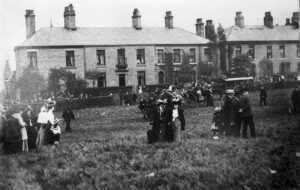
In 1874, the famous cricketer, Dr W. G. Grace, brought a team to play in Glossop. It was reported that there were 5,000 spectators. There is a legend that Grace hit the ball over houses on Norfolk Street all the way to Lord Street.
North Road Ground
Over time it became clear the Norfolk Street ground was too small and difficult to use. On match days the field was surrounded by canvas, but this did not stop enterprising young boys entering without payment.
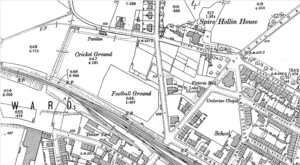
After the North Road Ground was expanded and the stream covered over in 1896, it then included the football ground with a covered stand being built on the north side of the football ground opposite the railway.
It was decided to find a new ground and pay rent. In 1880 the Club moved to their current site on North Road. The Rev C. B. Ward, the Vicar of Whitfield, loaned the money to lay out the new ground. This also included a bowling green.
Sir Samuel Hill-Wood, the son of Samuel Wood, began playing for the Glossop team in 1890. He was also involved in the formation of the Football Club. The lease for the North Road Ground expired in 1896. After some debate it was decided to renew the lease and expand the grounds by taking on the gardens flanking North Road. These were levelled and the stream that ran through the grounds was covered. Sir Sam paid for all this work.
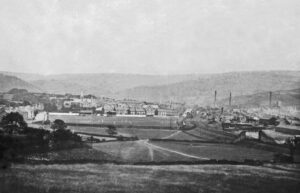
In 1925 money was raised and borrowed to buy the ground, which was being sold as part of the Glossop Dale Estate sale by Lord Howard of Glossop. At the same time the pavilion was repaired, and a boundary wall built.
Pavilions
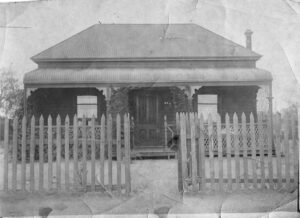
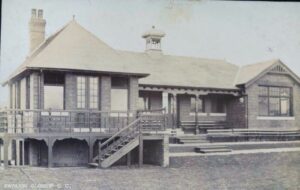
The old pavilion had been moved from the Norfolk Street ground to the North Road Ground in the 1880s. After the ground had been expanded in 1896, it was decided to build a new pavilion. In 1898 a new pavilion was opened on the site of the current pavilion.
Patrons and Benefactors
Many have supported Glossop Cricket Club in its long and successful history. It has had many generous donors over the years.
The Dukes of Norfolk and later Lord Howards of Glossop all showed their support. Lord Howard of Glossop was patron of the Club and allowed the Club to use the Howard Lion Crest.
Edward Partington, the owner of Olive and Partington Paper Mills at Turnlee Mills, was President of the Club for many years. He assisted the Club with grants and helped to buy the new pavilion in 1898. His sons also contributed much to the Club.
The Rev Charles Bruce Ward, Vicar of Whitfield, supported the Club with loans to lay out the new grounds at North Road in 1880. He also provided other financial support over the years.
The Ellison, Rhodes and Shepley families, who all owned cotton mills in the area, all contributed generously to funds.
Isaac Jackson, the inventor of the famous Jackson’s Belt Fasteners, generously supported the Club by paying the rent, providing medals and prizes and a motor mower for the grounds. After his death his wife, Harriet Jackson, continued to support the Club.
The Wood Family, owners of Howardtown Mills were huge supporters of the Club in many ways. Samuel Wood was President of the Club for many years. His son, Sir Samuel Hill-Wood, played for the Club and was involved in both the Cricket and Football teams in the early 20th Century.