
Newton’s Mill
On the 24th of November 1782, according to Robert Hamnett, John Newton of Whitfield signed a lease for a plot of land on which to build a cotton spinning mill. If he built it soon after, it would have been the first in Glossop, the start of its transformation from poor rural area to thriving industrial town.
It’s been generally assumed that Newton’s mill “at Cross Cliffe” was on the site of the later Cross Cliffe Mill, demolished in 1902, which is now under the end of Slant Close on Shirebrook. However, the leases for that piece of land don’t match up with what Hamnett tells us about Newton’s mill. It would all make sense if Newton’s mill had been on a different site, but if so, where ?
Maybe the maps give us a clue. “Cross Cliffe” isn’t just a place, it’s a lane, running across the steep slope (or “river cliff”) above Hurst Brook, but the older maps show it running down the slope at its eastern end and stopping at Scotland (or “Scotty”) Brook, just before it joins Hurst Brook. Where was this lane going ? There’s no sign of it carrying on over the other side of the brook. It seems to be going nowhere.
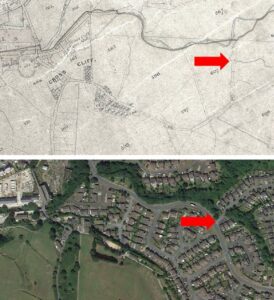
However, on the 1857 Poor Law Map, there’s a suggestion there might have been a building at the end. Might this be the site of Newton’s mill ? It would have been a sensible one. Scotty Brook would have been big enough to run a small mill without much risk of the water wheel (or the mill) being washed away in a flood.
It would have been sensible for another reason, too. In 1782 Richard Arkwright still held a patent on his water frame, and had started legal action against the many new start-ups which were infringing it. Newton was described by Hamnett as a “labourer”, which seems unlikely, as he would have needed both capital and basic literacy to set up a mill, but even so, he wouldn’t have been in a position to take on Arkwright, the Bill Gates of his day. The site of the later Cross Cliffe Mill was in full view of what was then still the main north-south road, but the other end of the lane would be much less visible to any passing lawyers. In June 1785 Arkwright lost his court case, and with no more need to pay a fee or hide away, other mills followed very quickly.
If Newton’s mill was indeed at the end of the lane, it would now be at the junction of Shirebrook Drive and Hurst Crescent. Is this the place where modern Glossop began ?
NEXT – Part 2: Simmondley Mill