
Long Clough
Chunal Brook, Gnat Hole Brook, Long Clough, Primrose Brook – call it what you like, the vigorous stream that runs for three miles from Chunal Moor to what, until a few years ago, was the Junction Inn was a good location for water-powered textile mills, and by 1811 there were no fewer than nine.
There were then almost no trees in the valley, so a visitor coming along the new turnpike road would have been able to see a string of small mills, still sitting in open fields apart from the little clusters of cottages around each. Sometimes the cottages, or the owner’s house, were attached to the mill itself. Their workforces would be no more than 20 or 30, and as whole families worked in the mill, a few cottages were enough to house them all.
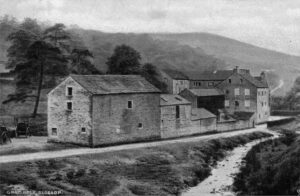
To begin with, all were spinning cotton or wool. At the top was Gnat Hole, a woollen spinning mill from 1790 to the 1880s, which (see pic) is still there, although somewhat cut down. Then there was Dover or Bury-me-wick. The original mill burnt down in 1833, but what was built later is now an engineering works. Then Charlestown, named after its builder Charles Hadfield of Lees Hall, which, greatly enlarged, became Walton’s bleach works and is now a building site, although without much sign of building.
Then, on the other side of the turnpike, a group of three mills close together, Turnlee and Whitfield Mills, built between 1802-5, which were all (together with Dover Mill) bought in 1873 by Edward Partington and then demolished in succession as his Turnlee Mills paper works expanded into one of the biggest in the world.
However, the last three on the brook – Lower Turnlee, Bridgefield and Primrose – had all ceased working by the mid 1890s. One factor in their early demise may have been what was happening above them. With the exception of Gnat Hole, by the mid-1840s the mills upstream were mostly either bleaching cloth or making paper.
In a cotton town, papermaking was a logical alternative, as it also required large quantities of water, and paper at that time was made mainly from waste cotton cloth, more of which was produced every time a weaver made a mistake (which they tried very hard not to, as they weren’t paid for a faulty piece).
However, the chemicals used in the process are highly polluting. Bleach works, likewise, produced pollutants. It all got a lot worse when Partington arrived with his sulphite process, involving the pulping of wood by boiling it in huge pans of acid. Until the 1930s these had to be emptied down the drain, and the brook became notorious as the “Chemic Brook”, but it must have been pretty bad even before he came.
If the workforce could stand the smell or fumes, a water-powered mill could still use heavily-polluted water to turn its wheel, but acid or alkaline water would corrode boilers and condensers, so steam power wasn’t possible without a good supply of clean water. Hamnett noted that by the middle of the 19th century, firms that didn’t yet have steam were beginning to go out of business – then as now, there were sometimes dry summers in Glossop! And clean water was also, of course, needed for any washing processes.
Further downsteam, below the confluence with Glossop Brook, Edmund Potter went to a lot of expense to keep polluted water away from his printworks and to pipe clean water from the hillsides. Companies were required to store pollutants in tanks and discharge them to the brook only at set times, when those downstream would close their sluice gates to protect their premises, and if the rules were ignored, Potter had lawyers. However, the three small mills were not in such a strong position. In the next two posts we’ll look at what we know about them and what, if anything, survives of them.
NEXT – Part 3b: Long Clough – Bridgefield Mill
PREVIOUS – Part 2: Simmondley Mill