
Long Clough – Bridgefield Mill
The oldest of the nine mills on Long Clough, and one of the earliest in the area, was Bridgefield Mill. It was built in 1784 by John Garlick, although in 1791 it was sold to John Shepley. Shepley is one of several family names which crop up repeatedly in accounts of the early mills; some were local farming families which had been active in the domestic textile industry, others were incomers attracted by Glossop’s advantages as a place to start a factory textile business.
The mill remained with the Shepleys or their tenants till 1807, then for much of the rest of its life was worked by Joseph Howard. It stood on a sharp bend in the brook, below the bridge over which ran the ancient lane between Charlesworth, Simmondley, and (Old) Glossop, then called Bridge Lane but now Slatelands (number 916 on the 1857 Poor Law Map).
The water supply arrangements, as shown on the map, were unusual. Water-powered mills needed a weir to create a head of water, and this was normally placed some way upstream of the mill, with the take-off to the millpond immediately above the weir. In this case, however, the weir (red arrow on the map) was almost next to the mill (169 on the map), with the take-off about 150 metres above it, feeding a long narrow millpond alongside the turnpike, where Earls Way and the frontage of Reliance Garage now is (109 on the map). The water must then have been carried to the mill over the brook via a pipe or trough, probably under the bridge which connected it to Bridge Lane.
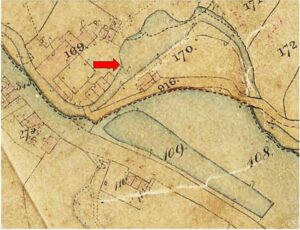
It’s unlikely that this was the original arrangement. The 1857 map shows a large pool behind the weir, running up past where Overdale Drive now crosses the brook, and this was probably the first millpond. However, in a cloudburst, if floodwater piled up behind the weir, there would have been nowhere for it to go other than through the mill cottages beside the brook, and possibly through the mill itself. It would also – see previous post – be impossible to keep polluted water out of the millpond and therefore out of the mill. When the mill was first built, the water was bound to be clean as there was nothing but fields and sheep above it.
Whether there had been some frantic baling-out on wet stormy nights, or the stink had got too much, or the mill just needed a bigger store of water, the new arrangement would allow pollution to be kept out of the millpond, and floodwater to be diverted through it and safely back into the brook below the mill, through the drain which can still be seen. The first mill builders, with little experience to guide them, sometimes had to learn the hard way that, although it would cost more, they needed to build their mills and millponds off the line of the brook, so that in times of flood or bad pollution they could just close their sluices and watch it all rush safely past.
In the end, it wasn’t a flood which did for Bridgefield Mill. In 1874 or 5 it succumbed to the other great hazard, fire. Its fortunes, though, had probably been in decline for some time. In 1842 Mr Howard was employing 47 people, but in 1851 Joseph Wilkinson, cotton thread maker and yarn doubler, had only 16 workers, and the 1857 map suggests that by that time some buildings had already been knocked down. Towards the end, it may well have been used for storage by other, larger companies. When built it would have been state-of-the-art, but 90 years later, over in Padfield, the Rhodes family was building the last of the area’s great mills, with 75,000 spindles, 1345 looms, 950 workers, and from 1887, electric light.
The two cottages attached to the back of the mill survived the fire, and are now 1 and 1a Bridgefield, and the site of the mill itself is now a private garden, hidden by trees from the road.
NEXT – Part 3c: Long Clough – Lower Turn Lee and Primrose Mills
PREVIOUS – Part 3a: Long Clough