
Long Clough – Lower Turn Lee and Primrose Mills
According to Robert Hamnett, Lower Turn Lee Mill, also known as Woollen, Tip or Fat Adam’s Mill, was built in 1791 by members of the Bennett family. This is another of the family names which crop up frequently in accounts of the early mills, and it will appear again at the end of this series.
The mill may well have started out spinning wool, but by 1811 it was being worked by members of the Kershaw family, another familiar name, as a cotton spinning mill. Later it may have been worked by Joseph Howard who also ran Bridgefield and, for a time, Primrose Mills. Its life, however, appears to have been very short. By 1879 it was “in ruins” and when Hamnett visited in 1898 he found that the main mill had completely gone, leaving just “a building without a roof, apparently a coach house or warehouse with some other rooms” and bearing the datestone “B 1825.”
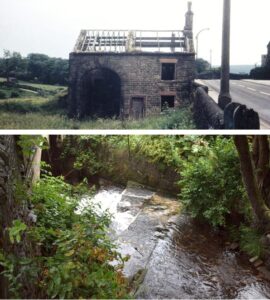
Amazingly that fragment, up against Turnlee Road (see top pic) survived much as Hamnett described it until the early 1970s, when it was demolished to make way for what’s now Turnlee Drive. Hamnett didn’t, however, find out who Fat Adam was – perhaps the geneaologists could enlighten us.
The last of the three “lost mills” on Long Clough was Primrose, which was probably built soon after the turnpike, Primrose Lane, was completed around 1805. The builder was Joseph Hadfield of Lees Hall, son of Charles Hadfield, builder of Charlestown Mill, and father of Matthew Ellison Hadfield, architect of the Town Hall and much else in the new industrial town.
The Hadfields were gentlemen, and gentlemen would build mills as investments, but leave the messy business of running them to rougher sorts. In this case that was one William Radcliffe or Ratcliffe, who according to Hamnett was “too fond of sport, neglected his business and eventually died a pauper.” Nevertheless, he was at the mill till the 1830s, after which it was briefly operated as a woollen mill by members of the Robinson family which owned Gnat Hole Mill. Then for a few years it was run by Joseph Howard in conjunction with his Bridgefield Mill upstream.
After that, for 20 years or so it was used for paper-making, latterly becoming part of Thomas Hamer Ibbotson’s paper business centred on Turnlee Mill, until he got into difficulties, to which a fire at Primrose Mill in December 1866 may have contributed. In 1872 there was an advert for a tenant, in 1878 it was occupied by John Jackson, cotton spinner, and the last reference is in 1887 when it was occupied by William Gilliat, a cotton waste spinner, with 4000 spindles. By 1897 it was “disused”, and by 1921 there was a nursery with greenhouses on the site.
The area of the mill and millpond is now occupied by houses and a care home. Just the remains of the weir survive, where the brook goes under Primrose Lane (see lower pic); from there, a culvert took the water under the road to the pond. Despite Mr Radcliffe’s negligence, the Hadfield family probably got their money back eventually, but this and Lower Turn Lee were typical of many early mills that, for whatever reason, failed to “take off” and spent most of their working lives on the fringes of the textile industry.
NEXT – Part 4a: Padfield Brook – The Torside Goit
PREVIOUS – Part 3b: Long Clough – Bridgefield Mill