
Padfield Brook – The Thornley Mills
William Thornley was a carpenter in Chisworth who, in 1783, acquired the lease of coal mines there. In the meantime, however, his son John had gone into the textile business, and became a partner of John Turner in a mill at Waterside on the Etherow. This, rather than Newton’s Mill (see earlier post) may, as early as 1777, have been the first powered spinning mill in the area, although there’s no documentary proof.
In the 1780s, John built a mill of his own on Padfield Brook, and after his death this was taken over by his son Robert. Jointly with John Turner, Robert invested in the construction of the Torside Goit, and in 1795 leased it from the Duke of Norfolk. It’s pretty clear that Robert, with his brother John jnr, had big plans. However, it was Turner’s plans which came to fruition – by the 1830s his Waterside complex, under new owners, was on its way to becoming the biggest mill in the world, but the Thornleys had gone back to selling coal.
It’s been generally assumed that the first of the Thornleys’ three mills on the brook, which was insured in 1788 for £980, the equivalent of £147,000 today, was what was later called Bankbottom Mill. This may be because it was shown on the 1879 Ordnance Survey map as “Thornley Mill”. However, that term isn’t used elsewhere – it’s always “Lower Mill.” In addition, it was aligned to Bankbottom, a road which didn’t exist in the 1780s. It was also described in 1842 as “Lower (new) Mill”, i.e newer than a mill or mills higher up.
It’s likely that the first was, in fact, Red Mill. It had gone before the first maps, but it’s pretty clear where it was, as the maps do show, on Lambgates Lane, a millpond without a mill, later filled in and occupied by a garage, and now a new housing site. The water came in at the north end, and logically, the mill would have been at the south, where the dam was, so would have sat roughly where the Hadfield Dental Practice and the adjacent houses now are. This would have been at the junction of the two old lanes, Kiln Lane (which then turned down what’s now Station Road) and Lambgates, within easy reach both of the village and of the joint Turner/Thornley mill at Waterside.
However, it doesn’t appear to have lasted very long, and perhaps not even past 1800. All we know is that it was built of brick, hence the name, and was “of light construction”. Although it’s unusual round here, many mills elsewhere were built of brick, but without a lot of bricks, or a very strong frame of wood or iron, the vibrating machinery would shake them to bits. Is that what happened to Red Mill ? Nobody had built large powered factories before, so there was a very steep learning curve.
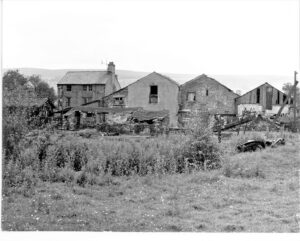
The Thornleys then – possibly as a replacement – went on to build Hadfield Lodge Mill, also brick but whitewashed, hence its colloquial name “White Mill”, and then Lower Mill. In the meantime, however, in 1795 they had started a new, and ultimately much bigger, development up the valley at Vale House. It may, though, have been a mill too far, as Robert and John jnr were bankrupt by 1824. Their brother Thomas had been working Hadfield Lodge, and then took on Lower Mill as well, but went bust in turn in 1831, and the mills were acquired by the Platt family. The Thornleys’ contributions to local Methodism – they built the first chapels in the area, at Vale House then Hadfield – were more enduring than their impact on the cotton industry.
Lower Mill was demolished in 1899 and the site now lies between Albert Street, Valemount and Vale House Drive. Most of White Mill was destroyed by fire in the early 1900s, but the weaving sheds and the Thornleys’ house survived as part of Hadfield Lodge Farm (see pic, 1970) and a small part of the mill was made into a cottage, finally cleared in 2011 to make way for housing. One tiny fragment of the Thornley mills can still, however, be seen. Does anybody know where ?
NEXT – Part 5a: Longdendale – Torside and Crowden
PREVIOUS
– Part 4a: Padfield Brook – The Torside Goit