
Longdendale – Torside and Crowden
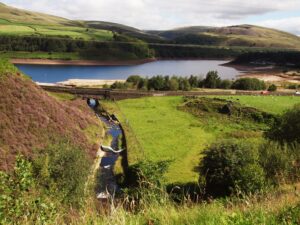
Just west of Torside car park, the Longdendale Trail crosses Torside Clough, and if you look down (see pic) you’re looking into what was once a millpond. The Woodhead road, which was moved when the reservoir was built, now goes across it, and the site of the mill, and the hamlet of Torside, is now underwater. This was one of four mills which suffered the same fate, but the one about which we know least. We’re not even sure when it was built, what it made, or what it was called. It’s shown on an 1836 plan as “Crodden Mill”, but Crodden, or Crowden, was on the other side of the river in a different county, and there was definitely another mill there of that name.
They might, though, have been two parts of the same business. The mill in Crowden appears to have been built, some time prior to 1797, by Thomas Hadfield, of the Hadfield family of Crowden Hall just 300 yards away. In 1814 it was occupied by John Lumb, cotton spinner, and it may be that the Hadfields initially let it out then took it back with a partner, as by 1830 it was being worked by “Hadfield and Wilkinson, cotton spinners”. By 1834 they were “spinners and manufacturers” indicating that they had added weaving to spinning.
By the 1840s it was a fairly substantial complex, about 60 yards long, just south of the turnpike (now A628) in the angle between it and Crowden Brook, with two millponds, which were not supplied from the brook but from a spring, via a goit running under the road. After the millponds were drained, the spring fed another pond lower down, now also recently drained.
By 1847 it belonged to Thomas and William Brown, cotton thread bleachers. Although the reservoir was finished in 1864, Manchester Corporation didn’t buy the works till 1867 and J and J Brown, yarn bleachers, appear to have been still in business there in 1869. Demolition must have followed soon after, though, as the main buildings had all gone by 1872.
In several local publications there’s a 1950s photo captioned “Browns’ Bleach Works”. This was a separate building, the “Mill Yard”, some distance from the mill, probably its cart shed and workshop. However, the 1847 tithe map, which describes it as “yard etc” shows that the Hadfields had kept it on their own land after the mill was sold, so it may never have been used by Browns. Later maps show that only a small part of it survived, but that it was then extended by the waterworks before being demolished in the 1970s. There’s nothing much left to see of either this or the main mill buildings, but the earthworks of the millponds are still visible, in the field immediately to the south of the old vicarage.
One puzzle, though, is where the workers lived. A mill of this size, both spinning and weaving, would have needed at least 30 to 40, but there were no cottages next to the mill, and few other houses in Crowden, and it would have been a long walk from Tintwistle. Perhaps some were living in the Hall. It was a common practice for gentry families like the Hadfields to split their draughty old mansions into multiple tenancies and either move into one wing or out altogether into something more modern and comfortable, where they could sit and count their cash.
NEXT – Part 5b: Longdendale – Arnfield Mill
PREVIOUS – Part 4b: Padfield Brook – The Thornley Mills