
Longdendale – Arnfield Mill
In the Industrial Revolution, when every other settlement in the area was expanding rapidly, Arnfield shrank. All that’s there now is farm buildings and two or three houses, but in the mid 18th century it was nearly as big as Tintwistle next door. Where did the people go, and why ?
The answer may lie in why they were there in the first place. The village couldn’t have supported many people through farming – too high and windswept, and all the best land was in the valley bottom, so from the late 16th century, if not earlier, most would have been employed in the domestic textile industry, spinning and weaving in their own homes.
When, in the 1780s, the first spinning mills were built along the Etherow, the women, who did most of the home spinning, would have been out of a job, so once housing was available closer to the mills it would make sense for the whole family to move even if the men were still profitably occupied in weaving by hand. A large chunk of the village on the east side, shown on an estate map of 1771, had disappeared by the early 19th century, leaving grassed-over roadways and house platforms, referred to in an archaeological report as a “deserted village.” There was just one house surviving there by the time of the tithe survey in 1847.
In the meantime, however, the village had acquired its own mill, albeit a small one, perched on the side of the narrow valley of Arnfield Brook. The 1797 Land Tax returns record John Kershaw as occupant of “land, house and mills” at Arnfield. By 1828, it was in the hands of William Buckley, cotton spinner.
The 1847 map shows that at some point since the 1790s a second building had been added, and also what appears to be a rope walk. For small spinning businesses, twisting the yarn into ropes was a better way than weaving of adding value to the end product, needing less machinery, staff, space and power. There was also a chimney, on the hillside on the other side of the brook, connected by a flue, traces of which can still be seen on the satellite image. This might just have been for heating – to prevent the threads breaking, cotton mills had to be kept warm and humid – but it’s more likely that a steam engine had been installed. Also on the other side of the brook was a gas making plant with gasometer.
There were a few cottages on the site, but most of the workforce must have lived in the village or in Tintwistle. There were only eight occupiers of properties in the village in the 1847 survey, but some of their premises were extensive and they could have had sub-tenants or lodgers.
In 1834 the mill was bought by John Hull, and he still owned it in 1847, but whether he carried on spinning, or rope-making, or for how long, is uncertain, as in 1850 the premises were described as being previously used for calico printing, but now unoccupied. The end would have been nigh anyway, as Arnfield Reservoir, lower down the brook, was completed in 1854. Manchester Corporation, which appears to have had thoughts of building another, higher reservoir, eventually bought the buildings in 1867, and they were all gone by the 1890s.
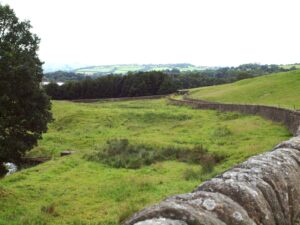
You can, though, still see where they were. If you walk along the track from Arnfield towards the reservoir, and are tall enough to see over the high wall, you can (see pic) see the dam of the millpond, with the overflow still draining into the brook below, and beyond it a level platform which was the site of the main mill. There’s no trace of the rope walk further down, but it may only have been a wooden shed.
Although, along with the grouse shoots, it would have brought a few new jobs, the waterworks also brought an end to at least 300 years of textile manufacturing in Arnfield, and with the industry went the people. Some of them would probably have gone to the new industrial village established in the 1790s by the Thornley brothers at Vale House, a mile away on the valley bottom, which was more sheltered and had modern houses, gas, shops, a school and a chapel, but that fell victim in turn to Manchester’s need for water.
NEXT – Part 5c: Longdendale – Vale House
PREVIOUS– Part 5a: Longdendale – Torside and Crowden