
Cowbrook Mill
In the early textile industry, business failures were frequent, and mills could be empty for years before restarting under new operators, often making a different product. Each interruption must have caused hardship for the workers, especially those living next to out-of-town mills who would have a long walk to another job.
Cowbrook Mill was an exception. William Hadfield built it in 1801 to spin cotton, and 97 years later his grandson Joshua was still there, still spinning cotton. In the early days, it was usual for t’owner to live next t’t’mill, in ces thur wur trouble, but by the 1890s machine-breaking was a distant memory and most had installed a manager and moved elsewhere to escape the noise and the smoke. Often, however, that was when the rot set in, and perhaps the continuous presence of three generations of Hadfields was why this mill kept going for so long in the face of competition from much bigger ones.
Another reason for them to stay was that the mill had been built on the family farm, which they continued to run, using part of the mill to crush grain for animal feed. The 18th-century buildings of Cowbrook Farm, which they converted to housing, still stand along Sheffield Road.
The fact that this was their ancestral home, not just an industrial site, may explain why they tried to give it at least some of the trappings of the country estate to which other millowners aspired. The millpond, complete with boathouse and boat, was fringed by trees, and whether or not they were responsible for the mock-Tudor chimneys on their house, they did lay flowerbeds in front of it, and also a garden at the back, plus what was probably a kitchen garden and orchard on the south side of the mill.
The original mill was small, with just a 10 horsepower waterwheel. Later, probably in the 1830s or 40s, it was almost trebled in size, with an extra 35 hp wheel and a beam engine, and by the end it had a horizontal engine in its own house, and the wheels had been replaced by a 80hp turbine. As the industry progressed, engineers learnt how to do more by machine, to cram in more and bigger machines, and to run them faster, so there was a constant demand for more power, and mills which couldn’t keep up were doomed to fail.
When first built, it was in open fields half a mile from (Old) Glossop, on a quiet country lane – the turnpike to Sheffield, now the A57, didn’t come past it for another 20 years. Now it’s surrounded by modern housing, and people travelling along Sheffield Road will see a row of houses which look much older than the rest, but probably don’t realise what lay behind them.
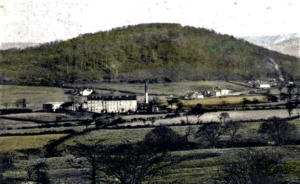
Or, indeed, how much still does. In addition to what can be seen from the road – owner’s house, cottages, gateposts, former office – behind them the engine house, and a fragment of the 1801 mill at the other end, have been converted to houses, with the foundations of most of the rest visible in between. This is the best-preserved early mill site in Glossop.
After 97 years of stability, the end was sudden. The 41-page inventory for the auction included 4½ tons of cotton still on its way through the mill – the machines had just stopped, throwing the employees out of work. Although other family members carried on the farm, the 60-year-old Joshua Hadfield became a tenant in his own house, and lived just three more years. The auctioneers were at pains to stress the “excellent” condition of the engine, suggesting that it was relatively new – many older mills failed when they borrowed to upgrade but were still unable to swim against the tide. In 1898 huge new spinning mills with thousands of horsepower were being built in Greater Manchester, and even the biggest Glossop firm, Sidebottom’s, went bust the following year.
A question remains, though. Where was the Cow Brook? Was this just an old name for Hurst Brook, or was there another stream which has disappeared? The mill sits at an odd angle to Hurst Brook, suggesting that it was originally run from a stream coming down from Shire Hill, but there’s now no sign of one.
NEXT – Part 7a: Milltown
PREVIOUS – Part 5c: Longdendale – Vale House