
Milltown
Until controversially demolished in 2016 to make way for housing, John Wood’s Narrow Mill, latterly home to Volcrepe, was an imposing presence at the east end of the town centre. However, it wasn’t the first building on the site. In 1803, 18 months after William Hadfield started at Cowbrook, Thomas Shaw leased land for a mill likewise spinning cotton weft (the thread which goes across the loom, in the shuttle.)
Although a smallish mill with a short life, Milltown played an important part in the development of the other mills along Glossop Brook and the new town, Howardtown, which grew up around them and was the nucleus of modern Glossop. It was originally referred to as the Lower Mill, being lower down the brook than the ancient manor corn mill, belonging to the Duke of Norfolk, which had given its name to Milltown, a little hamlet on the road from (Old) Glossop to Whitfield. Shaw worked the new mill with his partner John Beeley, Shaw’s leases and water rights passing after his death to his son-in-law.
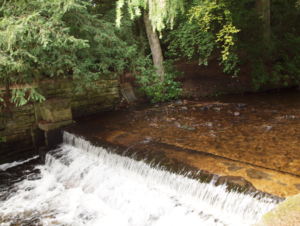
Their mill took its water from the tailrace of the corn mill, which in turn took it from the sluice above the weir the remains of which can still be seen in Manor Park, at the end of the rose garden (see photo). After it left Shaw’s mill, the water went along a goit into the pond of George Burgess’s Bridge End Mill, where Wetherspoon’s now is, then under the road and across what became the market ground to Shepley’s (Green Vale) Mill (where the Methodist church and ambulance station now is) and then to the mills lower down, finally going back into the brook at Brookfield.
Until the 1890s the brook was also the town sewer, so it was sensible to take as much water as possible from a point higher up where it was (relatively) clean. This arrangement, which was almost certainly devised, in stages, by the Duke’s agents who drafted the leases and water rights for the mills, also protected them, to a degree, from flooding, as in extreme conditions they could close their sluices which led directly from the brook but still get the water coming down from the corn mill.
However, each firm was then dependent for this water on the one above, which could lead to fallings-out, either because the water was being polluted, or because in times of shortage a mill was keeping its own pond full at the expense of those below. In 1819 John Wood bought Burgess’s mill, and some time later had a legal dispute with Shaw’s son-in-law about the supply from Milltown Mill.
In 1829 Beeley, by then in sole charge at Milltown, built himself a house, East View, looking out over the fields towards Cowbrook. It was later rebuilt, as Easton House, by the very much richer millowner Francis Sumner of Wren Nest. The following year, a lease was obtained for the land in front of and below the house, west of the brook.
This appears to have been the start of expansion, including the construction of a second millpond on the newly-acquired land. Water was still important in the 1830s, as waterwheels were still more powerful than steam engines – provided, that is, there was enough water. As their mills got bigger, the Glossop millowners were finding themselves short in dry weather, so needed more storage, and in 1837 obtained an Act of Parliament to build a reservoir at Hurst.
Whether the development was completed by Beeley or a new owner isn’t clear, as in 1833 he put the mill up for sale. By 1836 it was to let, “lately enlarged” to include both spinning and weaving, with a 22 hp water wheel and 100 workers. The first Ordnance Survey map suggests that a second block had been built on the west side, at right angles to the first. It was still not as big as Cowbrook, but had more than double the workforce – weaving was a more labour-intensive process than spinning.
It didn’t fare well, however. In 1839 the new operators, Daniel Hodgson and Jonathan Wright, filed for bankruptcy, and although they weathered this crisis, things went from bad to worse……
NEXT – Part 7b: Milltown Mill
PREVIOUS – Part 6: Cowbrook Mill