
Milltown Mill
At 2 o’clock in the morning of 27th January 1842, a passer-by spotted a fire at Milltown Mill. There was then no public fire brigade, so mills depended on their own resources and help from neighbours – Cowbrook had a 4-man manual fire engine – but “the inhabitants of the neighbourhood being wrapped in sleep, a long time elapsed before assistance could be obtained. On the arrival of the engines, the devouring element had gained so great ascendance, that they were wholly insufficient to arrest the progress of the flames.”
The mill, with its machinery, much of which would have been less than six years old and which was valued at £2000, the equivalent of £198,000 today, was totally destroyed. And it was only partially insured, no doubt a reflection of the financial difficulties its proprietors, Messrs Hodgson and Wright, were already in. And their 100 employees were now without a job.
One firm’s disaster, though, was another’s opportunity. John Wood, who already had three mills and nearly 1300 workers, had been advancing eastwards from his starting point at Bridge End but was still a field away. He now leapfrogged over this field and acquired the Milltown Mill leases, and having demolished what was left, in 1845 built a much larger spinning mill on the site.
In October 1846 he and his sons John, Daniel and Samuel leased the field in between, and built a second mill back-to-back with the first – a wider one, as in the meantime, spinning mules had got bigger, so the first mill became known as the “Narrow Mill”. As the Milltown Mill leases also included the land between the road and the brook, later the site of their Great Eastern Mill and Shed, they now had all the land they would need to complete, within 35 years, the expansion of their Howardtown Mills complex into one of the giants of the industry.
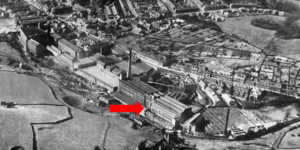
Milltown Mill and its original pond now being under the Glossop Brook housing development, all that’s left to see is the second pond in front of Easton House, together with the goits on either side, all now empty and overgrown. However, in 2017 archaeologists unearthed a large wheelpit beneath the floor of the demolished Narrow Mill (see arrow on the 1950s pic). They thought it was from Shaw’s 1803 mill, but this seems unlikely – it was too big for a small mill of that period, which would need only 10-12 hp, and outside Shaw’s original plot, and much more likely that it was for the 22 hp wheel from the 1830s enlargement.
Although John Wood had, in the 1820s, introduced steam power to Glossop, and water power was on the way out for new mills by 1845, he re-used the existing wheel, which measured 20 x 14 feet, with a steam engine alongside it. It was, effectively, free power, and he didn’t get where he was by not taking advantage of every opportunity which came his way.
NEXT – Part 8a: Charlesworth and Chisworth
PREVIOUS – Part 7a: Milltown