
Charlesworth and Chisworth – Chew Wood
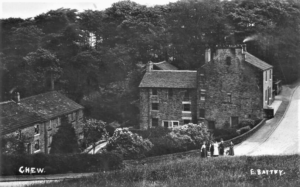
Chew Wood Mill isn’t really “lost” – it featured on Edwardian postcards (see photo) and what’s still there is very visible as you drive along the A626 from Marple Bridge into Chisworth. However, we know little about it, which is surprising, as from it sprang one of the last of Glossop’s cotton empires, that of the Rowbottoms, spinners, rope and band makers.
Robert Hamnett says that it started in 1795 and was first used for carding and scrubbing wool. At that time those processes didn’t need power, or a lot of space, and so it’s likely that the original mill was the three-storey building in the centre of the photo, now 6-8 Chew Wood. Later it was housing, but as there was room for conventional cottages it’s most unlikely that it was built as such. If that’s correct, it’s a rare survival in this area of an unpowered textile mill, one of only four we know about.
John Rowbottom, a local farmer, took over the business in 1811, probably to be run by his son, and a new, much larger mill, on the left of the photo, may have been built then, or in 1824. It was powered by the drain from a nearby pit, which went under the road into a small millpond; by the time of the photo the pond was hidden behind a screen of bushes, and it’s now a sunken garden. It can’t have produced much power, and the 1857 Poor Law Map shows a chimney, probably indicating a steam engine. The mill occupied the whole of the building apart from a single dwelling, but by 1879 it had been subdivided as shown on the photo, with two fairly substantial houses on the end.
At some point – probably when the new mill was built – a large public house was built onto the original mill, fronting onto the raised turnpike which had been constructed around 1804. In 1857 it was the Queen’s Arms, but in 1832, according to the diary of George Booth jnr, who will feature in the next post, it had been the King’s Arms, and he’s a reliable source as it’s apparent from other entries that he would have known the names of the local pubs. He also tells us that the local Methodists “now occupy a room in Rowbottom’s factory at Chew Wood”, but it seems less likely that he knew this from personal acquaintance.
It’s not clear whether the mill ever spun raw cotton, as opposed to waste. By 1841 it was turning the yarn into cotton band; in 1857 it had a rope or band walk, and in 1858 it was advertised as a “cotton waste mill, with adjoining cottages and land, to be sold or let.”
Although they eventually stayed on, the Rowbottoms may have wanted to sell up as by then they were moving on to bigger things. In 1834 they were operating Kinderlee Mill on behalf of its owner, and in 1869 James, great-grandson of John, took over Holehouse Mill. In 1881 he was described as a “master ropemaker” with 78 employees, and in 1887 he went on to acquire the bigger Hurst Mill in Glossop. His younger brother Samuel, manager at Chew Wood in 1861, moved to Glossop and in the early 1870s was responsible for one of the area’s last mill developments, Meadow Mills in Old Glossop. Like Holehouse, it made drive bands and ropes for mills and factories, plus “all kinds of belts and tapes.”
Although Chew Wood was by now just a satellite, younger Rowbottoms continued to live there, and to work it until James Rowbottom and Co went out of business in 1938. On the 1898 map the rope walk had gone, but a large extension had been built onto the back. During the Boer War it dyed cloth khaki for uniforms, and in the 1900s it was employing about 14 workers to make “tubular baut”, baut being a local dialect term for string or twine. Holehouse made drive ropes of up to two inches diameter, so Chew Wood appears to have focussed on the thin end of the rope business, which wouldn’t have required a rope walk.
Although the houses on the end survive, the mill itself was finally demolished in 1962. However, if it is indeed a late 18th-century unpowered textile mill, the building that’s now 6-8 Chew Wood may be more significant historically than what’s disappeared.
NEXT – Part 8c: Charlesworth and Chisworth – Mouse Mill
PREVIOUS – Part 8a: Charlesworth and Chisworth