
Arundel Street and Surrey Mills
Samuel Booth may have taken a step too far in 1824 when he built a mill in Charlesworth with steam power only, but by mid-century the technology had moved on, and there was good coal by rail, so would-be millowners no longer had to look for sites on streams in remote valleys – in fact, the closer to the station, the better.
Station Mill, built in Hadfield in 1855 by the Platts, couldn’t have been any closer. Latterly Wilmans, it was the last working mill in the area. In the same period two steam-powered mills were also built in Glossop, close to the railway on the western edge of the expanding new town, but they fared much less well.
Arundel Street Mill, next to the gasworks, may have started in the 1850s making bobbins, but by 1857 it was occupied by Joseph Stafford and Co, spinners and manufacturers. In 1863 it was described as making cotton band, and in 1884 as a waste mill, from which it can be deduced that it was spinning yarn from cotton waste, no doubt obtained from the big mills nearby, and weaving it into band or tape.
Around 1887, however, Stafford appears to have sold the business, although he stayed on, as in 1888 he was described as a “mill manager” living at 61 Norfolk Street. The new company was William and Alfred Booth and Co, cotton, wool and silk spinners, who were probably also using waste. However, the venture was short-lived – in the 1891 directory there’s no sign of the Booths, Stafford, or the mill.
Meanwhile, just across the road, a much more ambitious scheme was taking shape. The early mills had been owned by individuals, who could become very rich if the business flourished, but lose everything if it didn’t. From 1855, however, a company could be owned by multiple small shareholders who, if it failed, stood to lose only the amount they’d invested.
This created an opportunity in Glossop to break the power of the great millowning families – who controlled the mills, their workers and everything else that wasn’t controlled by Lord Howard – by setting up businesses which were owned and run, if not by the workers, then at least by the middle classes. In 1861 the Glossop Co-operative Cotton Manufacturing Company was formed, with an office on Arundel Street.
However, it was a bad year to raise capital for a new cotton mill, as in April the American Civil War broke out, leading to the “Cotton Famine” which lasted till 1865. Eventually, in October that year, tenders were accepted for construction of a mill on Surrey Street, and in September 1866 it was leased to the Glossop Cotton Manufacturing Company Ltd. The “Co-operative” bit had been dropped, perhaps so as not to frighten Lord Howard, whose agent was Chairman of the board – he wasn’t keen on the big millowners, who had been set up in business by his family but had got bigger than him, but co-operation was associated with what we now call socialism, and he would have been even less keen on that.
The company was in trouble within two years, and was wound up in 1869. The mill was sold by the liquidator in 1870 and under its new owner, a printer and stationer from Rochdale, it struggled on till at least 1875. Its failure has been linked to the general decline in the industry in Glossop which set in after the Cotton Famine, but that was because many of its mills were old and becoming obsolete. The industry as a whole continued to grow strongly until after World War 1, and this was a brand-new weaving mill, of a kind then springing up by the dozen in Lancashire, which if properly financed and managed should have been able to find a niche.
In 1877, greatly expanded and with a tall new brick chimney, Surrey Mills became Glossop Ironworks, maker of the cast-iron bollards round Norfolk Square, and by the 1970s it was Ferro Alloys, smelter of molybdenum, and the chimney, and its even taller steel replacement, played a starring role in a saga featured in a TV programme, Glossop’s Fuming. The site is now Foundry Close.
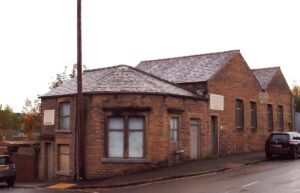
By the 1920s what was left of Arundel Street Mill had become a hall, used for many years by the Scouts, and it, the mill office and the bricked-up gateway still stand, see photo, on the corner of Edward Street and Arundel Street, one of only a handful of surviving mill buildings in a town once full of them.
NEXT – Part 10a: Old Glossop
PREVIOUS – Part 8d: Charlesworth and Chisworth – Charlesworth Mill