
Old Glossop – The Waterloo Mills
According to legend, John Wood was penniless when he came to Glossop to seek his fortune in the mills. Many other Yorkshiremen were, but not him – he already had money and experience, plus contacts in Manchester, the centre of the cotton trade. In September 1815, three months after the Battle of Waterloo, he took the tenancies of two of Robert Bennett’s empty mills, one of which had been vacant for eight years. In his first year he turned over in excess of £30,000, the equivalent of £2.7 million today, and in 1818 added the third mill, forming a group which he christened “Waterloo Mills.”
The site, though, had its drawbacks. It was sloping, and even with Bennett’s elaborate engineering there was a limit to how much power could be got out of Shelf Brook. Steam could provide more, but the coal pits were some distance away. In 1819, Wood bought Bridge End Mill, below the junction of Shelf Brook with Hurst Brook, near the intersection of the two turnpike roads at what’s now the Howard Arms, and with a large area of level ground behind on which he began to expand.
By 1823 he had the area’s first steam engine and power looms, and was building houses along what’s now High Street East. A new town had begun, at first called Howard Town, but which by the early 1840s was “Glossop.” By the time of his death in 1854 his Howardtown Mills were among the biggest in the industry.
Although he continued to live on Hope Street until 1828, by 1824 he had given up all three of his Waterloo Mills. Their life in his hands was very short, but as the site of his first cotton empire and springboard for the second, and for the new town, their historical significance is considerable.
After Wood left, they had a chequered history, with multiple tenants and long periods empty. The oldest, Thread Mill, at various times made bobbins, wadding and tape, and was an isolation hospital and a brewery (although probably not at the same time, or there would have been a queue for admission !). The second, usually referred to as Lower Water or Waterloo, acquired two steam engines but burnt down in 1879.
According to the late 19th-century historian Robert Hamnett, the third, Higher Water or New Mill, never had steam power, and this had caused it to fail before it partially burnt down in 1875, but the 1857 map does appear to show that a boiler and engine house had been built on its western end. Frequent changes of tenants and owners meant frequent changes of name, so historians have tended to confuse one mill with another.
By 1897 the whole site, including the cottages, was derelict, and by 1921 it had been cleared of buildings and grassed over, and the two lower millponds had been drained. However, unlike most of the other early mill sites in the area, it hasn’t been redeveloped, and is zoned by the planners as “open country” on the edge of the National Park, so has a degree of protection.
One of the themes of this series has been the ways in which, with varying degree of success, early millowners, from the 1780s on, tamed the powerful upland streams which were the area’s main asset. The water power systems they created, beginning with the realignment and dredging-out of the streams and the building of weirs, were often very complex.
However, there’s now little to see of this water infrastructure, and few records of it. Many of the early mills had gone by the mid 19th century, or were absorbed into bigger ones, and most sites were cleared and redeveloped in the 1960s and 70s before there was a legal requirement to make a record. Glossop Historical Society did its best, however, and this series has been largely based on its work and that of Hamnett.
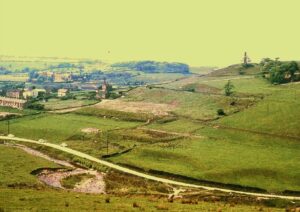
So what’s left of the Waterloo Mills ? The Historical Society photo, taken from Shire Hill in 1968 before the trees, shows John Wood’s house on the corner of Hope Street, and top right the pond for Higher Water Mill, now refilled and fringed by tall conifers. Below that can be seen the ponds for Lower Water Mill and Thread Mill, the back wall of which is still standing in part and can be clearly seen by walkers heading up Doctor’s Gate. The foundations of the mills, the cottages and the gas works are probably still there under piles of rubble.
What makes this site very rare, however, is that, as they run through the National Park, the goits which brought the water from the weirs have also largely survived – over one-and-a-half miles of them, mostly underground. These mills, of such historical importance to Glossop, are not entirely lost.
END OF SERIES
PREVIOUS – Part 10a: Old Glossop