
In the late 1890s Lord Howard arranged for some carved stones, built into a wall in Hadfield, to be removed and taken to Glossop Hall. It’s likely this was part of an effort to retrieve objects which had been taken from the Roman fort at Melandra, which the Glossop Antiquarian Society, led by Robert Hamnett, was then investigating. Hamnett, however, having consulted “eminent authorities”, concluded that the stones were “very early Christian”, and therefore couldn’t be from Melandra “as has generally been supposed”.
There are many and varied accounts of how they got into the wall, but all seem to go back to Hamnett, who in 1901 wrote of “the stones removed from the gable end of the house at Hadfield, which were found prior to 1846 at Mouselow Castle by the Rev George Marsden.” In 1904 he wrote that “In 1846 the Rev George Marsden, a retired Wesleyan Minister, was building a house in Hadfield. He got permission to get stone from Mouselow Castle, and whilst doing so discovered some curiously marked stones. These were taken away and built in the gable end of a house near the Spinner’s Arms, Hadfield.” In a Chronicle article in 1913 he said that Marsden found them “whilst digging for stone to build himself a house” and “built these stones in the gable end of a house.”
Some were later transferred to the Victoria Hall along with finds from the early Melandra excavations; others went to Manchester Museum. In 1938, when the Melandra finds at the Vic went to Buxton Museum, the stones went with them, eventually being joined by those which had gone to Manchester. They remained in store until in 1984 they were brought back to Glossop for an exhibition to coincide with the excavation of the castle on Mouselow. After they returned to the museum they were built into an arch in the new “Wonders of the Peak” display, until it was revamped in 2017.
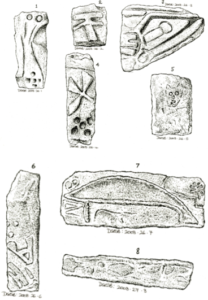
More recent experts have thought them to be Celtic, i.e Iron Age, and that they might have been part of a shrine. The problem is, though, that unless either brand new or heavily weathered through long exposure, carvings can’t be dated by appearance; experts can say they’re in the style of a particular period, and what they represent, but not whether they were carved in that period or more recently.
However, the experts agreed that these carvings showed little sign of weathering – if they were ancient, they must have been long buried. The crucial bit of Hamnett’s account is therefore that Marsden found them “whilst digging for stone”, the implication being that they were well below ground. If he’d found them on the surface, they couldn’t have been there since the Iron Age, or – given all the activity on the hill – very long at all.
In advance of the revamp, the museum got them looked at again. Their conclusions are here – https://collectionsinthelandscape.wordpress.com/2013/10/31/the-mystery-of-the-mouselow-stones/ – basically, they are more likely to be mediaeval or post-mediaeval and made by a person learning to carve; there’s evidence of machine working; and they may be associated with the late 18th/early 19th century Druidical movement which was active in the Peak District and which revived interest in Celtic culture.
So do they have any connection with Mouselow? The interest in them, and some peoples’ belief that they have supernatural powers, arises from an assumption that they were dug out of a very ancient and probably very sacred site by someone who was most unlikely to be party to a hoax. But does Robert Hamnett’s account stack up?
Next – Part 4: The Stones 2 – False Provenance?
Previous – Part 2: The Castle