
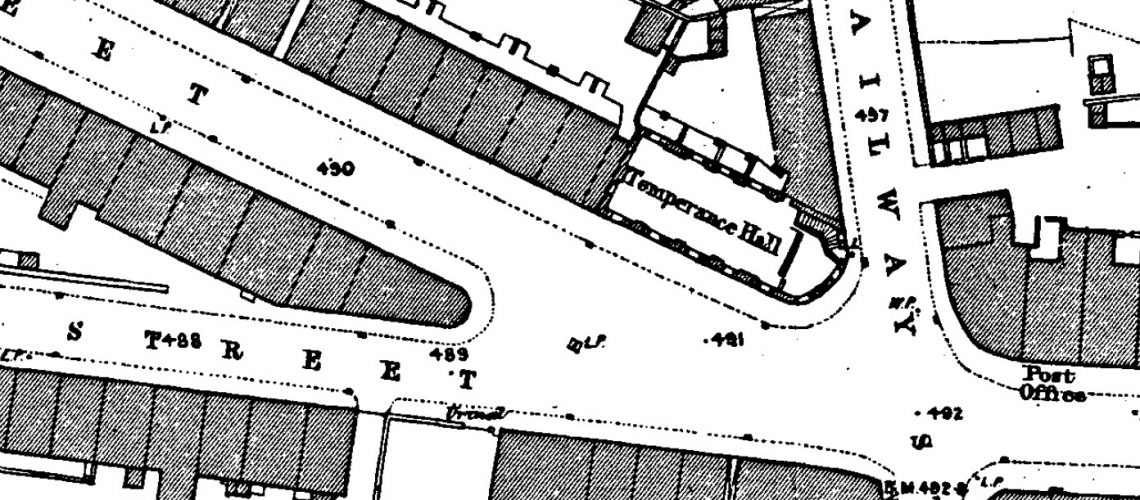
Location: Railway Street, Glossop
Opened: 1850 by the Rechabite Club
Owners: Rechabite Club/Temperance (1850-1879), Glossop Liberal Association (1879-c.1916), Glossop Labour Club (c.1916-1948), Mentors, MacArthur Beatie, Olivers, Private ownership.
Rechabites and Temperance
The Temperance Hall was built in 1850 by the Rechabite Club at a cost of £800.
The Independent Order of Rechabites was a friendly society that had been set up in Manchester in the 1830s. They were named after the Rechabites of the Old Testament. Most friendly societies met in pubs. The societies had been created to help working people with things such as health insurance and death benefits, as there was no welfare state. The Rechabites had been created by a group of Manchester Methodists to provide friendly societies with alternative meeting places to pubs. They were concerned encouraging men into pubs was harming their health and moral welfare.
During the early 19th Century the population of Glossop had rapidly increased with the growth of the cotton mills. The area around Arundel Street, Edward Street and Bernard Street, had been constructed around the 1840s and was densely populated with back to back houses. A number of pubs and beer sellers had opened nearby including The Fleece, the Bush Inn and The Lamb Inn.
The new Temperance Hall was set up in a prominent position opposite two of the pubs. It also included a temperance hotel. The hall was a hub of social activities including lectures, concerts and tea parties. It was also used to host political meetings. In 1859 a deputation from Hyde Union (cotton operatives) held a meeting to encourage the workmen of Glossop to form a branch union. The first meeting of the Glossop Co-operative Cotton Manufacturing Company was held there in the 1860s.
Liberals
Glossop Liberal Association had opened a new club room in 1871 in a building behind the Norfolk Arms. The committee of the Liberal Association at this time included many of the mill owners and business owners of Glossop including Francis Sumner, Edmund Crompton Potter, S. Kershaw, W. S. Rhodes, T. Hampson and J. Woffenden. The Association continued to grow and in the late 1870s they were contemplating adding another storey to their current building.
In May 1879 they decided to purchase the Temperance Hall and convert it into club rooms at the cost of £1,500. They showed “remarkable signs of activity” after moving into their new property.
The Liberals extended the hall to include the building along Railway Street down to the Lamb Inn on the corner of Surrey Street. They called the new hall St James Hall. It covered the whole of the top floor and included a billiard room and a club room that served alcohol. This caused a rift between the members as many of them belonged to the Temperance body. This carried on for some time and caused damage to the reputation of the Liberal Association. In 1898 a meeting was held in Victoria Hall and the two sides finally put aside their differences in a grand hand shaking and reunion.
The buildings underneath the Liberal Hall included cottages and a shop on the corner. These were also owned by the Liberals and rented out.
Labour Club
In 1913 new trustees were appointed for the Liberal Club including Herbert Partington and Major Sidebottom. The Liberals had decided that they wished to build a new club on Norfolk Square (now the Partington Theatre). The foundation stone was laid in 1914 but building of the club was then put on hold due to World War One. The new club was finally completed and opened in 1916.
Glossop Labour Club had moved into 7-9 Railway Street by the early 1920s from the rooms they rented in George Street. In 1924 they held a bazaar to help pay down their debts. They hosted many meetings and events in the club for nearly 20 years before they moved to new premises on Chapel Street.
Shirts and Furniture
In the 1950s the hall completely changed its use and now contained Mentors shirt factory and later MacArthur Beatie. They manufactured shirts and pyjamas for bigger companies.
MacArthur Beatie closed in the early 1980s and it then became Olivers selling carpets and furniture.
Eventually this also closed and the building was then divided up into private apartments.
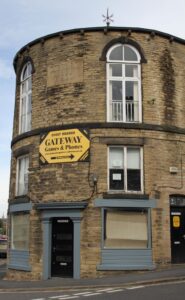
The cottages and shops on the ground floor have constantly changed over time. Hazlewood’s barbers used to own the shop on the corner for many years. There have also been taxi companies, hairdressers, vets and phone shops.
The building is one of the many in Glossop that has been used for different purposes at the same time as leaving a constant reminder of its past.
Sources
Glossop Chronicle, various dates
Notes on the History of Glossop by Robert Hamnett, compiled by Neville Sharpe (GHT Archive)