

Wesley Street
(Methodist)
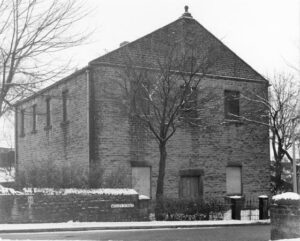
The origin of the work and its development up to the year 1913 has been well told by Mr. H. W. Houseman in his “Reminiscences of Old Glossop Wesleyan Chapel and School and its Worthies.”
The contract for Masons work was let on 13th April 1812. On 26th October 1812 glass for the windows was obtained and there was the payment of a lease of £7. 15s. 6d. The yearly rent was £1. The walls and the roof were completed on 16th November of the same year. The painters bill was £4. 10s. 11d which was paid on 16th May 1813. The bill for the woodwork for the gallery was £180 and was paid to G. Thorpe. Putting pews in the bottom section cost £57. 19s. 6d. The total cost of the Chapel was £522. 19s. 8½d. It was opened in May 1813 by Rev. John Fairborne.
In 1834 a new lease of the land allowed the Chapel to be enlarged to double its original size. At that time the pulpit stood close to the wall at the east end. On the right of the pulpit was a short seat for singers and behind the pulpit was a painted figure of Moses with the tablet of stone.
In 1869 there were more building alterations. An organ chamber and vestry were built and the figure of Moses removed. In 1871, Alexander Villa on Talbot Road, Glossop was the Ministers house. In 1890 the freehold of the site was purchased for £215. A new organ was installed in 1894 costing £200. More renovations in 1898 cost £180 when the old windows were replaced with new leaded lights. 1908-9 saw the modernisation of the heating and lighting by which time the Chapel was free from financial encumbrance.
Circuit Superintendents:– 1912-1915 J. Walker Duthie; 1915-1918 James Archer; 1918-1921 E. Douglas Jackson, B.A.; 1921-1924 Thomas G. Squire; 1924-1927 W. H. Oliver Lake; 1929-1932 J. Claude Whiting; 1932-1935 Snowdon Walsh; 1935-1935 Frank Metcalfe; 1938-1945 Harold W. Stephenson; 1945-1949 Frederick John.