
High Street West
(Wesleyan Methodist)
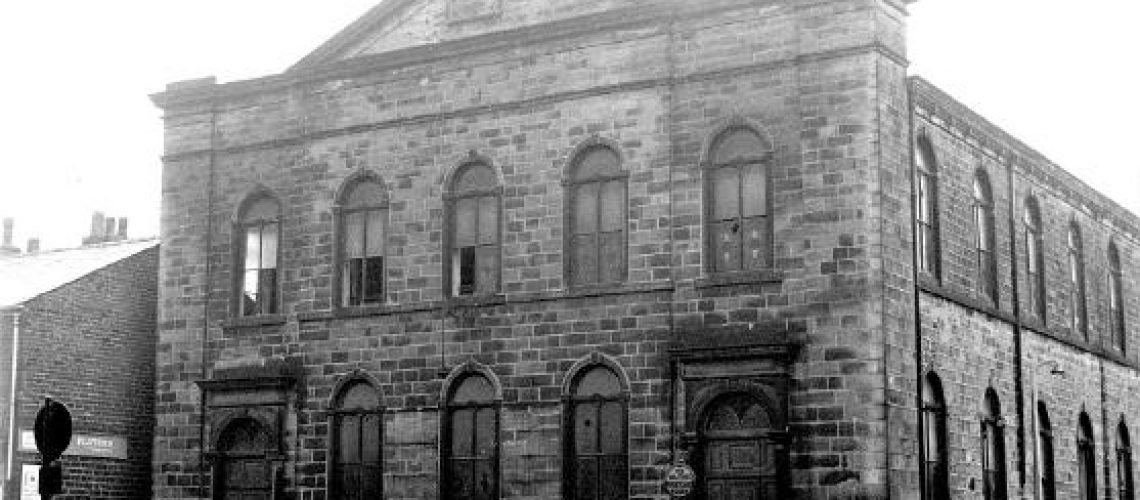
This is by far the largest Chapel on the Circuit centrally situated, and known to Glossopians of all denominations as “Big Wesley”.
The first preaching’s were at a cottage at Wrens Nest, then a room was taken over some stables but the place proved too small and inconvenient. The old Shepley Mill had ceased working and the bottom room was taken and converted into a preaching room and Sunday School.
The first Wesley Chapel was projected in the old mill bottom. On Good Friday 1844 the foundation stone was laid. There was a procession joined by about two thousand people. Medals were struck for the occasion. The ceremony was performed by the Venerable Rev. George Marsden assisted by Rev. John Randerson and Rev. J. D. Brocklehurst. The architect was Mr. Joel Buxton.
The Chapel was large enough to accommodate about 500 worshippers and had a small school room behind it where a Sunday School was carried on. The congregation increased so rapidly that in a few years the place was too small. A larger Chapel was greatly needed, subscriptions were raised and plans obtained for carrying out the contemplated design. There arose a difference in opinion in the congregation as to what would be the most desirable thing to do – whether to enlarge the Chapel or build a new one. This caused considerable delay. The difficulty was overcome by the counsel of the Rev. Benjamin Frankland. Mr. Frankland came into the circuit in 1859. He was a practical architect. In various parts of the country he had superintended the enlargement of Chapels and the building of new ones. The Wesley case was at once laid before him and after duly considering it he declared it would be best to build a new Chapel. This settled the matter and preparations were commenced.
The second Wesley Chapel, erected on the old site was also commenced on a Good Friday. The Rev. Benjamin Frankland was the architect. It was a large and commodious building containing about 1500 sittings. The foundation stone was laid by S. Turnbull Esq. of Manchester on Good Friday 1858 and on the same day a year later it was duly dedicated by Rev. Thomas Llewellyn.
The workers and standard bearers at Wesley have been legion and it is worthy of note that William Robinson took an active part in the building of both the first and second Chapels and at the latter his sons rendered Yeoman service. The Neilds, Atkins, Woodcocks, Hunters, Leeches, Dearnaleys, Olivers, Holdgates, Ernills, Hydes, Woods, Hadfields, Dixons, Nelsons and many others are honoured names.
The Fieldings, for several generations a talented musical family had wielded the baton at Wesley every since it was built. Mr. Enoch Fielding was born at Valehouse in 1823, he came into Glossop in 1844 and for 34 years he was honorary organist at Wesley Chapel. Mr. H. Fielding succeeded his father at the age of sixteen.
In 1892 a Grand Naval Bazaar was held to raise money for repairs. It was opened by the Mayoress of Glossop, Mrs. Wood of Moorfield and Mr. Hadfield of Cheadle. There were musical events, waxworks and museum and oxy-hydrogen lantern show. It was called a Naval Bazaar because all the stalls were decorated like ships.
Here in 1912 was installed a magnificent organ upon which from time to time famous executants have performed. It is best remembered for “Messiah” recitals between the wars.
The Chapel closed on August 28th 1960 when there was a reorganisation of Methodist Chapels and the congregation transferred to Central Methodist Church, Chapel Street, Glossop.