
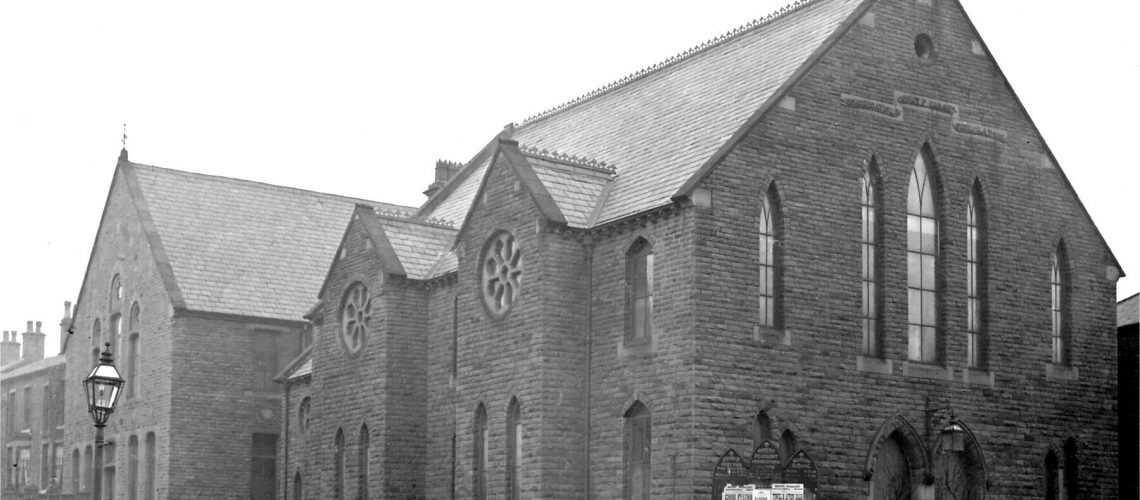
Princess Street / St Mary’s Road
(Congregational / Independent)
In 1858 , Fourteen people – eight men and six women banded together to form a Church. This number increased quickly to 23 and they met together in a room at Charles Street, Glossop. Membership increased so quickly however that the room was soon too small and larger premises were sought. The main cause of such a rapid increase in the congregation was probably the strong evangelistic nature of the work. In order to accommodate the extra members arrangements were made whereby services could be held in the Temperance Hall which was later used as a Labour Club.
Ten years from the commencement of the cause the present church was erected. The foundation stone was laid on May 23rd 1868 by Henry Lee Esq. of Manchester with the Rev. G. Conder, Professor F. S. Williams and the Rev. R. Stanton taking the Ceremony. Twelve months later the building was opened for Divine Worship.
When the debt on the Church was cleared the congregation began a scheme for building a school. They were successful and on Good Friday 1875 the foundation stone of the Sunday school was laid by Henry Flint Esq., founder of the Church. Henry Flint died in 1878. On 17th November 1896 an organ was installed and dedicated.
Membership of the Church and School rapidly increased and the men’s class had a membership of 50 and was turned into a Brotherhood. There was a Band of Hope with upwards of 250 members.
A memorial to the memory of Mrs. Deborah Higginbottom, wife of one of the first members and donor of the Manse, was erected in the Church in 1915.
The first World War took the lives of eight members of the Brotherhood. They were: Privates Fred Bradbury, Herbert Taylor, Walter Taylor, George Haughton, Robert Hague, Louis Hadfield, Tom Haughton, Arthur Haughton, Frank Cartwright and Arthur Sandham. The five windows in the front of the Church and a tablet were given in their memory by the congregation at a cost of £400.
In 1918 a men’s institute was formed and soon afterwards a cricket club. In 1920 an illuminated address was presented to Mr. Ellis Dewsnap, the oldest member of the Church and a life deacon. In the years 1964 – 1965 £600 was spent on interior decorations and a further £400 on outside repairs and improvements.
The second World War took the lives of three more members of the Church, they were: George Casey, John Hoyland and Stanley Russell.
Ministers: The first Minister was Rev. R. Stanton followed by, W. Telfer (1860-1862), J. Jones (1871-1873), C. Robinson (1875-1876), J. K. Kirby (1878-1898), M.Hindles (1899-1901), S. Skelhorn (1902-1909), A. W. Goodwin (1909-1947), J. I. Price & A. Oldfield ( 1949-1952), L.N. Cooper (1952-1954), J. Henderson (1955- ?).
A special service took place on April 28th 1908 to celebrate the Jubilee Year of the Church. The Centenary of the Church was celebrated in April 1958.
The Church is closed and is now a private residence.