

In the early 1890s the Glossop Carriage Company started to run a horse drawn bus from the Norfolk Hotel to the Commercial Inn at Bankbottom in Hadfield. However, it only ran three times a day and public transport to serve the mills, the growing town centres and the areas where mill workers lived did not arrive until the tram service started in 1903.

Development of the internal combustion engine during the first world war led to motorised buses becoming a practical proposition. The North Western Road Car Co. Ltd. was formed in 1923 and saw an opportunity for public transport services in the area. The tram service ran in a restricted area and anyone wanting to go by road from Glossop to Hyde or Stalybridge, had to walk from the tram at Woolley Bridge to either the Hyde tram terminus or through “The Cutting”.
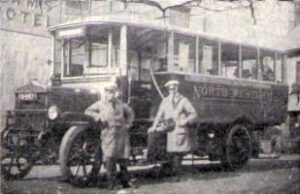
North Western was able to introduce a service between Hyde and Glossop but because the running power in Glossop (licensed by the borough council) belonged to the Urban Electric Supply Company, Ltd., the buses were prohibited from picking up passengers on Glossop’s streets. As a result the red buses started from the Norfolk yard at Glossop and ran to the Norfolk yard at Hyde, passengers only being booked for the full journey; people entered the bus in the centre of Glossop and dismounted in the centre of Hyde. What the company as able to do, though, was to opened up the road to Buxton and the intermediate villages, making it much easier to travel from Glossop.
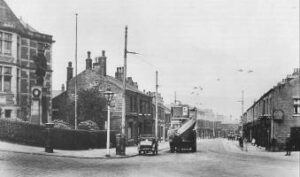
A significant change occurred only a few years later. The costs incurred by the tram service had outweighed the revenue it received for several years and, in 1927, the Urban Electric Supply Company offered to sell the company to the council. After several months of negotiation the council decided not to purchase, even though the price had dropped to about a quarter of the sum first asked by the company. As a result the company announced that it would cease to provide a service on Christmas Eve 1927.
That caused a dilemma for the people of the local folk, who were used to travelling between Glossop and Hadfield by tram rather than walking “o’er t’ top” as their parents and grandparents had done. In ceasing the tram service the Urban Electric Supply Company had relinquished its running powers, meaning there was now no obstacle to prevent the North Western buses picking up passengers in the streets, but the red buses ran only to Hyde and Buxton. The council called a special meeting, to which it invited the North Western director, George Cardwell (who later became chairman of the Road Passenger Executive). Mr. Cardwell had no hesitation in agreeing to the request of the council that he should organise bus services in the town to start operating immediately the trams cease. There was no break in continuity, and no inconvenience to Glossop. A number of the tram conductors were immediately employed by the North-Western to work on the buses.
The one organisation which was upset was the Glossop Carriage Company which felt that, having run horse buses in the past, it should have an opportunity to run the new services. It was clear that the Carriage Company was not large enough to run a service alone and it was thought that the competition arising from licensing both companies would cause a menace on the roads. Despite persistent applications from the Carriage Company for permission to run a local service, the council held firm and granted licences only to the North Western Company.
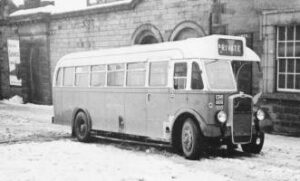
Three photos of winter conditions in the 1940s.
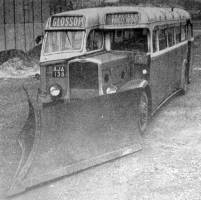
In the severe winter of 1947 the council tried using the plough pictured in the first photo but had difficulty in finding a suitable vehicle to attach it to and then, having done so, in manoeuvring the plough. The council decided that the best vehicle the plough could be attached to was a bus and they asked the North-Western Road Car Company for help. Only too eager to obtain a better plough the company jumped at the offer. The plough added another half length to the total length of the bus and made driving more difficult but staff thought that provided they could get round corners all right the plough would be the answer to their snow troubles.
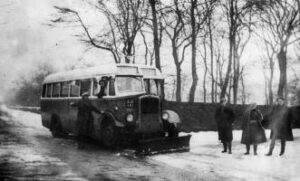
The second photo shows the more normal type of plough attached to buses whilst the third photo shows a bus having no difficulty waiting at Glossop Station, despite the snow.
The Glossop Official Handbook of 1948 tells us:
Town services are provided by the North Western Road Car Co. Ltd., as follows:
Index No. 6, Old Glossop (Queen’s Arms), Glossop (Town Hall), Dinting, Woolley Bridge, Bank-bottom and Hadfield Station;Index No. 7, Glossop (Royal Oak), Tintwistle and Hollingworth via New Shaw Lane and Hadfield, and via Arundel Arms (for Cemetery), Hadfield, Tintwistle and Stalybridge;
Index No. 8, Whitfield, Padfield, via Dinting Vale before 10 a.m. and Dinting Road after 10 a.m.;
Index No. 9, Glossop (Norfolk Arms), Junction Inn and Simmondley.
Frequent services to Manchester via Stalybridge and Ashton-under-Lyne and to Hyde via Mottram; also a service to Buxton via Hayfield and Chapel-en-le-Frith.
Bus Offices, 4 High Street East, Glossop.
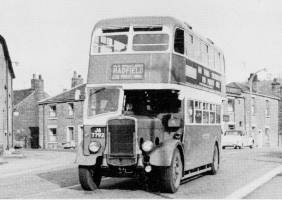
A double decker on the 128 service pictured on High Street East near the Commercial. Buses on that route were low profile to fit under the Waterside Branch bridge at Brookfield.
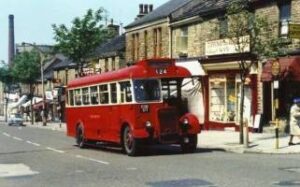
In the Official Handbook of 1957 we find:
Town services are as follows:—
Service No. 128 Old Glossop to Hadfield Station (via Wooley Bridge or Hadfield Road).
Service No. 128a Whitfield to Padfield (via Dinting Road).
Service No. 129 Glossop (Town Hall) to Simmondley Village.Out of town services:—
Service No. 127 Royal Oak (Sheffield Road) to Stalybridge (via Newshaw Lane and Hadfield).
Service No. 127a Royal Oak to Stalybridge (via Cemetery Road and Hadfield).
Service No. 125 Glossop (Norfolk Square) to Manchester (via Hyde).
Service No. 6 Glossop (Norfolk Square) to Manchester Lower Mossley Street (via Stalybridge and Ashton).
Service No. 85 Glossop (Henry Street) to Buxton (via Hayfield, Chinley and Chapel-en-le-Frith).
Service No. 124 Glossop (Henry Street) to Marple Bridge (via Charlesworth and Chisworth).
Service No. 39 Manchester to Sheffield bus (via Snake Pass) goes through Glossop, summer months only.
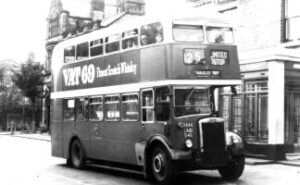
The forecourt outside the Norfolk Arms was used as a terminus for many years. Crews could control a special traffic light to enable them to leave without difficulty.
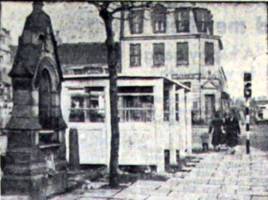
At the time it was hailed as both improving amenities and blending well with surrounding buildings.
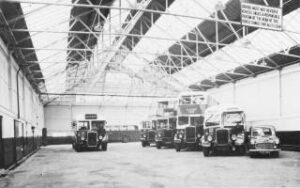
North Western was the dominant bus service provider in Glossop for over 40 years, operating from its depot in York Street, until the advent of the National Bus Company 1 January 1969, with only some out of town services being provided by the Stalybridge, Hyde, Mossley & Dukinfield Joint Board and Manchester City Transport.
 |
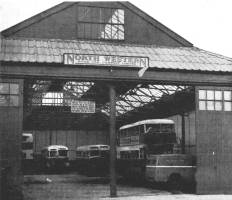 |
| Two scenes from the York Street Depot | |