
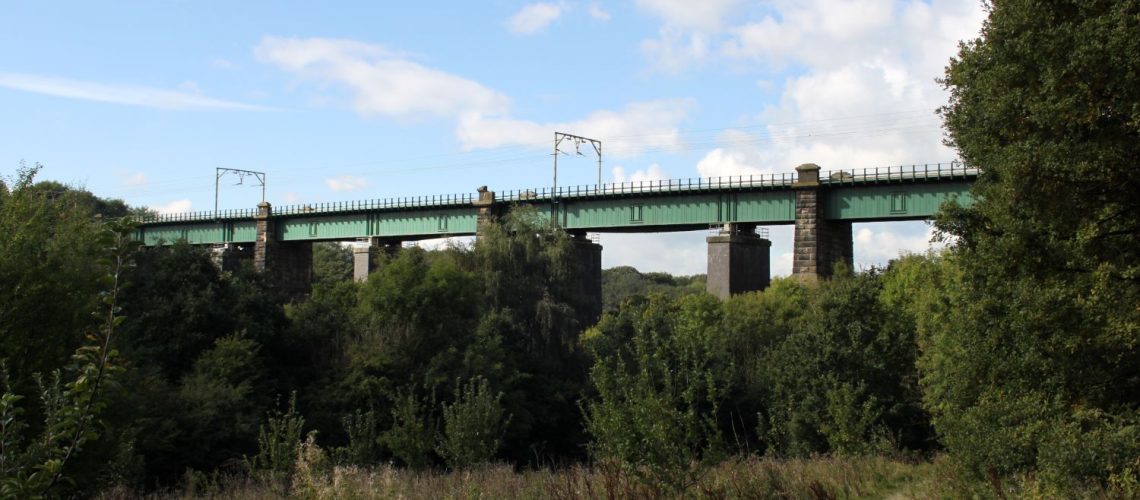
In 2022 Kate Raine from Glossop Heritage Trust and Lauren Riley from Lauren Riley Design hosted a walk and talk as part of the Glossop Creates Wan.der series. The walk looked at the history of Edmund Potter and the Dinting Vale Printworks and the textile industry in Glossop.
Walk Map – Part 1
The walk begins on Glossop Brook Road. If you enter Glossop Brook Road at the junction between Tesco and Wren Nest Mill retail park. Carry on up the road until just pass Kingspan on your left and Burger King on your right.
DIRECTIONS – Follow the public footpath by the side of Glossop Brook Business Park.

DIRECTIONS – Walk along the path, with the buildings on your right. Then turn right and walk up the hill. Then turn left and follow the path with the railway on your right. After a short while stop and look over at Simmondley and the Nab.
Simmondley
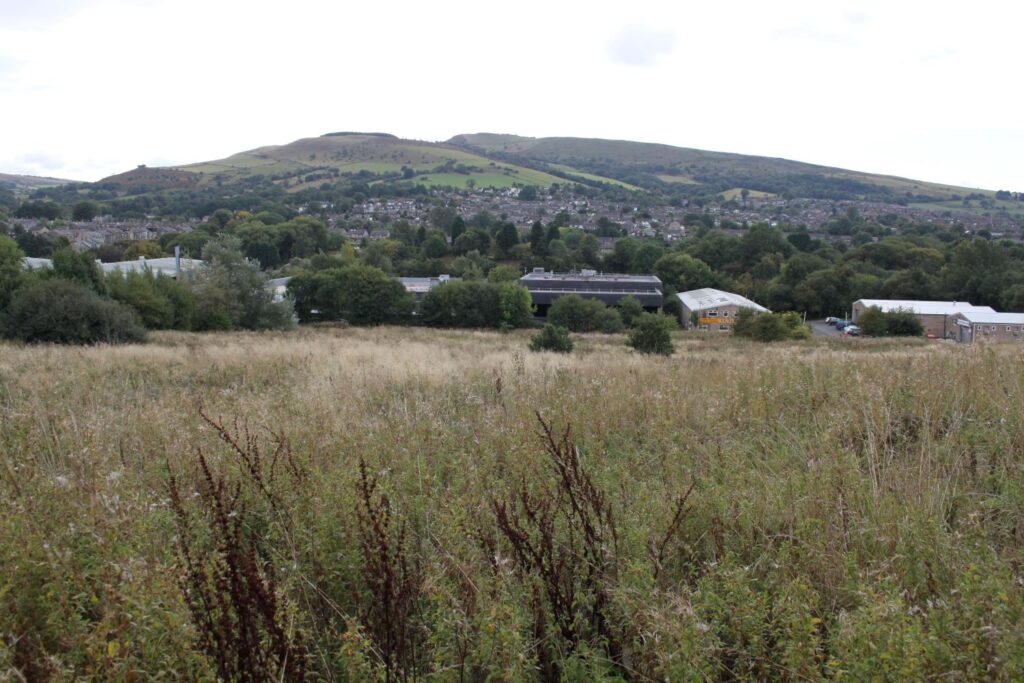
In the distance you can see Simmondley with the Nab rising behind it. Simmondley is where the story of Dinting Vale Printworks began. In the 1820s, it was a small hamlet with pubs, weavers’ cottages, farms and an old hall.
Joseph Lyne of Simmondley Hall built two cotton mills in 1817, Simmondley Mill and Lower Mill in Dinting. The Lower Mill was never worked and remained empty. It was eventually put up for sale by Moses Hadfield in 1823.
DIRECTIONS – Walk ahead a little way and then stop and look back towards Glossop.
Glossop and Wren Nest Mill
 |
 |
| Look back towards Glossop. You can see some prominent buildings in Glossop such as the Town Hall clock, Howardtown Mills and St Mary’s Church. You can also see the remaining building of Wren Nest Mill. | |

The site of Wren Nest Mills used to be larger than it is today. It covered the area that is now Tesco, Kingspan, Wickes and the retail park. The original mill was built by Thomas Ellison in 1815. Thomas and his father, Matthew, were agents of the Duke of Norfolk and lived at Glossop Hall.
In 1827 Francis Sumner, Thomas Ellison’s step nephew, took over the running of the mills. He introduced steam engines and power looms. Francis Sumner was the owner of Wren Nest Mill until he died in 1884. His company then carried on running the mills. For this reason, the mill complex was also known as Sumner’s Mill.
Wren Nest Mills was one of the largest mills in the area and alongside Waterside Mills in Hadfield and Howardtown Mills in Glossop they produced coarse grey calico, which Edmund Potter then printed colourful designs on to at the Dinting Printworks.
DIRECTIONS – At the crossing go straight ahead, with the houses on your left and the railway line on your right.

DIRECTIONS – Walk straight ahead and stop just before the next crossroads.
Dinting Mill

In the distance you can see the factory site where Dinting Mill used to be, before it was demolished in 1960s. It was built as a cotton mill in around 1804 by the Wagstaffe brothers.
It had a small group of cottages around the mills where the workers lived. In 1831 it was turned into a paper mill. Edmund Potter successfully sued the owner Mr Oliver for polluting the water. The business fell into bankruptcy and Potter purchased the mill in the 1840s. We come back to the history of Dinting Mill in part 3.

DIRECTIONS – At the crossroads go straight ahead. The railway line is on your right.

DIRECTIONS – Walk straight ahead until the path splits in two. Take the left fork. Dinting Allotments will be on your left.

DIRECTIONS – Stop when you see the spire of Holy Trinity Church, Dinting directly in front of you on your left.
Dinting
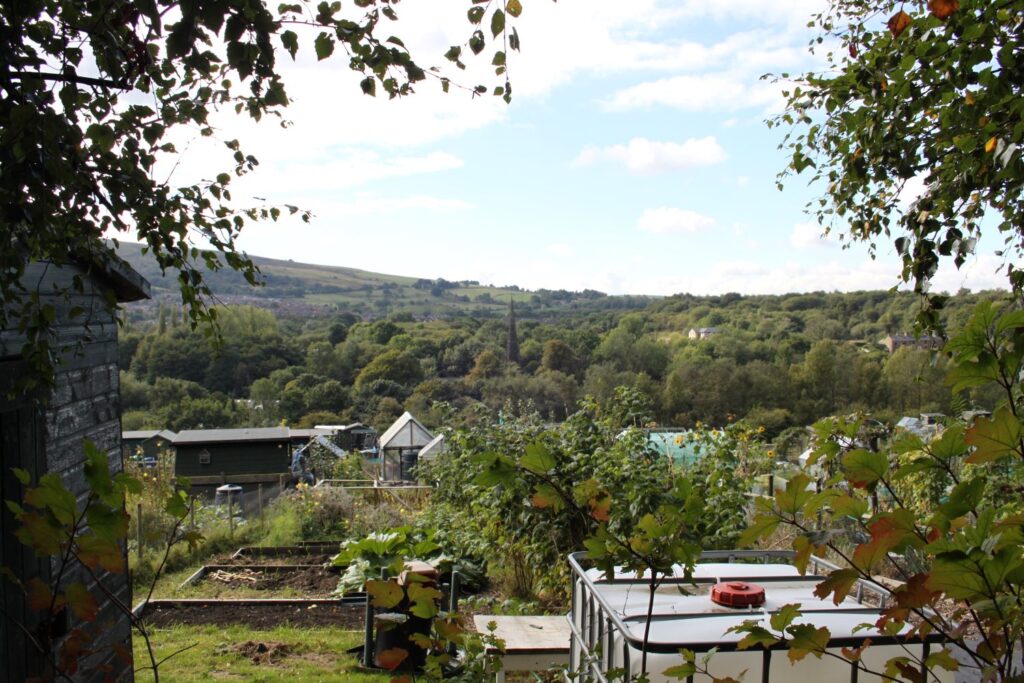
The village of Dinting that we know today developed after the Printworks were established. The old hamlet of Dinting is what we know today as Higher Dinting at the top of Dinting Lane.
The landscape today is covered with trees but this was not always the case. This picture showing Dinting around the 1930s shows a rough and open land with very few trees.

DIRECTIONS – Follow the path ahead through open grass. When you reach the top of the hill look ahead at Dinting Arches before you descend.
Dinting Arches

This painting has often been attributed to Joshua Shaw, a 19th Century painter. More recent research suggests it was painted by the landscape painter, Thomas Christopher Hofland of Derby. Looking out to Dinting Arches now, this picture can help you to imagine the landscape before the railway arrived.
In the foreground of the painting, to the left, you can see ‘Boggart Mill’. This was the Lower Mill in Dinting that had been put up for sale in 1823. It was purchased in 1825 by the young entrepreneurs and cousins, Edmund and Charles Potter to start their calico printing business.
The mill had been named Boggart Mill by the locals, who believed the mill was haunted. It was on a dark and lonely road and had been empty since it had been built seven years before. People could hear owls hooting in there at night when they walked past, if they dared!

Edmund Potter was a great supporter of the railway and instrumental in its arrival in Glossop. He believed it would open up trade “…the railway became necessary, capital forced it, made it, and it removed us from the position of a wild moorland district to an adjunct of Manchester. It cheapened our carriage and saved our time.”
The Sheffield, Ashton Under Lyne and Manchester Railway was begun in 1838, reaching Glossop at what is now Gamesley in 1842. Dinting Arches were completed in 1844 and made from laminated timbers. These had to be strengthened with iron griders in 1860 due to the amount of heavy traffic travelling over the viaduct. In the early 20th century it was strengthened again with additional brick pillars.
DIRECTIONS – follow the dirt path down the steps and across the small wooden bridge.

DIRECTIONS – You will now find yourself underneath Dinting Arches.

Edmund Potter was one of the invited guests to travel on the first train from Manchester to Sheffield on 8 August 1844.
In 1846, Potter paid 600 of his employees a days wages and shilling, as a treat, and sent them on the train to Ardwick. From here they went in procession up Oxford Road, Mosley Street, Market Street to St Ann’s Square with a band in front. They then dispersed and enjoyed at day in Manchester before returning to Glossop by train later that night.
DIRECTIONS – Follow the path until it comes to a fork with a path straight ahead across a bridge and back to the road or a path to the right which runs alongside the reservoir.
Part 2 follows the right hand path (alternatively, you can leave the walk here or cross the bridge in front of you to the road and follow part 3 back into Glossop)