
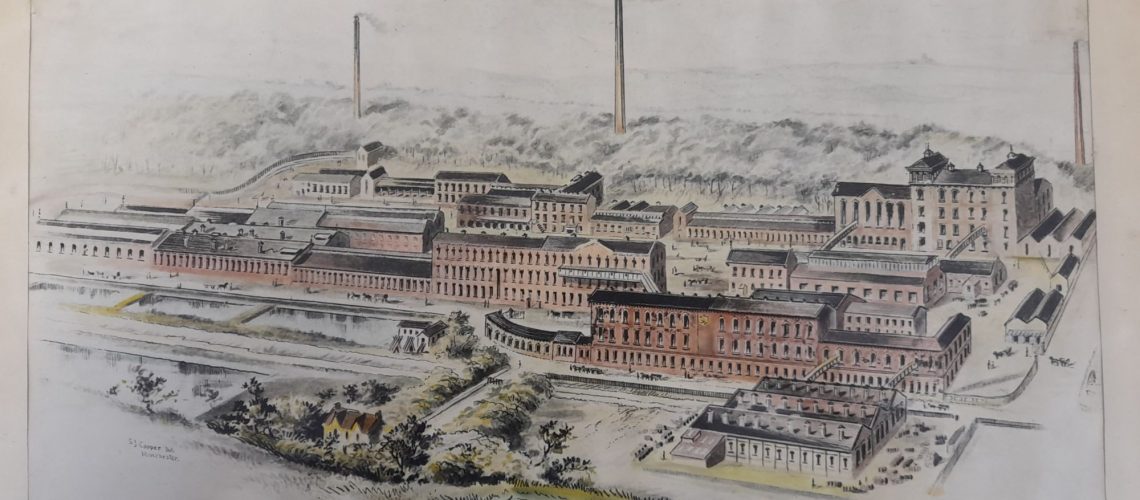
In 2022 Kate Raine from Glossop Heritage Trust and Lauren Riley from Lauren Riley Design hosted a walk and talk as part of the Glossop Creates Wan.der series. The walk looked at the history of Edmund Potter and the Dinting Vale Printworks and the textile industry in Glossop.
Walk Map – Part 2
DIRECTIONS – From where you stopped at the end of part 1, follow the path to the right, before the bridge.

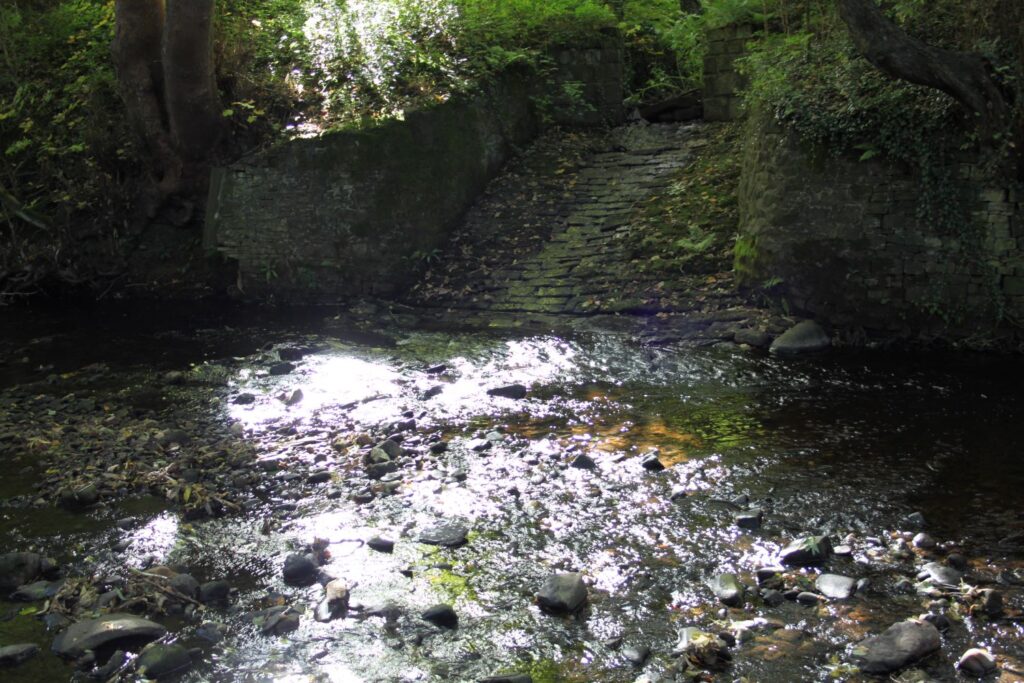
DIRECTIONS – You will come to a small mound just before the reservoir with the remains of a weir coming into the brook opposite.
Reservoirs
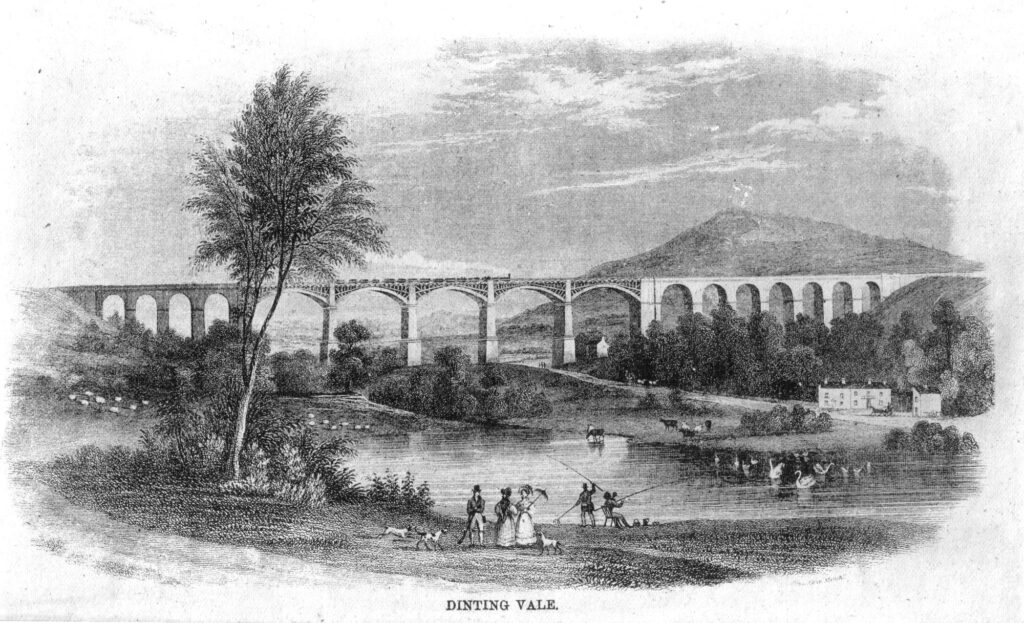
Water was the reason the Manchester millowners came to Glossop. The steam powered machinery that were utilised in the big mills from the 1820s made the difference from the earlier failures in the cotton industry in this area several decades before.
The millowners changed the natural water course all over the valley. They added weirs, sluices, goits and ponds to control the flow of water and ensure that they always had a constant supply.
Water was used for many different processes such as bleaching, washing, dyeing and using in boilers to create steam power. For processes such as washing and dyeing they needed the water to be clean and good quality. There were many legal suits over water quality between millowners up and down stream.

DIRECTIONS – Turn right and walk down the path with the brook on your left and the reservoir on your right.

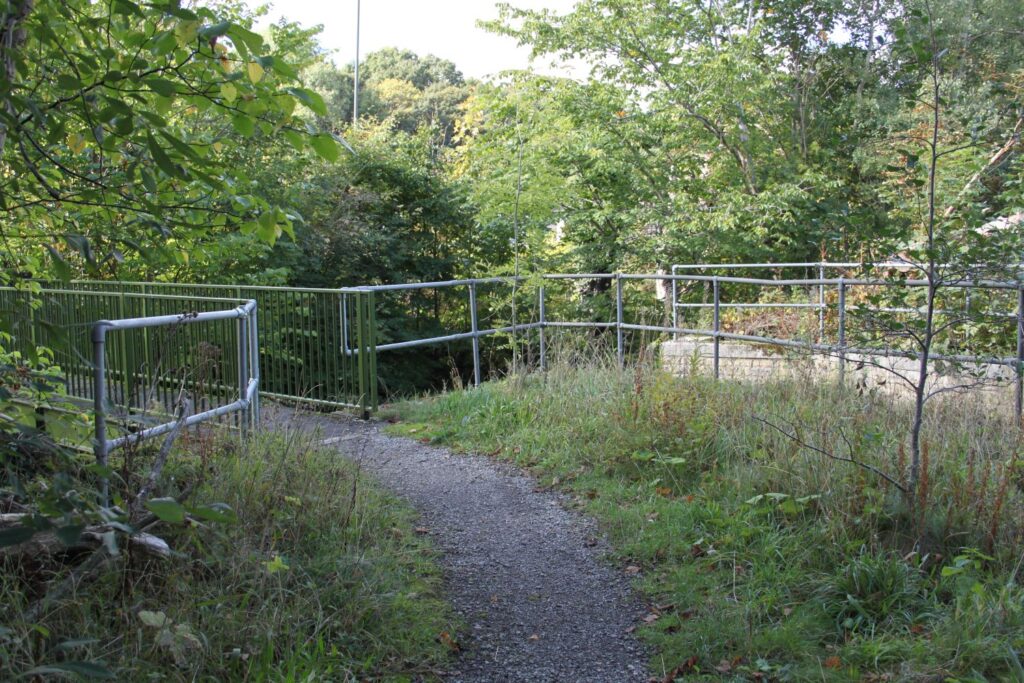
DIRECTIONS – Follow the path past the factory (Carpenters) until you reach this bridge (pictured below). Turn to look at the factory. This area was once the entrance up to Dinting Lodge, which is now underneath the factory.
Dinting Lodge

Dinting Lodge appears on the 1838 one inch OS map and was probably built around 1837. Its first recorded occupant was Alfred Gee and his family. Alfred was the chief engineer of Dinting Arches. The house was probably built by Edmund Potter for the engineer while he was building the railway. Edmund moved his family from Manchester to Dinting Lodge sometime in the early 1840s, probably after the railway had been completed.
It was a grand and luxurious house in a wooded copse called Potter’s Wood. There was boat house on the reservoir at the back of the house, so they could row out on the lake.
All the Potter children spent some of their childhood at the houses including Rupert Potter, father of Beatrix Potter the author of Peter Rabbit. It is unknown if Beatrix ever visited Glossop. Most of the family had moved to London or Manchester by the time she was born and she never mentioned visiting in her surviving letters or journal. She did correspond with Edmund Potter and Company and used some of their fabric samples to cover her portfolio. You can read more about this on Lauren Riley’s blog.
Many of Edmund’s friends and acquaintances from Manchester will have visited the house including William Gaskell, Richard Cobden and John Bright.
Edmund moved to London in the 1860s when he became the MP for Carlisle. In 1866 he also built a new home, Camfield Place in Hertfordshire, where he spent his later years. His son Edmund Crompton Potter then ran the printworks and lived at Dinting Lodge. By the 1880s the house was being lived in by the manager of the works. Later it became a private residence and for many years it was lived in by Dr Milligan, the Medical Officer of Health. Dinting Lodge was demolished in 1960s, with just a few structural foundations remaining in the woods for many years before Carpenters was extended.
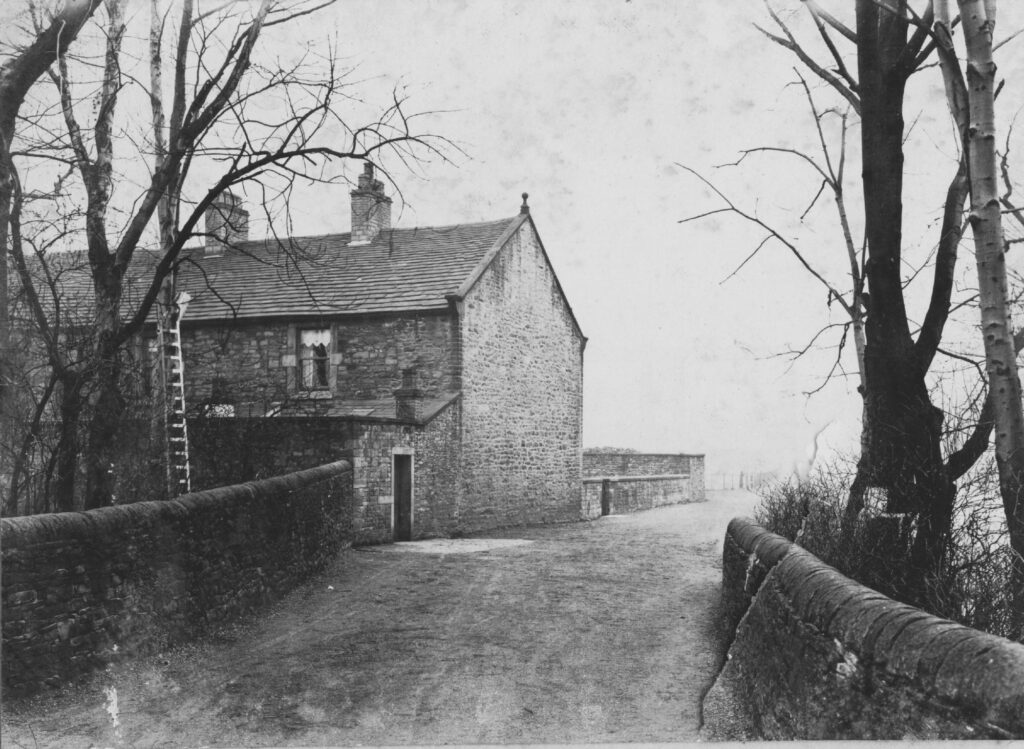
Closer to the road by the bridge you are standing at now were cottages for coachmen and gardeners. These later became private residences. They were derelict for a number of years in the mid 20th Century before being converted into one property in 1980s. This was later demolished to become part of Carpenters.
DIRECTIONS – Cross over the bridge back to the main road. On your left is Dinting Vale House.
Dinting Vale House

Dinting Vale House holds our blue plaque to Edmund Potter. It was built in 1827 by Moses Hadfield. In the early days of the Potter’s business, Edmund lived in Manchester. His cousin Charles lived here with his young family to oversee the day to day running of the business.
When the business failed in 1831 mainly due to the failure of the calico printing factory in Over Darwen, which was owned by Edmund’s uncle, Charles’ father. After this Edmund took over the business at Dinting by himself and worked the business out of debt. Charles returned to Over Darwen and set up a successful wallpaper printing business.
Dinting Vale House was later occupied by other managers before becoming part of the works as offices and a canteen.
DIRECTIONS – Stand on the pavement and look up and down the road to view the buildings that remain from the Dinting Vale Printworks. Turn left and follow the pavement back towards Glossop.
Dinting Vale Printworks
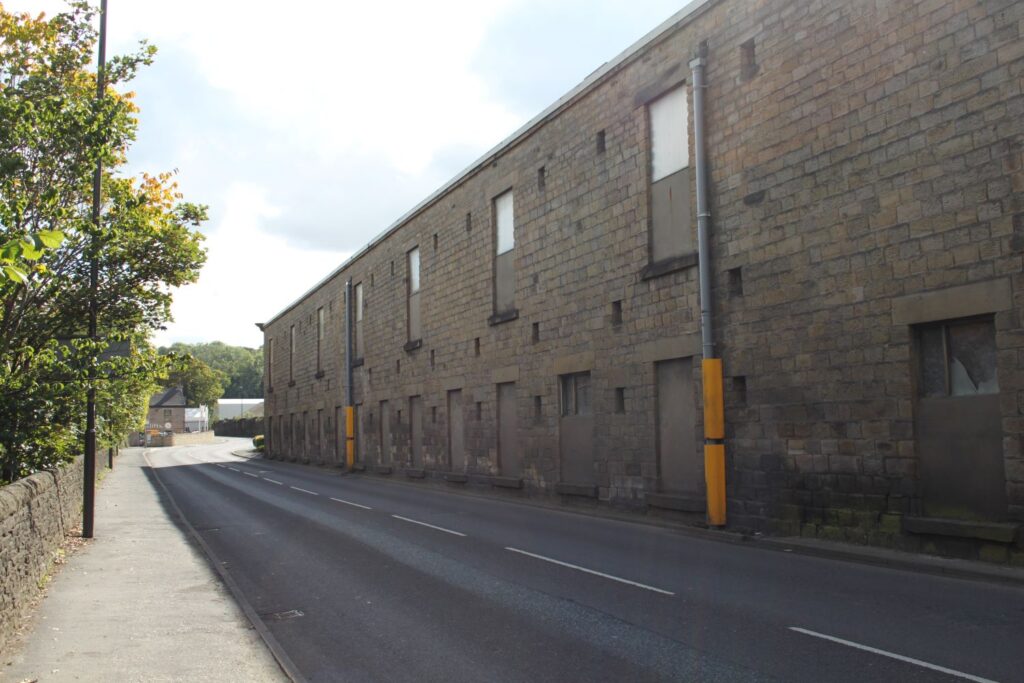
Little remains of the enormous site that once was Dinting Vale Printworks.
When Edmund and Charles first arrived at Boggart Mill in 1825, calico printing was done by hand with wooden blocks. After the business failed in 1831, Edmund began switching to machine printing.

This involved a machine with patterns engraved on copper rollers. The calico ran through the machine and around the rollers where the patterns were printed on for each colour. Machines could print 16 colours at once. Lauren Riley’s blog contains some of the many bright and intricate pattern books of the printworks.
In 1840 Dinting Print Works had 117 hand block tables and 4 machines. By 1851 the had no hand block tables and 24 machines.
There were different parts of the works for different processes including bleaching, dyeing including a colour laboratory, room for engraving copper rollers and machine rooms.

Potter’s success was very much down to this decision to move entirely to machine printing and after the arrival of the railway in 1844 he had the capacity to expand. Potter was printing on calico produced at Waterside in Hadfield as well as Howardtown Mills and Wren Nest Mills in Glossop.
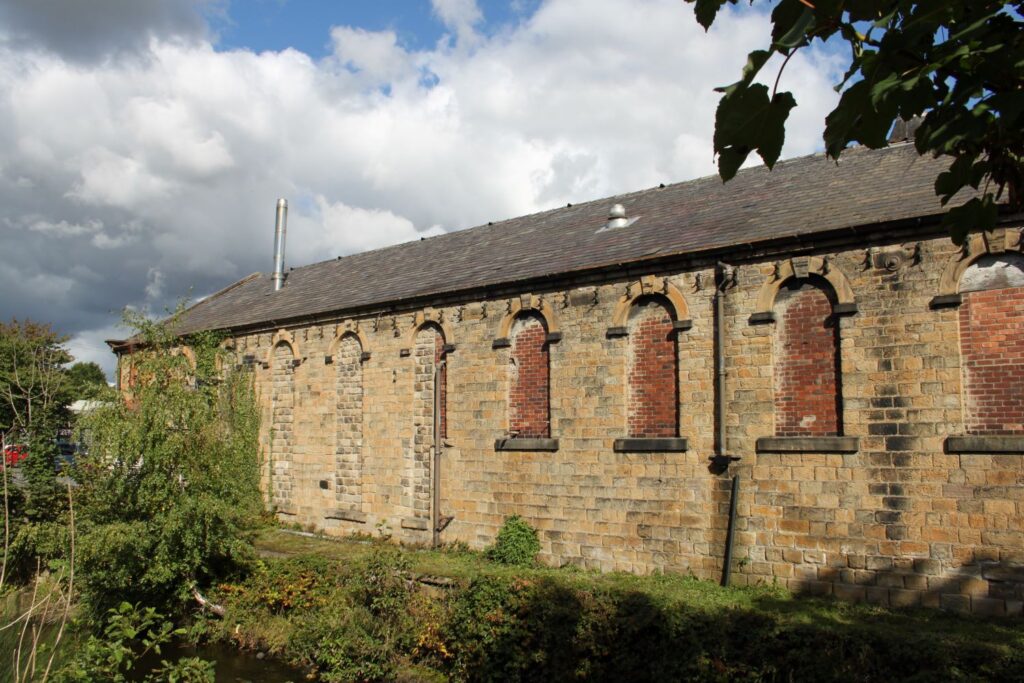
During the cotton famine in the early 1860s, Potter decided to take a risk and underwent a massive building programme, which carried on for most of that decade. This was also to give his workers some employment while the factory was closed. He diverted the road to its present course and built a new print shop with 25 new machines. He built another reservoir, engraving department and a new bleaching department (now part of Carpenters – pictured below).
By the 1870s he claimed to be the largest calico printing factory in the world. Edmund Potter retired from the business in 1873.

At the time of Potter’s death in 1883:
The site at Dinting Vale covered 7 acres and the reservoirs 10 acres.
2 million gallons of water were used a day.
25 boilers consumed around 80 tons of coal.
1000 people were employed.
51 machines produced one and a half million pieces (of 30 yards) annually which was enough calico to encompass the world.
In 1891 after the death of Edmund’s wife Jessy Potter, Edmund Potter and Company became a Private Limited Company. It joined as part of the newly formed Calico Printers’ Association in 1899. The business finally closed in 1966.
Library and Reading Room

“I believe there exists in almost every thinking class of society, an honest, benevolent wish, to try to better the world, to educate, civilise, refine and embellish. In fact, the object of all of us ought to be, to leave the world better than we found it.”
Edmund Potter, Picture of a Manufacturing District, 1856
Edmund Potter was concerned about the welfare and education of his workers. Just inside the entrance to the Printworks was a library and reading room, which had been built in 1845. This provided an excellent assortment of books on subjects such as religion, science, history and travel as well as newspapers and periodicals. The librarian for many years was Thomas Barlow, who was an employee at the Printworkers, but also a published poet known as “The Bard of Longdendale”. Barlow’s book “A Pic-nic at Woodhead: Scenes Around Castleton; and Other Poems” published in 1867, was dedicated to Edmund Potter.
DIRECTIONS – Follow the road with the reservoirs on your left. On your right the site of Printworks ends. The unusual shaped building just after this was the Toll Bar for the Glossop to Marple Turnpike road. On the other side of the road was the former Plough Inn.
Toll Bar and Plough Inn

Dinting Printworks was sited well on all the major turnpikes. Edmund had described Glossop in 1856 as “Glossop is singularly situated: it is now near the Manchester markets, and yet fifty years ago was distant, in fact separated by bad roads, – an almost inaccessible place… ”. By the time he arrived Boggart Mill was on the main turnpike from Sheffield to Manchester (now A57).
The oddly shaped building in front of you was the toll bar for the Glossop to Marple turnpike that was opened in 1804. It was called the Nursery Toll Bar as behind it was the nursery plantation owned by the Dukes of Norfolk.
Opposite the toll bar was the Plough Inn. Samuel Bennett acquired a lease to land here in 1832 and was granted an alehouse license in 1844. This pub was well used by the workers at Dinting Printworks.
DIRECTIONS – Follow the road towards Glossop. Walk underneath Dinting Arches. Just after is a house opposite called Viaduct House above the door.
Viaduct House

This house was one of many that were lived in by managers of the Printworks. There are other managers’ houses such as those on the Shaw and a few in Dinting Vale. In 1871 and 1881 census, James Humphreys, a sub manager lived here. After this the cashier of the Printworks, Charles Hadfield, lived here for a many years.
End of Part 2
You can carry on to part 3 of the walk that takes you back into Glossop (alternatively you can leave the walk here)