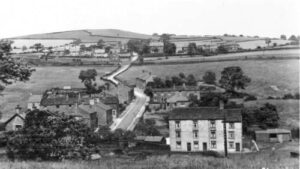
The Hamlet of Dinting by Robert Hamnett
This page is based on the notes of Robert Hamnett, originally published as an article in the Glossop Advertiser in 1913. The first authentic information
DINTING is a small scattered village and hamlet, usually called Higher and Lower Dinting, situated near the Glossop railway branch, 1 mile W. from Glossop, on a fine eminence, which commands a rich view of the vale and the surrounding district. It contains 584 acres of land, and had in 1851, 133 houses and 670 inhabitants, of whom 341 were males and 349 females; rateable value £2369 6s. 8d.
The principal part of the inhabitants are at Dinting Vale, a small village which connects itself with Green Vale, at the Junction Inn. On entering this vale, the viaduct of sixteen arches, constructed of wood and stone, which crosses the valley and turnpike road, strikes the beholder with astonishment at the daring of the present generation. In the vale are the extensive calico print-works of Messrs. Edmund Potter & Co., who, about 16years ago, established a school, now attended by about 80 children. In connexion with the school they have also a reading-room for the workmen, which is open at noon, and every evening. Dinting or Glossop railway station, 12 miles from Manchester, is at a short distance from the viaduct, and near the road leading to Charlesworth; it is a convenient stone building; Mr. Alex. Maxwell; station master.
White’s Directory of Derbyshire and Sheffield, 1857

This page is based on the notes of Robert Hamnett, originally published as an article in the Glossop Advertiser in 1913. The first authentic information
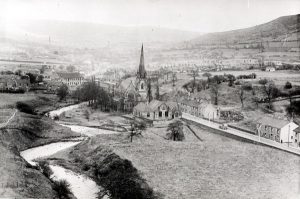
Holy Trinity Church Dinting Vale (Church of England) The foundation stone was laid in 1873 and the Church was consecrated by Bishop Selwyn, Bishop of