A Town Hall Like No Other
The story of Glossop’s Town Hall A new town The foundation stone of Glossop Town Hall was laid on the day of Queen Victoria’s Coronation,
HOWARD TOWN or NEW GLOSSOP, ¾ mile W. from Old Glossop, forms the centre of the largest portion of the inhabitants of the township, and a focus for most of the other townships.
A Market was established under the powers of an act of parliament passed in the 7th year of the reign of Queen Victoria, by the late lord of the manor, which was opened 19th July, 1845. The market, held on Saturday, progresses very well, and presents an animated appearance in the evening. A Fair for cattle and merchandise is held on the 6th of May; and another was established in 1854, which is held on the first Wednesday after the 10th of October. Feast, first Sunday after 13th of September.
A handsome Town-hall and Market-house was erected in the Italian style, of which the first stone was laid 28th June, 1838, (the coronation of Queen Victoria,) and opened as above stated. A Lock-up prison was erected in connection with the above. It contains 4 cells which are warmed by hot water. Mr. William Hatton is the superintendent, with four assistant constables. Behind the Town Hall is a covered Market-house, with shops for butchers, greengrocers, and other trades. The tower which crowns the Town Hall is provided with an excellent clock, and the whole enclosed by a low wall and palisading. The entire cost has exceeded £8,500, executed under the superintendence of Messrs. Weightman and Hadfield, architects, Sheffield.
In 1818, Howard Town contained only three houses, one a farm house occupied by the Wagstaffs, the other the Howard Arms Inn, and the last one was erected by Mr. Collier, father of the present Mr. Thomas Collier. In 1825, the late Mr. Wood, bought the Old Woollen mill, and in 1826, built six houses on the site thereof, since which period its progress has been very rapid, and it can now boast of many handsome houses, excellent shops, and superior inns. The Temperance Hall, in Howard town, is a neat stone building erected in 1850, by the Rechabite Club, at a cost of £800. There are to be three chapels, one for the church, one for the Dissenters, and one for the Catholics. The Odd Fellows, Foresters, Druids, and the Freemasons, have lodges here and several other Friendly Societies.
White’s Directory of Derbyshire & Sheffield 1857

The story of Glossop’s Town Hall A new town The foundation stone of Glossop Town Hall was laid on the day of Queen Victoria’s Coronation,
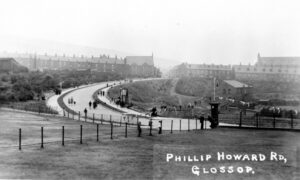
At the start of 1959 Glossop Council was undertaking work on further improvements to Philip Howard Road. To coincide with the work Councillor Sam Bamforth
Bethel High Street East (Pentecostal) The chapel was founded by Principal George Jeffreys and dedicated to him in 1947. The original membership consisted of a
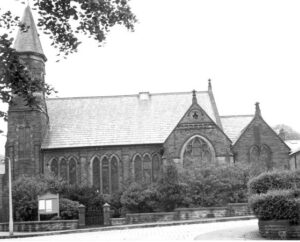
Fitzalan Street (Unitarian) In 1874 for a lease of £1 360 square yards of land in Fitzalan Street was obtained from Lord Howard and on

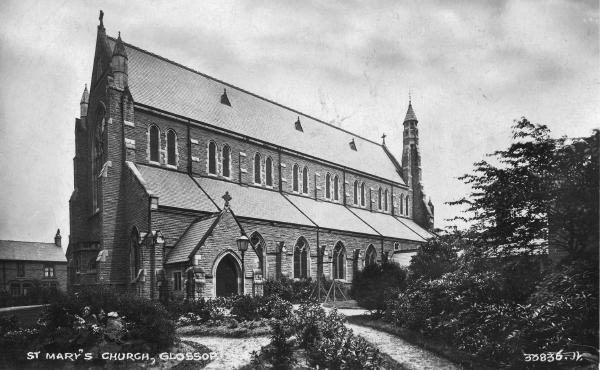
Sumner Street (Roman Catholic) The Church was erected in 1882 at a cost of £17,000 on a site donated by Lord Howard. It was paid
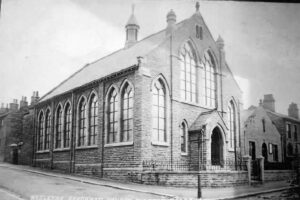
Howard Street (Wesleyan Methodist) The original School and Chapel were erected at a cost of £1,000. The Chapel was opened on 5th November 1854 with
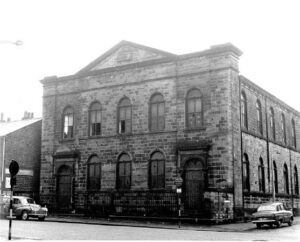
High Street West (Wesleyan Methodist) This is by far the largest Chapel on the Circuit centrally situated, and known to Glossopians of all denominations as
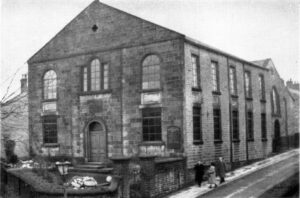
Shrewsbury Street (Primitive Methodist) Prior to the building of Shrewsbury Street Chapel the Primitive Methodists worshipped at Greenvale. The present Chapel was erected and opened
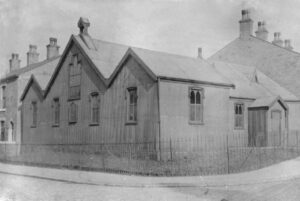
Princess Street (Primitive Methodist) The Princess Street Chapel – the only one on the Circuit not built with stone – was erected in 1893, shortly
Primitive Methodist Chapel Greenvale (High Street West) (Primitive Methodist) Primitive Methodists formed in 1810 built their first Chapel in Glossop at Greenvale near to the