
Buffalo Bill, a Prepossessing Young Lady, and “A Most Outrageous, Mean And Cruel Libel”
George Thomas Wilson, artist and professor of music, a man of “very eccentric habits”, was known as Buffalo Bill, as he “went about the town dressed as a bushman” carrying a loaded revolver. He was manager of Shaw’s Piano Warehouse at 9 High Street East, now Bar 2 (see pic, 1887). In August 1896 his employer called unexpectedly, found the shop locked, forced entry, and found him in such a state that he was dismissed on the spot. On November 17th, he appeared before the magistrates at the Town Hall charged with criminal libel.
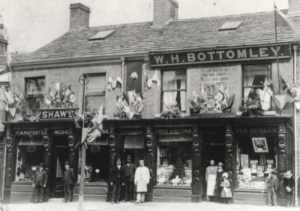
The papers went wild. “An extraordinary case”, “sensational postcards and telegrams”, “serious allegations against a young lady.” “The courtroom was crowded, while hundreds were unable to gain admission.”
The hearing “lasted several hours”, during which Wilson was seen to drink from a bottle, but the gist of it was that he believed that his employer had been tipped off by the shop’s bookkeeper, Edith Marion Wood. He then alternately pleaded with her to leave her job and go abroad with him, and threatened that “if he caught her he would shoot her” and that he “intended to let all the people in Glossop know” that she had been his mistress, “and have exceeded the worst girls there are.” He then sent a series of postcards, letters and telegrams to her, to her family in Millom, and to various places in the town including the grocer’s shop at no 11. Miss Wood, “a prepossessing young lady” said she had destroyed parts of the letters as they were “too disgusting” to show to her family.
Wilson alleged in reply that the case had been brought only because her family had borrowed money from him and he now wanted it back. Of course, what the crowd in the gallery, and the press, were eager to know was the content of the disgusting letters and whether it was true, and in questioning Miss Wood Wilson’s solicitor, Theo Walter Ellison, did his best to oblige, despite the frantic efforts of Miss Wood’s barrister to stop him – “you may not cross-examine as to character!”
On the question of truth, Their Worships, led by Edward Partington, sat on the fence. “Whatever intimacy there might have been, there was nothing to warrant the libellous matter stated by the defendant.” They bailed him for trial at the Assizes in Derby.
When they got there, with the national press now on the case, on the advice of their lawyers the parties settled. The judge thought “they were wise to refuse to satisfy scandal by the hearing in public of these very offensive libels”. Wilson agreed to be bound over not to repeat them, and the Derby Daily Telegraph thundered that “to libel a lady is one of the most cowardly acts imaginable, and he has reason to thank his stars that the object of his offensive attacks magnanimously expressed herself satisfied with his repentance.”
Twelve months later he went into Shreeve’s butchers, 110 Victoria Street, to buy some steak, and, as a joke, pulled out his revolver. It went off, killing the manager, George Cowley. His lawyer said that “he had had a lot of money left him, and it seemed to have excited him so much he did not know what he was doing.”
He got ten years for manslaughter. Edith Wood must have thought she’d had a lucky escape.
NEXT – Part 13: Cannon, Bells, Bazaars, a New Library, and The Cricketing Clowns
PREVIOUS – Part 11: The Teetotal Bigamous Schoolmaster, the Piano, and the Coffee Palace