
Virtue, Truth, Liberty – and filthy stairs and leaky roof
Across the front of the Town Hall, in very faded gold letters, are the words “Sola Virtus Invicta”, the motto of the Howards, Dukes of Norfolk. However, in 1866 the building got new tenants with their own, off-the-shelf, motto, “Virtus, Veritas, Libertas” – Virtue, Truth, Liberty.
After the millowners’ sycophantic 1850 address to the 13th Duke, relations went downhill. They fell out with his son Lord Edward over the issue of water supply, and decided it was time to run things themselves. Lord Edward, who was Liberal MP for the Ducal seat of Arundel, was probably relieved – he could spend more time in London and Arundel, and when the new Borough Council first met in December 1866 he was nowhere to be seen.
They met in the Town Hall, but didn’t know whether they wanted to carry on doing so, or – as he wasn’t around – whether Lord Edward would let them and if so on what terms. His agent, Francis Hawke, thought he would want some rent, although he couldn’t say how much, but the new Councillors were unwilling to pay anything at all without improvements.
The room, they said, was very cold, being heated only by open fires at either end, and uncomfortable, the only seating being the benches used by the courts. The press complained, too, that they couldn’t hear the speakers as they were sat behind them, “confined in a kind of prisoners’ box.”
It would also have been fairly plain, probably with whitewashed walls. Glossop’s big millowners were now some of the richest men on the planet – in the 1850s the Sidebottoms’ Waterside complex was probably the biggest mill in the world – and they wouldn’t be keen to spend hours debating on hard benches in a cold austere room.
In the end, though, agreement was reached, and a big table was purchased around which they could all sit, although that must have made it even harder for the caretaker to reconfigure the room for its multitude of other uses, such as the visit in March 1871 of Signor Bosco, “The Greatest Wonder Of The Age”, and his Enchanted Palace Of Illusion.
The building, though, wasn’t loved or appreciated by its reluctant tenants. In April 1871 a ratepayer complained in the Record about “the filthy state in which it is kept…the steps appeared not to have been swept for months…the accumulated dust was in some places at least half an inch thick…the walls were simply abominable…the Council Chamber was hardly better.” Once they had acquired a lease on the whole building, they also permitted (see pic, 1892-6) arcade shops with elaborate fronts, partly obscuring Matthew Ellison Hadfield’s elegant Italianate arches.
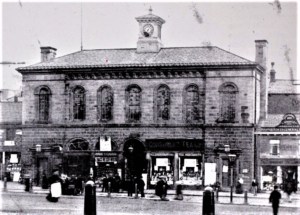
After 30 years, the fabric also needed attention. In October 1870 “when it was very wet, the floor of the Council Chamber was flooded” by water coming through the ceiling. When built, it would have been one of the first buildings in Glossop lit by gas, from the Duke’s private gasworks established in 1840 on Arundel Street, but technology had moved on, and in May 1877 a diorama – a light show – had to be cancelled as the gas pipe wasn’t big enough to supply the lights.
Its biggest weakness, though, was that it had only a couple of small offices, on the second floor, so most of the Council’s staff were scattered around the town centre, with clerks with documents scurrying about. It was a problem which would take over 50 years to resolve.
Amidst all the change, however, one thing remained the same – the Ellisons were still running the show. Thomas Michael, clerk to the magistrates and Lord Edward’s legal adviser, got the Bill through Parliament then became Town Clerk, and the first Mayor was Francis Sumner, his cousin. It would eventually fall to Thomas Michael’s son, Theo Walter, to bring the curtain down on the Howards’ involvement in the governance of the town.
NEXT – Part 15: A multi-use space, multi-tasking policemen, and a Marks and Sparks
PREVIOUS – Part 13: Cannon, Bells, Bazaars, a New Library, and The Cricketing Clowns