
What Next for the Town Hall ?
Over the last 19 weeks, we’ve charted the story of Glossop’s central halls, from the 1837 plans for the 12th Duke of Norfolk’s Town Hall to the opening in 1976 by the 17th Duke of the revamped Arcade. For most of their life, these buildings have been very busy – the Town Hall was packed for sensational court cases like the drunken vicar or the libellous cowboy, or for lectures, public meetings and entertainments, and on Saturday nights the police had to clear the crowds from the Market Hall. The Council, too, held regular meetings and big civic events, and in the 1960s thought it would soon need bigger offices.
Now, although the Arcade is packed with stalls, as it would have been before the first Market Hall was built, the rooms above it have been out of use for 11 years. The Market Hall is empty, too, and the Municipal Buildings have vacant space. The immediate cause of the closures was the cumulative effects of poor maintenance, but as we’ve seen, that wasn’t just something recent; throughout their history these buildings have suffered long periods of neglect, and have often seemed little valued by those who owned or used them.
That was especially so for much of the 20th century, when the town was impoverished and the Council likewise, with more urgent priorities than the wholesale replacement of time-expired fabric. People think Victorian buildings were “built to last”, but stonework apart, their materials are less durable than modern ones and need more regular (and expensive) repair and renewal. Over the last 20 years surveyors’ reports have detailed the consequences of constant patching and making do, such as the sealing of leaky slates with an asbestos mix which eventually forced the closure of the Town Hall.
There was poor design, too. On the Town Hall, Matthew Ellison Hadfield’s “secret gutters” were neat but inaccessible, and when they failed, the water soaked into the walls. And the early 1970s alterations to Town Hall and Market Hall were not to standards acceptable today, especially for Listed buildings.
Councils, though, spend money on buildings which the public use and value, and which will repay the investment, and despite the doubling of the population, these buildings became less and less used, as they became less and less suited to modern needs and expectations. However, there’s now a good prospect that by the end of 2022 they will be fully renovated, fit for 21st- century purposes, and able to earn their keep.
Some loss of historic fabric is inevitable. However, this is just the latest of several revamps over 183 years, so much of what’s there is relatively recent. There may also be gains, like the stripping-out of the tacky, utilitarian 1970s indoor market, completely alien to its historic surroundings, and the exposure once more of the 1850s iron framework, with its Corinthian capitals and arched traceried beams. The mezzanine floor will also acknowledge the foresight of people like Joseph Doyle who recognised 70 years ago that this was a valuable unused space in a prime town-centre site.
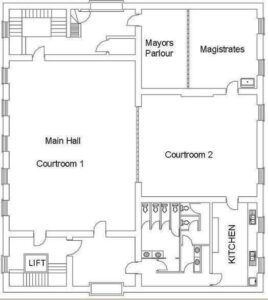
The future of the Town Hall, though, is still unclear. A design rooted in the 18th century, its layout (see pic) has never been ideal for any of its many functions, and poor access would have closed it eventually if damp and asbestos hadn’t. Once the Victorian ceilings, removed due to the asbestos, have been replaced, a major challenge will be to find 21st century uses for it which will both generate income and allow it once more to play a part in the social and cultural life of the community.
END OF SERIES
PREVIOUS – Part 18: The Duke Returns