
Part 8 – Whitfield
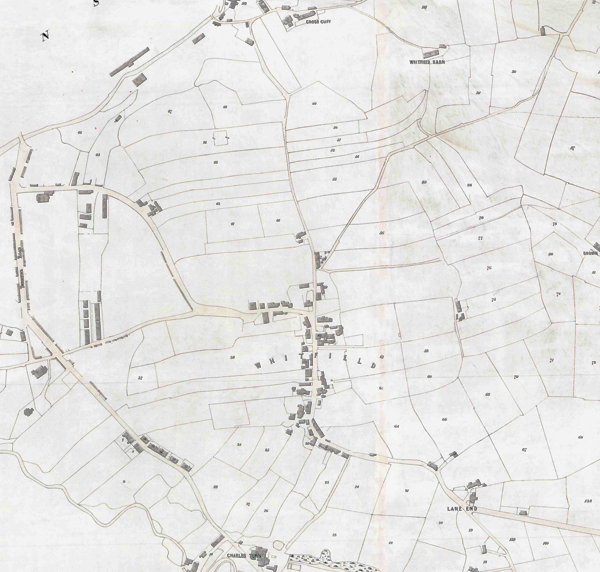
If you look closely at the 1852 Tithe Map (see pic) you will see that Whitfield was once surrounded by multiple open fields – at least 8 or 9, total area around 110 acres. Outside them on former common there was then a ring of farms or hamlets, probably established between the 16th and late 18th centuries – Pikes, Cross Cliffe, Whitfield Barn, Jumble, Hurst, Brown Hill, Lane End. Further out, to the east and south, was the remaining common, almost a third of the area of the village, which wasn’t enclosed till 1813.
This shared arable was bigger and more complex than in the other villages, and the common lasted longer – elsewhere it had almost all gone by the late 18th century. Why was Whitfield different?
After 1066, King William held all the land south of the river, but not for long. The unpopular Norman monarchs took care to keep their supporters happy, and William soon handed custody of the Royal Forest of the Peak to his (alleged) illegitimate son William Peverel. The Forest was in turn a serious jobs-for-the-boys operation, with 16 classes of official most of whom probably did very little but watch the boss’s back. The more senior of them at least were rewarded with grants of land, so when the monks arrived from Basingwerk in 1157 to establish the Manor of Glossop they could take possession only of what the Peverels hadn’t, on the King’s behalf, already given away.
That included Whitfield and Chisworth, plus land in Charlesworth, Simmondley and Chunal and possibly elsewhere. Eventually, by one means or another the Abbey and its successors the Talbots and the Howards managed to get most of it back, but not Whitfield.
This meant that it was not involved in the push, begun by the Abbey and continued by the Talbots, into commercial sheep farming at the expense of arable. Its lords were absentees who held land elsewhere, and so were probably content to allow their tenants to continue their Anglo-Saxon way of life, adding more open fields and pasturing their cattle and sheep on the common.
Then the Tudors changed the rules. Under the Norman feudal system, land was only “held”, the ultimate owner being the King, who could take it back, and it usually came with multiple duties and obligations. However, Henry VII and his successors also needed to keep their main supporters, the minor gentry, happy so promoted unconditional ownership, which made land easier to buy and sell. In 1606 Thomas Bagshawe, the last lord of Whitfield, sold the whole of the village to at least 14 buyers, some of whom then sold on at a profit.
As a result, it came to be divided between multiple freeholders. If communal arable farming was still being practised in 1606, it would quickly have become unworkable, as sharing fields and ploughing, and dividing the strips fairly, required either goodwill between the holders of the strips or a lord who could keep them all in line. The new freeholders might also have acquired a scattered mix of strips and enclosed fields, which was inefficient, so would want by buying and selling to consolidate their land into a single holding.
However, they still shared the common. In the other villages, whilst holders of strips would have rights on it, the lord had overall control and so could oversee its enclosure when that became desirable. In Whitfield the freeholders would all have to agree how to divide it up, but they obviously couldn’t, as in 1810 they applied to Parliament for an Enclosure Act.
This appointed Commissioners, whose job was to divide the common fairly between all those with a valid claim. When it was done, it was the end of a way of life which had lasted nearly 1200 years.
Finally, next week we arrive in (Old) Glossop, where there are several puzzles…..
NEXT – Part 9 (Old) Glossop
PREVIOUS – Part 7 Charlesworth and Simmondley