
In the early 1800s the cotton industry, centred on Manchester, depended on Sheffield for sharp steel blades to cut the yarn and the cloth. However, the direct route between them was just a packhorse way, Doctor’s Gate, named (we think) after a 16th-century Vicar of Glossop who went that way to visit his folks in Sheffield.
In 1818, therefore, Bernard Edward Howard, Duke of Norfolk, Lord of the Manors of Sheffield and Glossop, and the Duke of Devonshire, who owned the Ashop Valley in between, clubbed together to fund the Sheffield to Glossop Turnpike. They employed a Sheffield surveyor, William Fairbank, to design and build it, although when he got into difficulty they had to bring in the famous Scottish road-builder John Macadam, and his son Loudon, to finish the job. It was completed in 1821.
It wasn’t a success. It was hugely expensive, being (very unusually) a complete new-build rather than an upgrade of an existing road, and on steep, unstable slopes, prone to slippage, as we’ve seen even within the last year. The trustees of the rival turnpikes were also investing heavily – in 1819 the Winnats Pass was bypassed via Mam Tor, and (see next week) in 1826 the new Saltersbrook Bridge was opened – and soon there wasn’t much difference in journey times, plus the Woodhead summit was 190 feet lower and so less vulnerable to snow. Traffic was less than forecast, and the road was already in financial trouble, with the Dukes pouring in yet more money, before the railway opened in 1845, killing it off as a major inter-city route after just 24 years.
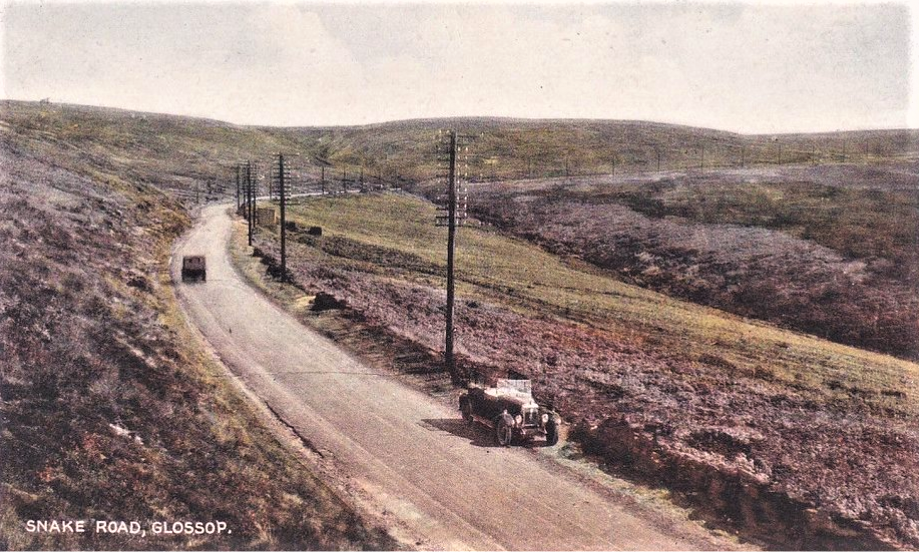
After that it was little used other than by day trippers or shooting parties in coaches or wagonettes, and from the 1890s by cyclists and then pioneer motorists, who found it a challenge due to the long climbs and poor surfaces. They stopped for refreshments at the remote Snake Inn, so named from the Duke of Devonshire’s crest over the door, and eventually the road became known as the Snake Pass.
In its heyday, though, it did a lot for Glossop. In 1821 the new town, Howardtown, was just getting going, and the new road turned it, briefly, into the 19th-century equivalent of a motorway services, with fast coaches to Sheffield and Manchester. The first major building in the new town centre was a large inn, the Norfolk Arms, equipped to serve the regular coach traffic, with a cobbled drawing-off area in front, extensive stabling behind to house the teams of replacement horses, and a big dining room serving Georgian fast food to travellers whilst the horses were being changed. The driver might have something stronger to keep him warm on Coldharbour Moor in a freezing gale.
The town also got a new, wider Woolley Bridge, and a smaller inn, the Royal Oak, which would have served the lumbering stage waggons pulled by heavy horses. Now – although it’s probably not what the two Dukes had in mind when they sank in £3.7 million in today’s money – the road is a magnet for bikers, and we have on our doorstep one of the most scenic drives in England.
Next – Part 10 – Tally-Ho !
Previous – Part 8 – Grand Designs