
In the early 1800s a stagecoach, even when overloaded (as they often were) and weighing over two tons, could still maintain a steady 15 mph or so on a level road. On steep hills, though, the pace would drop to a crawl, and the tired horses would then need to be changed sooner rather than later, adding further delay. Over 40 years the trustees of the Manchester-Saltersbrook turnpike had done their best to speed things up by building new lengths of road with easier gradients.
Their new line of road up Staley Hill to Roe Cross, completed around 1800, climbed steadily at about 1 in 21 for almost two miles. The old road then dropped away very steeply past Lower Roe Cross and into the hamlet of Spout Green at about 1 in 12, but in due course they dealt with that by by-passing Spout Green along what’s now Old Road but was then, of course, a New Road. They then shifted their attention to upper Longdendale (see Part 10) before returning to deal with another problem.
In the centre of Mottram, the road turned at 110 degrees onto Mottram Moor. That was OK for the coaches if they were stopping there, but not if they were in a hurry to get somewhere else, and the stage waggons plus horses, as long as a modern artic but much less manoeuvrable, would have struggled to make the turn. In 1826, therefore, the trustees obtained powers to build the first Mottram bypass.
However, they couldn’t decide whether to build a longer or a shorter one. Does this sound familiar? Eventually, in 1834 they opted for the shorter one, what’s now Back Moor. In the meantime, though, in 1833 they had obtained permission for a very much bigger project.
On December 11th 1834, at the Angel Inn in Mottram, the contracts were let for the Deep Cutting and the embankment, total length “12 to 1300 yards.” The cutting would be 38 feet deep, the embankment 29 feet high. The motivation was clear – the Hyde-Mottram turnpike, long delayed, finally opened in 1835, and the Trust’s toll income immediately dropped. To compete, the coaches had to be speeded up.
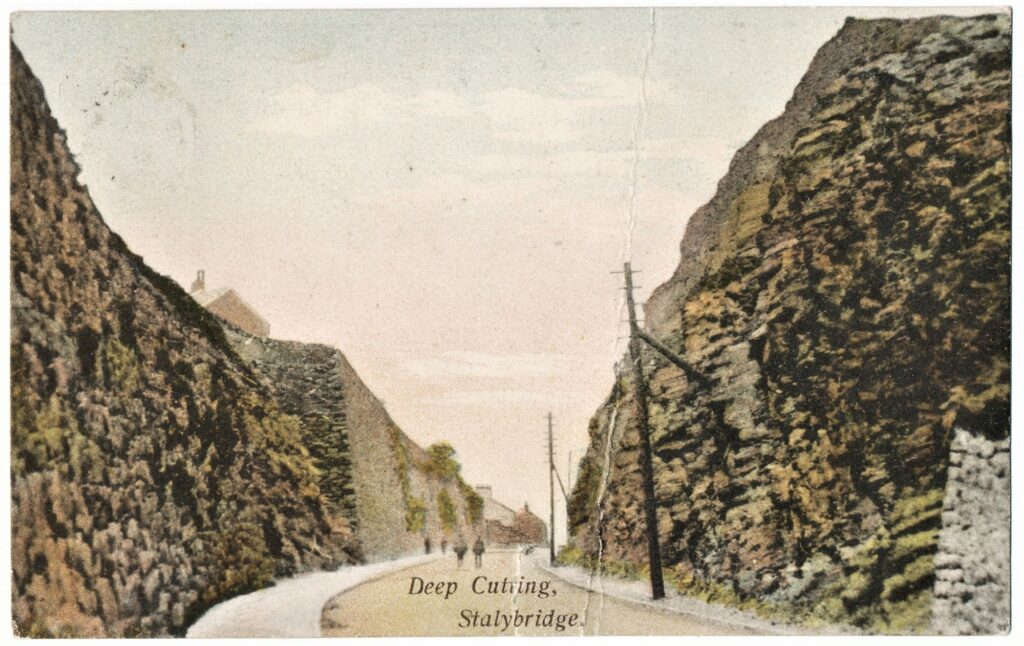
However, a new and more serious competitor was steaming rapidly towards them. In May 1837 the Sheffield, Ashton-under-Lyne and Manchester Railway Act was passed, and in July 1838 work started on the Woodhead tunnel. 12 months later, with the cutting and embankment still not finished, the trustees panicked and applied the brakes. With his weekly spending reduced again and again the surveyor, Joseph Harrison, struggled on, but by the time the cutting was open in 1841 the trains had reached Godley, and by December 1845 they were in Sheffield. The Trust’s income collapsed, and by 1847 it was close to bankruptcy.
The trustees had spent around £5000, the equivalent of £450,000 today, to reduce the gradient from Stalybridge from 1 in 21 to 1 in 27 for the benefit of coach services which were about to vanish. If done 40 years earlier the Deep Cutting might eventually have paid for itself and would have been an impressive piece of engineering, but by 1841 it was dwarfed by the railway construction, where the wage bill alone reached £2600 a week. There was no more talk of new road schemes in this area for over 100 years.
END OF SERIES
Previous – Part 10 – Tally-Ho !