
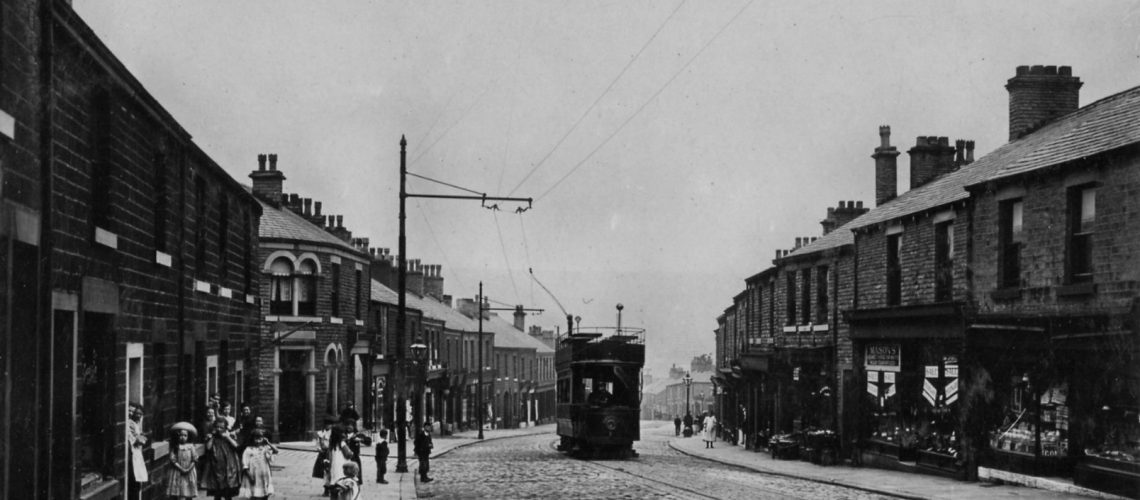
Towards the end of the 19th century the railway had been in place for 50 years or so but there was no public transport serving the mills, the growing town centres and the areas where their workers lived.
In the early 1890s the Glossop Carriage Company started to run a horse drawn bus from the Norfolk Hotel to the Commercial Inn at Bankbottom in Hadfield. It only ran three times a day though, at 2 p.m., 6 p.m. and 10 p.m.
The first indication of change happened in about 1900 when notices appeared stating that it was intended to lay tram lines and run trams from Old Glossop to Hadfield Station. The tramway was promoted by the Urban Electric Supply Co Ltd, which had been founded in 1898 and owned power stations scattered throughout the UK, including Glossop.
Locally, the company’s employee behind the scheme was Charles Edward Knowles, son of Glossop’s former vicar, John Dickenson Knowles, who had been born in Rawdon in 1865. He is described as an electrical engineer in the census of 1891 but by 1901 he was described as an Electrical Engineer living on own means at Holmedale, North Road. By that time he had also been a local magistrate for some years.
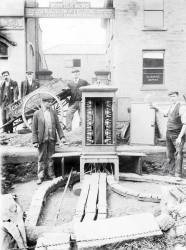
Responsibility for the layout of the tramway track and system was vested in Leo Arthur Hards, M.I.E.E., an engineer with the Urban Electric Supply Company who was an expert on Electric Tramway Systems. Authority for the tramway was given under the Glossop Electric Tramways Order of 1901.
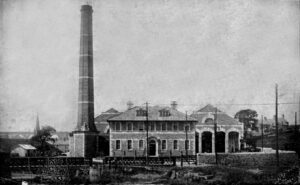
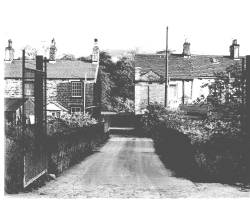
The depot was at the UESC works, where Lancashire Chemicals is today. Access was gained by a gap between houses (which always seems too narrow somehow) and across a bridge over Glossop Brook.
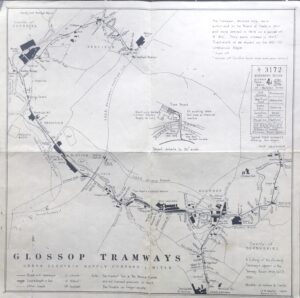
The Order provided for a single-track line running from Hadfield Station, through Woolley Bridge and along Brookfield through Glossop to the terminus at the Queen’s Arms Hotel in Old Glossop. A half mile branch line from the main line ran from Norfolk Square to Whitfield and the gates of John Wood’s house at Charlestown. The four and a half mile line appears to have been designed to serve as many of the mills of Glossopdale as possible. There were nine passing loops on the main line and one on the Whitfield line. A proposal by Councillor Braddock that the route ought to extend to the foot of Post Street in Padfield was rejected on the grounds that it would not pay.
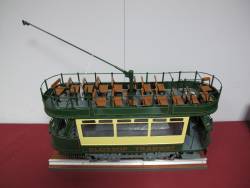
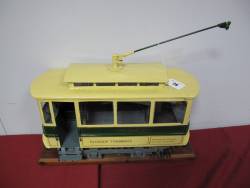
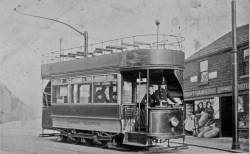
The initial fleet of trams was made up of seven Milnes open-top double-deckers. They sat 26 on the open top deck and 22 inside, and were freshly painted in green and cream. A BEC single-decker was brought into use in 1904, to run exclusively on the Whitfield branch and later a second-hand single-decker was bought from Sheffield.
|
|
|
| Photos of model Glossop Trams | |
The official opening of the tramways was on 20th August 1903. After a ceremony starting at 11 am, the great inaugural tramcar (driven by George Edward Colclough) carried its party of dignitaries along the tracks around the whole system. Services to the public started the following day.
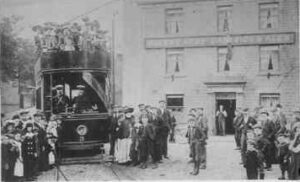
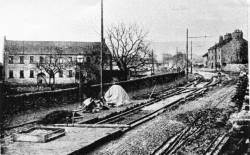
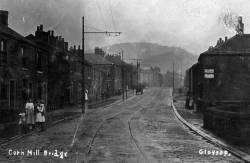
The photos below show a tram turning from Hall Street (Manor Park Road) into High Street East and the cable and lines at Corn Mill Bridge.
 |
 |
Initially the trams were popular. The first two days of public use attracted 8,505 passengers and in the first three months the system carried 20,000 passengers per week. The tramway took away three-quarters of the railway passenger traffic between Glossop and Hadfield, forcing a reduction in railway fares.
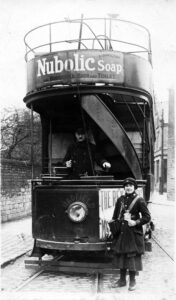
Cars ran every 15 minutes from Hadfield to Glossop, with alternate cars taking the Whitfield and Old Glossop routes. The round trip took an hour including standing time, and four cars maintained the quarter-hour service. The fare for the whole journey between termini was 2d but later penny stages (and halfpenny stages for workmen) were introduced.
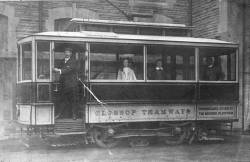
|
|
|
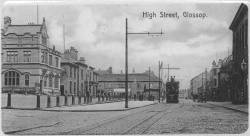
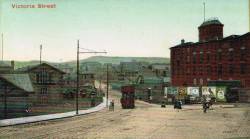
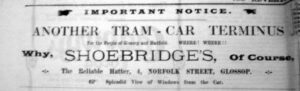
Only seven months after the opening of the tramways, on the evening of Sunday 25th March 1904, the Whitfield car started to run away when travelling down Littlemoor. The driver was James Cavanagh and the conductor James Fidler. The car tore, out of control, down Victoria Street, crossed lines in High Street and came to a stop with its front “feet” going to the cellar of a shop owned by one Septimus Shoebridge (he is listed as a hosier at 4 Norfolk Street in Kelly’s Directory for 1908). Apparently Mr Shoebridge took immediate advantage by advertising the new terminus!
Unfortunately enthusiasm for travelling on trams waned very quickly, from 1905 revenue began to fall sharply, and barely covered costs. It had been the intention to connect the system with those of neighbouring towns, but plans for this were always frustrated, harming the viability of the line.
At the other end the route went via Woolley Bridge Road and into Station Road before terminating at The Palatine.
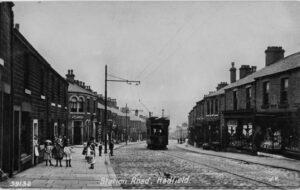
By 1910 the system was making a loss for the Urban Electricity Supply Company. By increasing fares and cost reduction by lowering the number of journeys the Company managed to carry on for a while. It was, though, inevitable that a service for such a relatively small population could not be maintained. The Whitfield branch was closed in 1918 and in 1927 the Company offered the tramways to the Glossop Borough Council. The offer was declined, leading to the final tram running on Christmas Eve 1927.