

Location: Wood Street, Whitfield
Architect: Harry S. Fairhurst of Blackburn
Donor: George Ollerenshaw
Date opened: Saturday 10th January 1903
Owner: Glossop Borough Council (1903-1974), High Peak Borough Council (1974-present)
Brick Yard
Robert Hamnett remarked on this area of Wood Street before its transformation:
“When I first remembered it there was a disused brick yard in the centre, with numerous depressions, which after heavy rain became dangerous to children playing there; in fact there have been cases of children drowning there.”
George Ollerenshaw
In 1901 this all changed. In August George Ollerenshaw announced he was going to purchase a piece of land from Lord Howard.
“His intention was to dedicate it to the use and benefit of the poorer children of the Borough as a playground for ever.”
He said there were no open spaces available as a playground for the very poor. He also proposed to build a one storey branch free library on part of the land. He would then gift them to Glossop Borough Council.
“His intention was that this should not put the Borough to much expense, or as little as could possibly be helped.”
George Ollerenshaw had been born and brought up in Glossop on Queen Street. His father, Robert Ollerenshaw was a cotton weaver and later a slater and plasterer. At the age of 14 George was working as a cotton weaver. Between 1871 and 1881 he had moved to Blackburn, Lancashire and was working as a tea dealer. It was in this trade he made his fortune in the “wilds of Lancashire”.
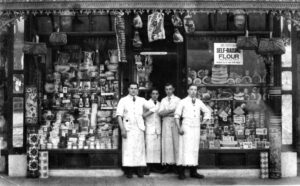
He returned to Glossop just before 1900 and lived at Highfield House, Talbot Road. He was recorded in the census as the director of a limited company – Hunters the Teamen.
When he returned he decided to stand as a candidate for the Town Council but was relatively unknown to the electorate. The announcement of the generous gift was made just before the municipal elections of that year.
Opening Ceremony
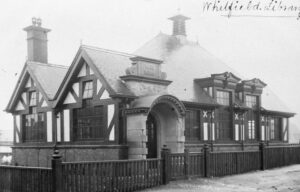
By 1903 the library and recreation ground had been completed. The architect was H. S. Fairhurst of Blackburn who had designed many of the iconic cotton warehouses in Manchester. The library was an unusual style for Glossop looking like a Tudor manor house.
On Saturday 10 January 1903 there was a grand ceremony to mark the opening. There was a Mayoral procession from the Town Hall to the new library. Mr Ollerenshaw presented the deeds of the library and recreation ground and the land they stood on to the Mayor, Edward Partington.
Speeches were made and the architect, Mr Fairhurst, presented a gold key to the Mayor, which opened the library. After this had been opened and inspected there was another ceremony to open the recreation ground.
After the ceremonies the members of the Council returned by carriage to the Town Hall where the Mayor entertained friends and the Council to a luncheon. Mr Ollerenshaw was presented with an illuminated address in a silver casket.
On the opposite side of the road to the recreation ground Mr Ollerenshaw had also built five pairs of new model cottages. These were also designed by Mr Fairhurst who had used inspiration from other model villages such as Bournville, Birmingham.
Election Bait
The library and recreation ground had received mixed enthusiasm since the offer was first made. Some believed it to be election bait. There was some criticism for several years that although the building may have been gifted it was a drag on the penny rate for free libraries leaving Victoria Hall in debt.
The libraries were covered by the Public Libraries Act 1850 meaning the Council could only use a limited amount of the local rates to fund them. This meant they were reliant on generous donors to help make up the difference. In a Libraries Committee meeting in March 1903, Mr Ollerenshaw gifted £100 worth of books that could be read within the library.
Branch Library
In 1936 the library was renovated and the lighting was replaced before being reopened as a branch library of Victoria Hall after a major reorganisation of the library system in the area. After it became a branch library, it opened one night a week for people to borrow books.
A Gift Horse
In the 1950s the library was described as “dog-eared”. It also needed some major structural repairs. The roof tiles were deteriorating, and the roof had sunk causing outward movement of the walls. It needed rods and backing plates to keep it in place.
There were also complaints about “disorderly conduct on the part of the children using the recreation ground” and its untidy and unkempt appearance. The Council insisted they did not have the funds to repair it.
 |
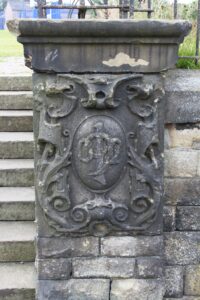 |
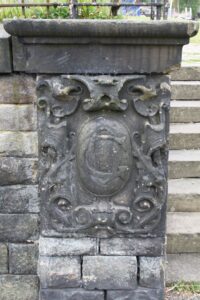
| Inscriptions at the entrance to Whitfield Recreation Ground. On the left “GO” for George Ollerenshaw. On the right “1902” for the year it was built. |
|
Demolition
By the mid-1970s the library had deteriorated further. It was still being used as a library once a week but also a playgroup for local children.
A report by the Council in 1977 showed there had been further movement of the walls which had needed shoring. This was creating a danger by children climbing on the roof and causing more damage. After the oil heating system broke down as well the Council said it had become a liability to rate payers. They decided to demolish the building and incorporate the site into the recreation ground so it was still of benefit to the community. This area is now the children’s playground.
Over 100 years later the site is still a well-used recreation ground and playground for the children of Whitfield and beyond just as George Ollerenshaw intended.
Sources
Glossop Chronicle, various dates
Photographs (GHT Archive)
Derbyshire Record Office. John Overend Todd Archive. D5162/8/28
Duplicate conveyance of pieces of land on either side of Wood Street in Glossop to be used for a branch of the Public Free Library in Glossop and a recreation ground, Francis Edward Lord Howard, Baron Howard of Glossop and his trustees to George Ollerenshaw of Glossop Esq Includes plan 18 Sep 1901 [Original not viewed. Catalogue entry accessed 24/07/2021 – D5162/8/28 catalogue entry]