
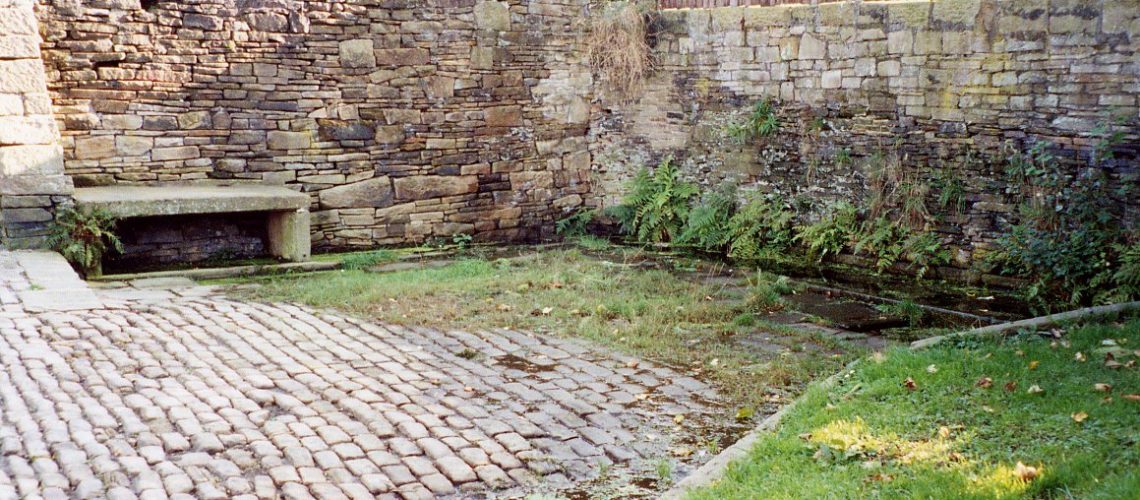
Location: Whitfield Cross, Whitfield
Date: 18th Century; adapted in mid 19th Century
Grade II listed: 27 Jan 1978, listing no. 1384307
Authority responsible for the wells: Glossop Borough Council (1875-1974), High Peak Borough Council (1974-present)
Watering Troughs
The original structure of the Whitfield Well is believed to date from the 18th Century. These were a couple of public stone watering troughs at the edge of a bend in the lane.
The right to use the water at the wells was covered by the Whitfield Enclosure Award, 1813:
“We have set out and allotted … the following parcel of land … as and for a public watering place for cattle within the said hamlet of township . . . that is to say, one parcel of land, part of the said common in the township of Whitfield, containing seven perches bounded by the town street of Whitfield, and by antient enclosures of Bernard Edward Howard”. Joseph Demspey Doyle in “The Wheatsheaf”, 1929
There is a constant flow of water through the wells as they are spring fed. The source of the water is believed to be a spring in the vicinity of Field Head. The water ran from the spring to the public troughs by the side of the lane running from Whitfield Cross.
From here it probably went off in a culvert behind the houses further down, then under the turnpike (now Victoria Street) and then emerging as a stream which ran down to Long Clough Brook.
In the early 19th Century the land next to the wells was occupied by the kennels for Glossop Hunt. Hunting and coursing were popular sports in Glossop especially amongst the owners of the cotton mills.
Whitfield Brewery
In 1849, James Robinson who built the Surrey Arms on Victoria Street leased the land next to the wells and built a brewery. Despite being advertised as having a “never failing supply of the best spring water” the brewery was never very successful.
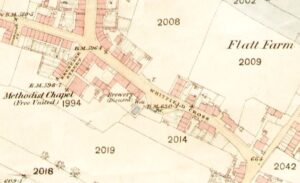
It was run by Archer and Co. in the mid 1850s, sold to Thomas Hampson in 1867 for £660 and to Samuel Clarkson of Barnsley in 1876.
In 1880 a group of people subscribed to form the Glossop Brewery Company. This only lasted a short time before it was dissolved. The brewery was then run by John Walton and William Wyatt, who ran the bleachworks in Charlestown.
“It afterwards became Walton’s Brewery, with Adam Slater as the brewer. He made a special brew of ale for the late Lord Howard of Glossop to be consumed when the present Lord came of age. It was buried, and I have been told that when it was opened, it was stingo; only one pint for each person was allowed, and even that proved too much for some – it was true barley wine.” Robert Hamnett
After their deaths the brewery was sold to Frederick E. Estcourt, Walter H. Mason and Charles A. Stead in 1889. After a few months this partnership was dissolved and Charles Stead ran the business alone as The Whitfield Brewery Company offering “first class mild and bitter ales”.
The brewery next came up for sale in 1892. The site comprised of many well built stone buildings including a boiler house, engine room, brewing house, large cellar, stables, cooper’s workshop, coach house and two excellent reservoirs of pure water from the Whitfield Wells. The brewery appears to have taken its water supply from the culvert via a chamber and a pump into a storage tank.
Whitfield Water Company
In 1852, just after the brewery was built, the Whitfield Water Company was formed. A group of property owners gathered at the house of George Hampson in Whitfield on 10th March.
They agreed to bring “…pure water in metal pipes from the old wells in whitfield down the public Road and thence to the Turnpike Road opposite the house of Mr Robert Thornley and also one branch metal pipe along the street in Freetown leading to the field of Mr John Hadfield.”
The present structure of Whitfield Wells probably functions as settling tanks to prevent silt getting into the pipework. The tanks may have been built at this time, or when the brewery was built. The water for the water supply was taken from a chamber at the end of the tanks, in iron pipes, presumably following the edge of the new road which was laid out at the same time, down to the turnpike and then to houses along it.
The legality of the water company may have been questioned at the time, as this was water that had been free to use for centuries. The water company agreement only required the householders to pay for the pipe work and not the water. They were not to sell or divert the water from the wells or use it for anything other than domestic use. There was also a clause that all those in the society will jointly pay the costs if it becomes “…necessary to defend the rights and privileges of this society by a legal process…”.
The householders may have been supplied with a continued flow of spring water but it was often contaminated. In 1870 the Sanitary Committee reported about the fouling of the water at the wells. Since the first Public Health Act in 1875, all wells became the responsibility of the local authority, Glossop Borough Council.
In 1885 Councillor Hampson reported that water coming down from Higher Whitfield was overflowing the grid and fouling the water in the wells. It was agreed at this meeting that the Council would supply 40 yards of old setts for the local residents to pave the road to prevent this from happening.
The water continued to be supplied to these houses for many years even after the rest of Glossop was receiving piped water from the Council (but they still had to pay the water rates). In the mid 1940s the Medical Officer of Health, Dr Gilloran, reported on the susceptibility of the Whitfield Wells to surface pollution. It was decided the safest thing to do was connect these houses to the Council’s piped supply and in 1948 the Whitfield Water Company came to a close.
Well Dressings
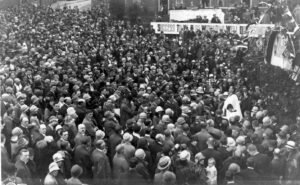
Well dressing and rush carts had been a feature of the Old Glossop Wakes for many years. The first newspaper report of the Well being dressed at Whitfield was in 1874. The Whitfield Original Brass Band held a sporting competition in the place of Glossop Cricket Club who were unavailable. This was accompanied by a dressing of the Well at Whitfield. The Wells were decorated in the Italian style with a triple arch fronting the road.
The well dressings happened for the next few years before lapsing, apart from a couple of years in the 1890s, until 1908. The well dressings were then revived by Glossop Old Prize Band to raise funds for new instruments. The wells were decorated with heather and all kinds of flowers and in the evening lighted with fairy lights. This was accompanied by musical concerts.
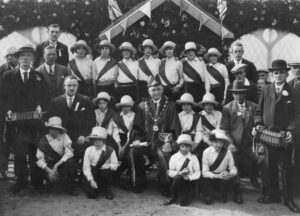
The events continued in the following years. From 1911 the well dressings were no longer organised by the band. A group of local people formed a committee and the monies received were donated to the Whitfield Cinderella Fund who provided clogs to poor people.
During World War One the fund from the well dressings were also donated to the Moorfield and Partington Homes, which were being used as convalescent hospitals for wounded soldiers. After 1915 the well dressings stopped again.
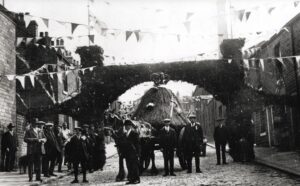
They were revived again in the 1920s along with the Old Glossop Wakes. In the late 1920s some of the biggest well dressing celebrations were held. Funds were raised for local hospitals and the Mayor’s Clog Fund in 1925, but after this all funds went to the local hospitals. The well dressing in 1927 coincided with the opening of Manor Park and re-opening of Norfolk Square. The wells were richly decorated and rush carts were made. An open air service blessing the wells was held and attended by thousands. There were also musical concerts and carnival novelties such as the greasy pole. The well dressings then happened on and off until 1934.
Steam Laundry and Firelighters
In 1895, Brook Furniss, landlord of the Albion Hotel on Victoria Street opened the Glossop, Hadfield and District Steam Laundry on the site of the old brewery. He had fitted it out with new machinery and modern appliances.
It was described as “a worthy venture” in the Glossop Chronicle. Mr Furniss said he could take in washing for 400 families at the laundry. Washing was collected by vans on Mondays, Tuesdays and Wednesdays and washed and delivered back on Thursdays, Fridays and Saturdays.
By 1925 the steam laundry had closed and the site was occupied by The Northern Firelighter Company, who made briquette firelighters. The site was managed by John Henry Cuthbert. In 1948 he let part of the site to a company that made industrial paint.
By the mid 1960s the site was also being used for the breaking up of scrap vehicles. A public enquiry was called against the owner as the site was a “nuisance” and an “eyesore”. The owner claimed the site had always been used for light industry and that firelighters were still made on part of the site and they were the ones generating the noise. The buildings on the site were eventually demolished and the site sold.
Houses have now been built on the site.
Well Dressings Revival
After several decades the well dressings were revived in 1966 for the Centenary of Glossop Borough. Glossop Whitfield Youth Centre organised the ceremony and it was estimated over 10,000 people visited over the weekend. The well dressings were reminiscent of earlier events with rush carts, morris dancers, bunting and the Well was dressed with heather. There was also a best dressed house competition.
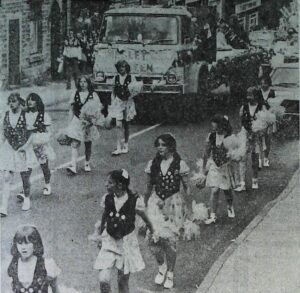
The well dressings happened for another couple of years before lapsing again. This time they were celebrated with a parade of decorated vehicles and people in fancy dress and carnival games such as tug of war and a pram race.
In 1973 the Glossop Chronicle reported that the wells were a dismal sight, “choked with rubbish and coated with slime”. By 1976 the wells had been cleaned up and the well dressing revived for the sixth time. There were parades and sporting competitions alongside the decorating and blessing of the Well. The well dressings happened on and off until 1985. The organisers commented on the apathy surrounding the event and not being able to put it on in certain years due to the lack of volunteers to help organise it.
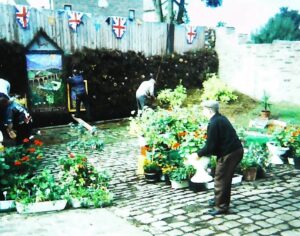
The well dressing was last revived for a seventh time in 1995. The wells were decorated with heather and colourful boards of flowers. There was a parade led by Glossop Old Band, five a side football and games and stalls. During the well blessing on the Sunday there was a sudden heavy downpour that lasted for a solid ten minutes, but no one seemed to mind.
Over the centuries Whitfield Well has been important to both local businesses and the community. The well dressings, although sporadic, have brought the community together in celebration. Only time will tell whether there will be an eighth revival.
Sources
Glossop Chronicle, various dates (including “Whitfield Enclosure Award, 1813” by Joseph Demsey Doyle in “The Wheatsheaf”, reprinted in the Glossop Chronicle 30 Aug 1929 and “Chequered history of a well-dressing ” by D. Shimwell, 17 Sep 1976)
Photographs, notes on Whitfield Brewery by Derek Slack, Programme of Old Wakes Pageant and Well Dressing 1925, copy of scrapbook of 1995 Whitfield Well dressing, copy of Whitfield Water Company agreement, 1852 (GHT Archive)
Whitfield Well (1384307). Listing Record. Historic England. (Whitfield Well Listing Record, accessed 9 Oct 2021)
Notes on the History of Glossop by Robert Hamnett, compiled by Neville Sharpe (GHT Archive)