
Even as work was starting on the Chapel-Enterclough turnpike (Part 6), a proposal was made to revive another of the ancient routes across the Manor of Glossop. The old packhorse way through Charlesworth and Mottram had been the shortest route between the twin cradles of the cotton industry, in the East Midlands and Saddleworth/East Lancashire, but turnpikes through Stockport and Manchester now provided easier ways round, leaving a large area of farms, coal mines and potential mill sites without access to modern transport.
Unlike Chapel-Enterclough, however, this scheme struggled to get going. That wasn’t unusual – many turnpikes weren’t started for years after their Act was passed. Parliament granted permission but not funds – the promoters then had to raise loans, which were rarely if ever fully paid back, and by the 1790s there were lots of projects competing for funding.
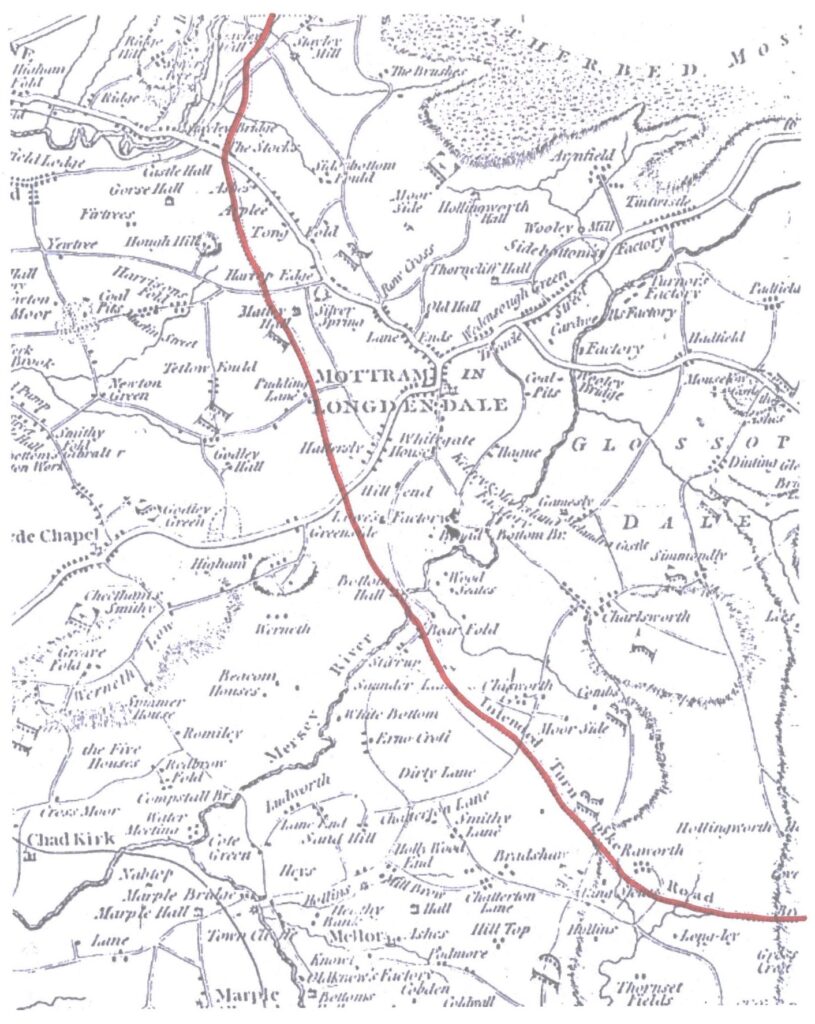
This one, too, was very ambitious. The old way was very hilly, involving a steep climb at Tom Heys (see Part 4) then another to 1200 feet at Charlesworth Cross, then beyond Besthill Bridge another at 1 in 6 up Gorsey Brow to Mottram, then up again at 1 in 12 to Roe Cross. The plan (see the “intended turnpike road” on the map, 1795) was to go round all these obstacles by building a new road about 15 miles long from the Chapel-Enterclough road at Brookhouses, via Rowarth, Ludworth, (Higher) Chisworth, Botham’s Hall, Hattersley, Matley and Copley, ending up at French Top in Saddleworth (near Greenfield Station).
However, this would have been largely new-build over country which was still quite challenging, and would have required an expensive new bridge across the Etherow nearly two miles downstream of Besthill. It also ran through three counties and had no single driving force, nor, with the exception of the Ludworth and Chisworth coal mines, any industrial enterprises along the line other than between Copley and Greenfield, so financial success would depend on attracting enough long-distance traffic. It was also extravagant in that it proposed a brand-new road between Hattersley and Copley when these places were already connected by turnpikes.
Although the promoters renewed the Act in 1814 and appeared intent on carrying on, they had only completed the section from Copley to Greenfield, now the B 6175 Huddersfield Road, and never went any further. By then another road, with guaranteed funding and toll income and powerful backing, had rendered the rest of the scheme largely superfluous.
We will come to that next week, but in the meantime we can only speculate about the effect this road might have had. It would certainly have taken some through traffic away from Glossop and Mottram, but the biggest effect would have been on the villages along the line. The ancient village of Chisworth, now Higher Chisworth, frozen in time up on the hill served only by country lanes, would by now be surrounded by executive housing.
Next – Part 8 – Grand Designs
Previous – Part 6 – Back On The Beaten Track