

In 2022 Kate Raine from Glossop Heritage Trust and Lauren Riley from Lauren Riley Design hosted a walk and talk as part of the Glossop Creates Wan.der series. The walk looked at the history of Edmund Potter and the Dinting Vale Printworks and the textile industry in Glossop.
Walk Map – Part 3
Playing Field

On your left when facing towards Glossop is the field behind Dinting school, which used to be owned by the Printworks. They owned lands and farms such as that at Adderley Place behind the houses opposite. They used the farms to grow produce to feed their workers. They also ran things such as poultry clubs and cow clubs. Later this field became a sports and recreation ground.
DIRECTIONS – Follow the road back towards Glossop.
Dinting School and Holy Trinity Church

The foundation stone for Holy Trinity, Dinting was laid in 1873. The Church was completed and consecrated by the Bishop of Lichfield in July 1875. The Church had been built through the generosity of Wood family of Howardtown Mills, Glossop.
It was designed by the architects Mills and Murgatroyd of Manchester. Part of the stone used came from Lees Hall Quarry in Glossop.
The school was also built in 1875 by the Wood family. It was enlarged in 1887 and could accept 405 children and 39 infants.
DIRECTIONS – Look at the building opposite the Church.
Viaduct Inn

Richard Preston, a bookkeeper, applied for an alehouse license in 1839 and called the pub the Railway Tavern.
John Rhodes, the next licensee changed the name to the Viaduct Inn in 1846 after Dinting Arches had been built.
This pub was also well used workers at the Printworks. In 1873 there was a fine supper and entertainment given by the Company to 56 dyers in recognition of the hard work they did after changes to the Factory Act meant boys under age were only allowed to work half time. The dyers had to make up this time with lots of overtime until more hands had been trained up.
The Viaduct Inn was closed in 1928 with compensation on the grounds of redundancy.
DIRECTIONS – Follow the road back towards Glossop. Cross Dinting Lane. At the first roundabout stop by the gap in the wall and look at the trees by the brook this was about the site of Dinting Mill.

Logwood Mill (Dinting Mill)

We looked at the early history of Dinting Mill in Part 1. Edmund Potter purchased Dinting Mill in 1840 and later renamed it Logwood Mill, as it processed logwood to produce a black dye on the ground floor.
On the upper floor he opened a day school for young children and half timers.
The first school master was Thomas Bailey. The children were taught reading, writing, arithmetic and drawing. They were also taught cleanliness and there was a wash room by the top of the stairs with soap, towels, brushes and blacking for clogs.
The school room was used as a meeting place for parties, annual teas and presentations including for the retirement of Edmund Potter in 1873.
The school was closed in 1881, after other schools had opened such as Dinting School and Zion School on Simmondley Lane.
DIRECTIONS – Look towards the second roundabout. The building that contains Simple Lettings used to be the Junction Inn.
Junction Inn
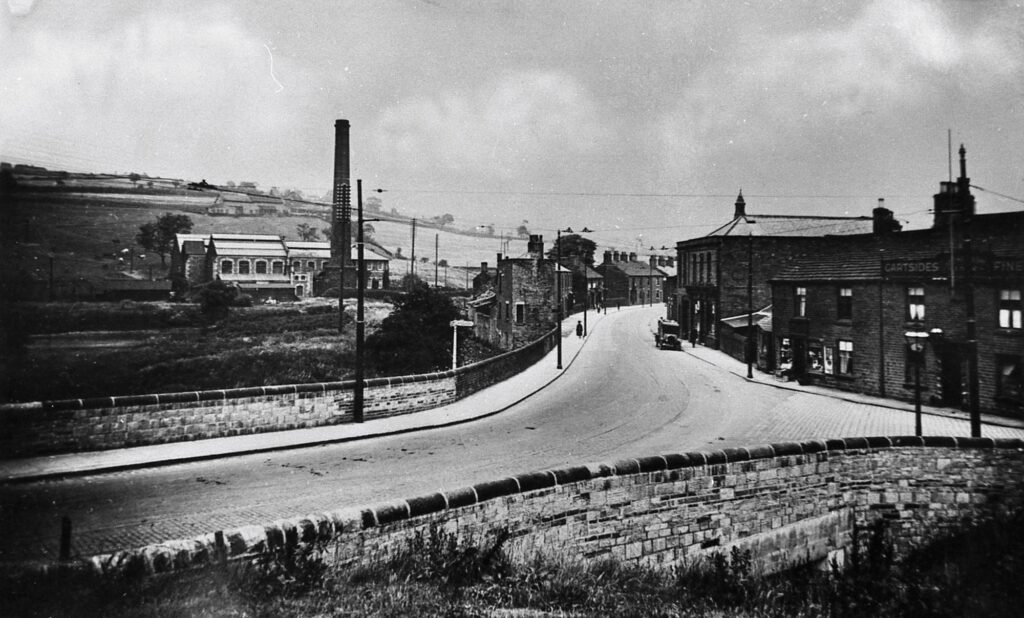
The Junction Inn was built by John Garlick in 1817. Several money and burial societies are recorded as being formed in this pub. These societies were formed by workers to give themselves some protection in times of need. The Junction remained a pub until the late 20th century.
DIRECTIONS – Keep on this side of the road and carry on walking towards Glossop. Look at the houses opposite when you reach the wheel sculpture (This wheel was placed here in the late 20th century, but does not have any historical significance that we are aware).
Glossop-Dale New Industrial Co-operative Society

The two newer buildings you see set back from the road now were once the site of a large branch of the Glossop-Dale New Industrial Co-operative Society. The branch was built in 1877 and had a large shop on the ground floor and a reading room on the first floor. The building on the left used to be a Post Office.
DIRECTIONS – Follow the road back towards Glossop until you come to 238 High Street West, a shop called ‘Hairways’.
Swann’s Shop

George Swann was a watchmaker and jeweller who once owned 238 High Street West. It was a famous landmark in Glossop in his time on account of the large clock above the door. After his death, “Swann’s Clock” was given to the town and placed in the Market Hall in Glossop. It was on display there until the 1930s when it broke down, and Glossop Borough Council decided it was uneconomical to repair.
DIRECTIONS – Follow the street towards Glossop. You will see that there have been very few changes on this street. You can see the date stone on you left for the block of houses called South View, which were built in 1849. There were shops all the way down the street so families had everything they needed close to home.
Workers’ Houses

Many workers from the Printworks lived in this area of Glossop. One such worker was Ralph Ratcliffe. He was born in 1826 in Over Darwen in Lancashire. This was where Edmund Potter’s uncle, John, owned a calico printing factory. This factory also went bankrupt in 1831 and many of the workers moved to Dinting bringing their experience of working the machines.
He lived with his parents at the Dinting Mill site in the 1840s before moving to 232 and later 337 High Street West. He started working at the Printworks as a labourer and later a machine printer. He died in 1882.
The workers would move about frequently with very few staying at the same property for more than a decade.

In 317 High Street West (the end house opposite – pictured) lived Edward Longton, an engraver that had been born in Chorley. In 1881, 16 year old Thomas Gray lived here with his family and worked as a calico bleacher. He later became a grocer’s assistant and by 1901 was running a grocer’s shop in Pikes Lane.
DIRECTIONS – Follow the street towards the centre of Glossop. On your right before the garage is the Grapes Inn.
Grapes Inn

In 1845 a bookkeeper called John Howard obtained a lease to build on land called Mow Wood. He opened the Grapes Inn in 1851. The pub has changed very little over the last 150 years and remains open today.
DIRECTIONS – Carry on towards Glossop. Look opposite from the pavement just after Tesco petrol station and you will see a large patch of grass.
Jerrytown

This area used to contain rows of back to back housing. It was called “Jerrytown” after Jerry Skyes, the builder. He was a shopkeeper and farmer and built the first houses down here at Sumner’s Place in 1820s for workers at Wren Nest Mills, which had been built opposite in 1815. He had built many properties by the time of his death in 1856, which he passed to his children.
These houses were demolished in the late 20th Century during the slum clearance programme in Glossop leaving the green space you can see today.

You are now at the traffic lights for the junction of High Street West and Glossop Brook Road and here the walk ends.
END OF WALK
We hope you enjoyed the walk. There is a lot more history to discover around Glossop and the surrounding area. Take a look around or search our website to discover more.