
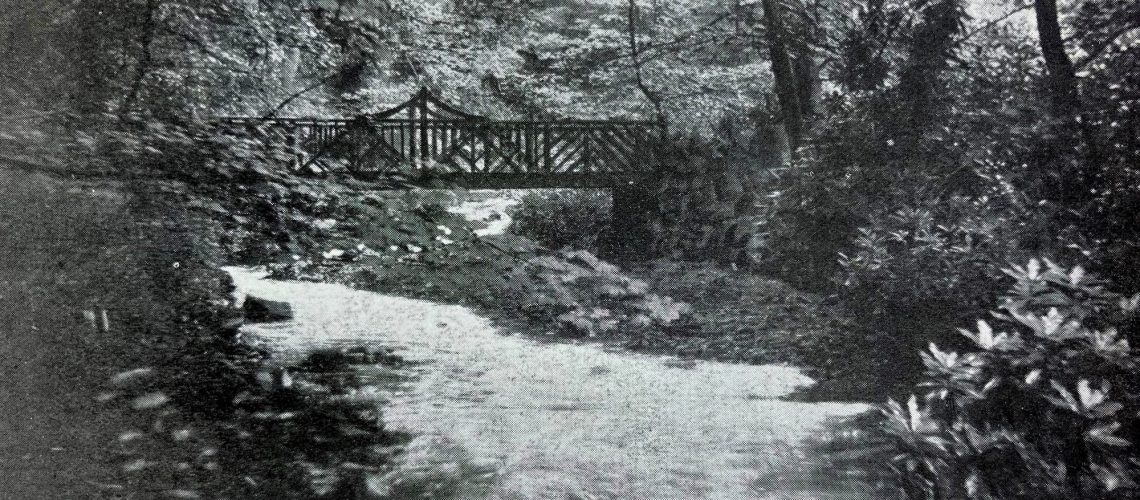
The walk around Manor Park took place on 19 July 2023, led by Kate Raine.
You can follow the walk as it was, pick points you would like to look at on the map or enjoy the walk from the comfort of your own home.
Walk Map
Start at the bridge on Corn Street before the Manor Park car park.

DIRECTIONS – From the bridge look over towards the Corn Street entrance. On the grass opposite just behind the houses was the site of the corn mill.
Corn Mill

The corn mill had been in this area since medieval times. It was owned by the Lord of the Manor to grind corn for local inhabitants.
This part of Glossop was called Milltown. It gained its name from the corn mill rather than any of the later cotton mills.

The building in the photograph is from the late 18th or early 19th century. The Malkin family from Staffordshire took over the corn mill in the 1890s. They worked the mill until the late 1920s, when their business failed.
DIRECTIONS – From the bridge turn right and follow the path. Cross the road and walk up by the skate park. Follow the road around the circular path at the top of the car park.
You will now arrive at the lake. Follow the left-hand path around the lake. Maybe enjoy a stop at the bench to read the next part.
Fishpond and Boating Lake

This lake started as one of the fishponds for the Glossop Hall estate. The tradition of fishing was kept up even when the estate was taken over by Glossop Borough Council as Manor Park in 1927.
Local resident, Ivan Bell, told us a tale when he and the Park Superintendent, Walter Waterworth, brought unwanted perch from Arnfield reservoir in dustbins and filled the lake, so children could catch fish.
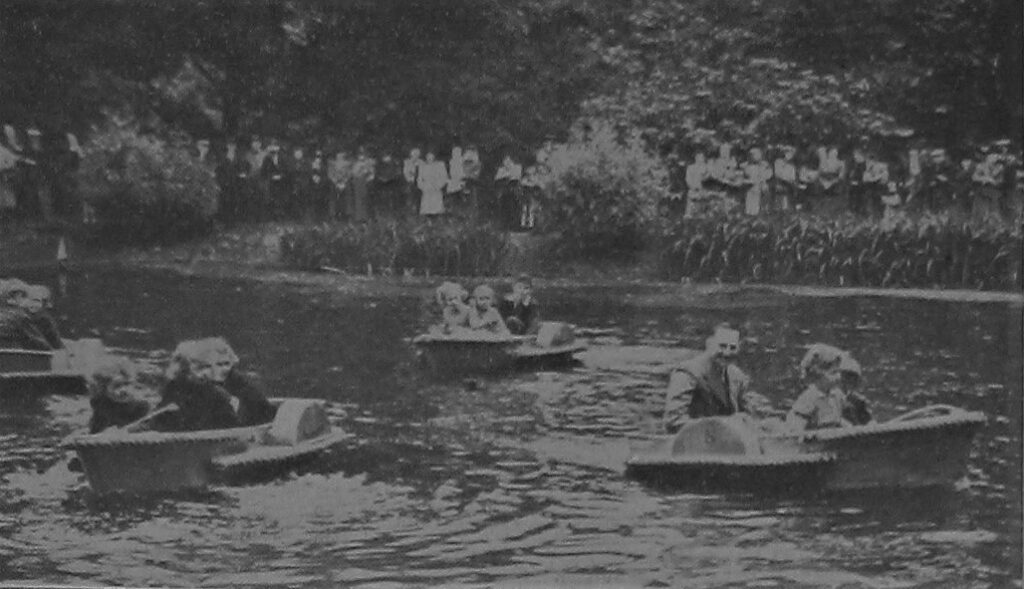
The lake has always been used as a recreation area of the park. In 1947 paddle boats were introduced onto the lake. These stopped after a few years, but pedalos were brought back a few decades later.
The lake was only about 18 inches deep and often got silted up. In the 1960s, it was divided into two and an island built. In the 1990s the lake was dredged and more islands created. By 2005 plans were made to improve the ecology of the lake and a sludge trap was built to prevent it silting up again.

Since the opening of Manor Park, the lake has been surrounded by charming riverside walks and at one point there was a rustic shelter.
DIRECTIONS – Follow the path until you reach the stone wall by the brook. If you look to your right you will see a weir and below you a sluice. To your left you will see a grassy bank in the Rose Garden.
Sluice and Weir on Shelf Brook
The course of Shelf Brook was changed with the arrival of the cotton mills in Glossop. The sluice and weir here was used to control the water that supplied the cotton mills downstream. Until the 1890s the brook was also the town sewer, so it was sensible for the millowners to take water from a higher point where it was cleaner.

The watercourse originally split in two from above this weir. One stream flowed along the path you have just walked into the corn mill pond. The brook from here travelled under High Street East to the pond at Easton House, then to Bridge End mill, then through the market ground to Shepley’s at Green Vale and then to the mills lower down to Brookfield.
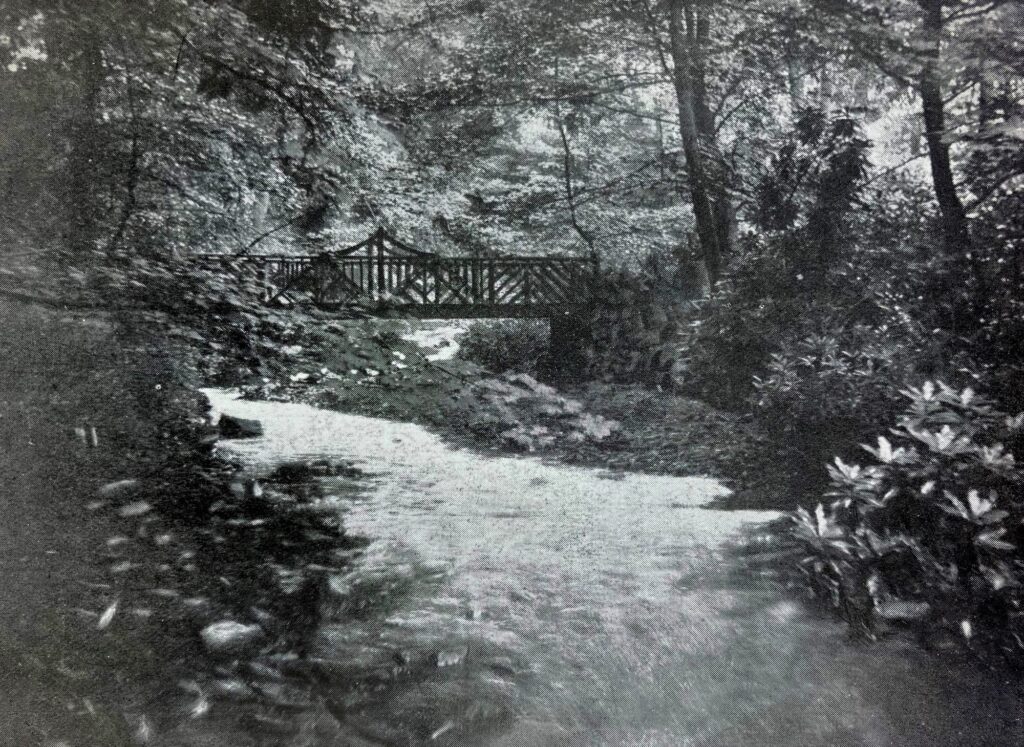
This area, being in the grounds of Glossop Hall, still retained its beauty. There was a picturesque bridge over the brook and supposedly a waterfall that could be heard from the Hall when the rains came down.
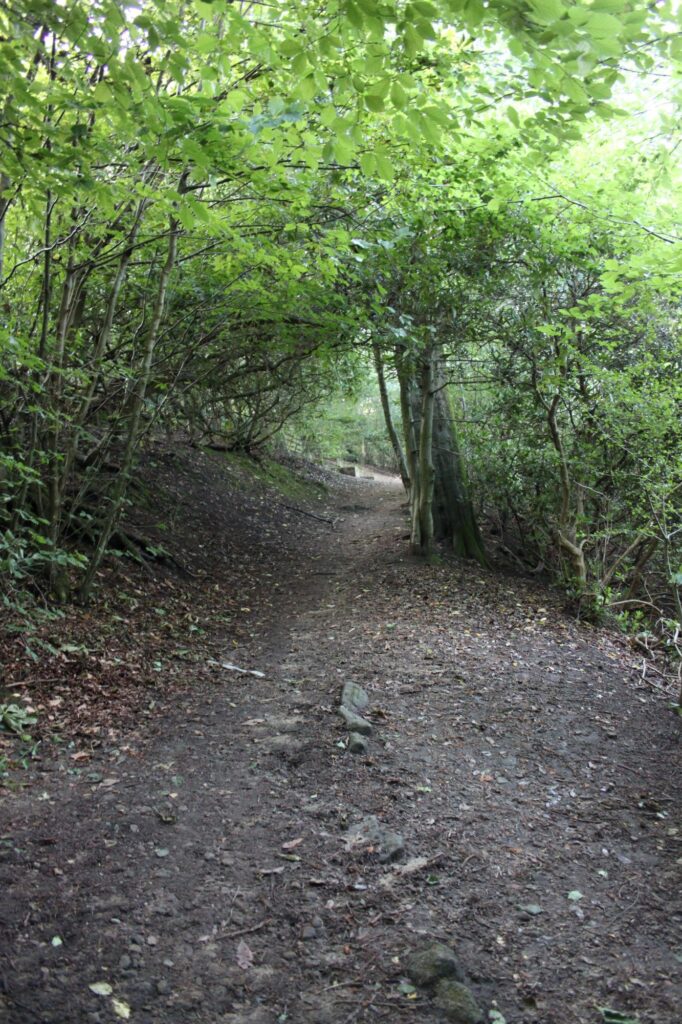
DIRECTIONS – Follow the path to your left up into the Woodlands. Stop after a little way when you are surrounded by trees.
Royle Hall, 1730s
‘Here hills with naked heads the tempests meet,
Rocks at their sides, and torrents at their feet’Pane of glass in Glossop Hall, 1795
Royle Hall was built in Glossop on Royle Fields about 1729. It was built by Ralph Standish Howard, as a home for himself, his wife Mary and infant son Edward. Ralph was the son of Lord Standish and Lady Philippa Howard. He had been given the Glossop-Dale Estate, as a younger son of Lord Standish to become his seat.
The Glossop-Dale Estate had been given to Jane, Dowager Countess of Norfolk in the 1680s along with other estates such as Rotherham. Jane was the second wife (and former mistress) of the 6th Duke of Norfolk. The Glossop-Dale Estate was then passed down her children, coming to Lady Philippa Howard after the death of her brothers.
Unfortunately, great tragedy struck and Ralph Standish Howard, his wife and son all passed away by the late 1730s and with them the Standish line. The Glossop-Dale Estate then reverted to the 9th Duke of Norfolk.

Henry Howard of Glossop
The 9th Duke recruited agents to manage the Estate. The Eyres lived on the estate from the 1740s. The children of Nathaniel Eyre were all born at Glossop Hall, including Vincent Eyre, later an agent of the Sheffield Estate.
In the 1760s, the succession of the Dukedom of Norfolk was in trouble. The 9th Duke was childless. His heirs, his two nephews, both died in their 20s. The new heir apparent was on the Greystokes line (a brother of the 6th Duke of Norfolk) and it was looking likely this line would also end up childless.
The heir presumptive was down the line of Bernard Howard (another younger brother of the 6th Duke of Norfolk). Henry Howard was born in 1713 and educated in Douai in France. He had become a vintner but got into financial difficulties. With the succession likely to go down this line, the 9th Duke of Norfolk assisted him, paid off his debts and made him the agent at Sheffield. In his new job at the age of 50, Henry quickly married and started a family.
Henry was given the Glossop-Dale Estate by the 9th Duke of Norfolk in a settlement in 1767, probably to prepare him and his descendants for the succession. Although an agent at Sheffield, Henry and his family may have spent some of their time living at Glossop Hall. His son, Bernard Howard, did become the 12th Duke of Norfolk in 1815. Before his death in 1842 he commissioned the Town Hall in Howard Town. The foundation stone was laid on the Coronation day of Queen Victoria.
Agents
When Nathaniel Eyre died at Glossop Hall in 1781 the Hall was of a fair size. It had a large parlour, little parlour, offices, bedrooms, kitchen, back kitchen, pantry, maids room and outbuildings including a beerhouse.
After the Eyres came Charles Calvert, who worked as a cotton merchant as well as the agent. During the 1790s Glossop Hall was often used as a shooting lodge. In 1797 the Ellisons arrived. Matthew Ellison and his sons Thomas and Michael were agents for the Glossop-Dale Estates. Michael Ellison later became the agent for Sheffield as well.
DIRECTIONS – Walk further along the path until you reach a set of steps on the path.
Glossop Hall, rebuilt 1850s

There was great change at Glossop Hall in the 1850s. The 13th Duke of Norfolk began to visit in the summer with his family and decided the old Royle Hall was not big or grand enough. In the early 1850s the Duke commissioned Matthew Ellison Hadfield (a relation of the Ellisons) to extensively enlarge, remodel and beautify the existing hall.

Some of the old hall was demolished and storeys and extensions were added. Beautiful Italian gardens were built at the rear of the hall and a stable courtyard. To the front of the hall a large, terraced lawn was constructed with steps going down to the lower grounds (now Manor Park).

The last set of steps are what you can see in front of you now.
At the same time as the hall was enlarged, a high wall was built around the site of the hall and all around the grounds that bordered Old Glossop and Hall Street (later Manor Park Road).
Ancient Pathway

An ancient pathway from Ellison Street to Old Glossop ran across the grounds that were enclosed. To keep this pathway open for the common man, the land was excavated and the steps from the terraced lawn created a tunnel overhead.
Old Well
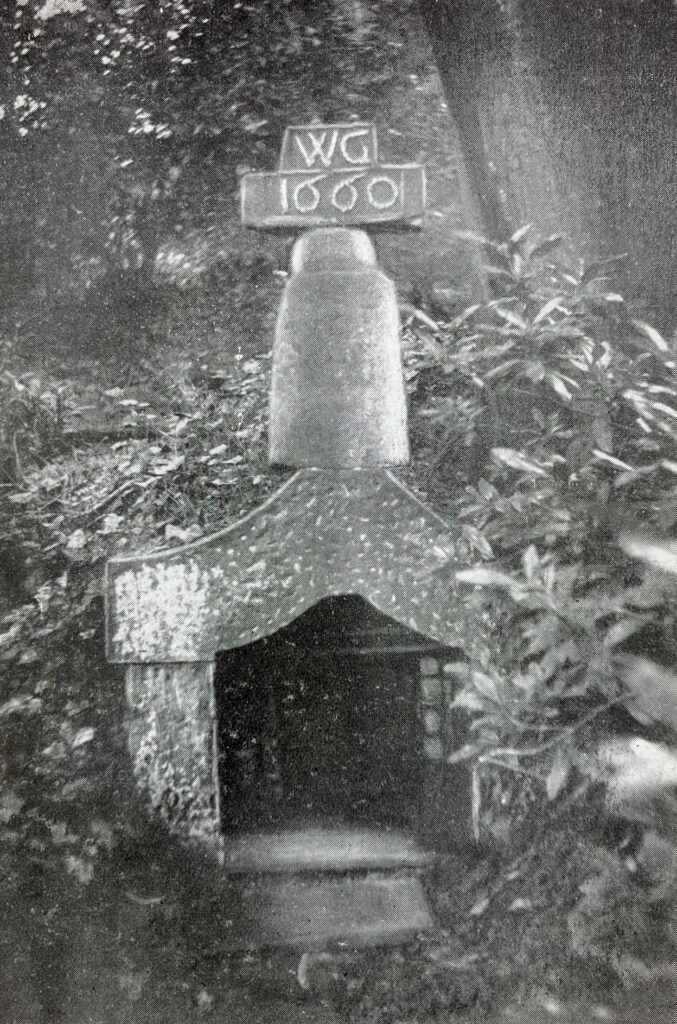
On one of these pathways is an old well (follow the path to right at the marker just past the steps. Some stonework of the well still remains). When the estate was sold in 1925 this was described as an old thatched well. In this photo from 1928 a topper dated 1660 has been added, but this was probably just stone work that was found elsewhere.
DIRECTIONS – Follow the woodland path a little way. In woods higher up to your left are the remains of an ice house (this is now filled in and nothing is visible above ground).
Ice House

From the OS map you can see this ice house was octagonal. This structure was an ice house and also a game larder. Glossop Hall during the times of the 1st and 2nd Lord Howards of Glossop was mainly used for entertaining and shooting parties. So a game larder would have been very necessary. The ice was probably taken from the nearby Beeley Clough.
Glossop Hall Extensions

On the death of the 13th Duke of Norfolk in 1856 the Glossop-Dale Estate and Glossop Hall was given to his second son, Edward George Fitzalan-Howard, 1st Lord Howard of Glossop (1st Baron Howard of Glossop from 1869). He did not visit much before the 1870s, as he was an MP for Horsham and also the guardian of his nephew, who became the 15th Duke of Norfolk in 1860 at the age of 12.
From the 1870s he began adding extensions to Hall. His son, Francis Edward Fitzalan-Howard, 2nd Lord Howard of Glossop also added more storeys and extensions. By the 1900s there was a chapel, campanile tower and the Hall had become a large and rambling building with over 60 rooms. The 2nd Lord Howard of Glossop was big on the social scene in London and mainly used the Hall as a large shooting lodge for entertaining.
The Hall and the grounds were put up for sale as part of Glossop-Dale Estate in 1925 after the 3rd Baron Howard of Glossop decided to move to his wife’s estate, Carlton Towers in Yorkshire.

Some of the features in Glossop Hall were older than the Hall itself. One of the fireplaces was dated 1672. This were supposedly taken from Hadfield Old Hall, which still exists in Old Hall Square, Hadfield and has a date stone of 1646.
Although there have been memories mentioning priest holes, there was no real need for any, as the earliest part of the Hall was not built until the 1730s. However, there was a sacristy (small room for a priest) in the chapel and a secret panel in the hall that lead to the cloak rooms.
DIRECTIONS – Follow the woodland path across the small bridge. Stop a little way along this path.
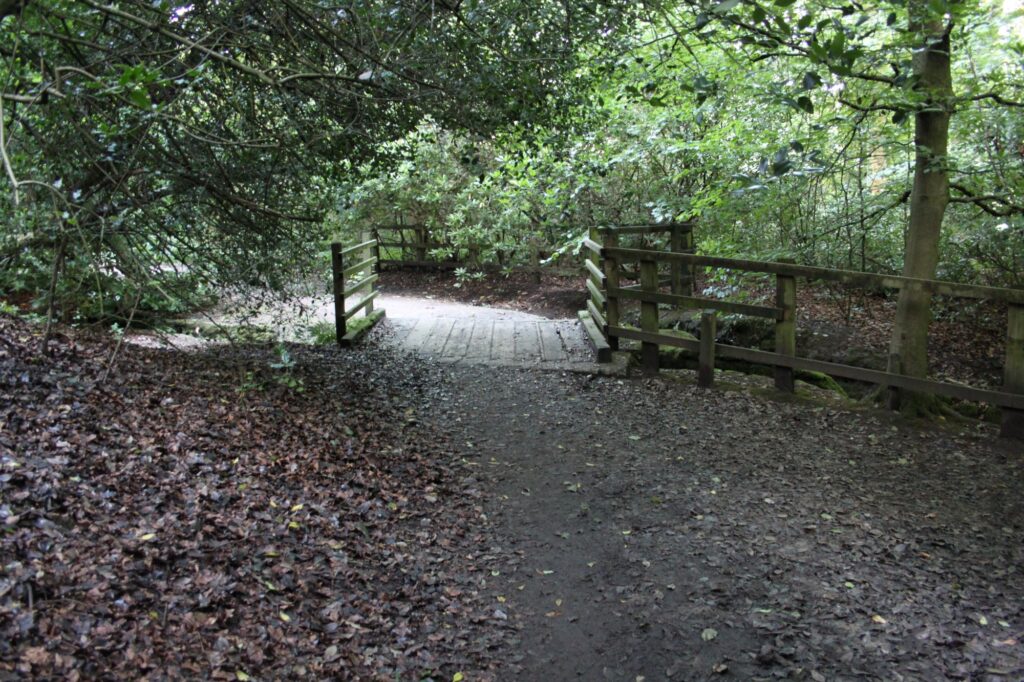
Kingsmoor School and Demolition

The lots for Glossop Hall and grounds did not sell at the sale of the Glossop-Dale Estate in 1925. Many of the lots were purchased by a middleman and then sold over the next few years. In 1927 a deal was made with Glossop Borough Council, who purchased the Hall and its grounds. Part of the grounds along Norfolk Street were sold for housing and part was made in the Manor Park. The Hall was leased to Kingsmoor School, which had formed in 1926 in Marple.
The school was a private boarding school. Despite a constant financial struggle, it rose to some prosperity and in 1949 purchased the Hall from the Council. However, by the mid-1950s it was struggling again financially and in 1956 it went into liquidation. The school moved out, first to Romiley and then to the old St Andrew’s School in Hadfield.
Demolition
Glossop Hall, then in the hands of the liquidators, remained empty. The Hall was a large and rambling building that had suffered from years of poor maintenance. It was offered for sale to the County Council as a new grammar school and to Glossop Borough Council, but no good use could be found for it.
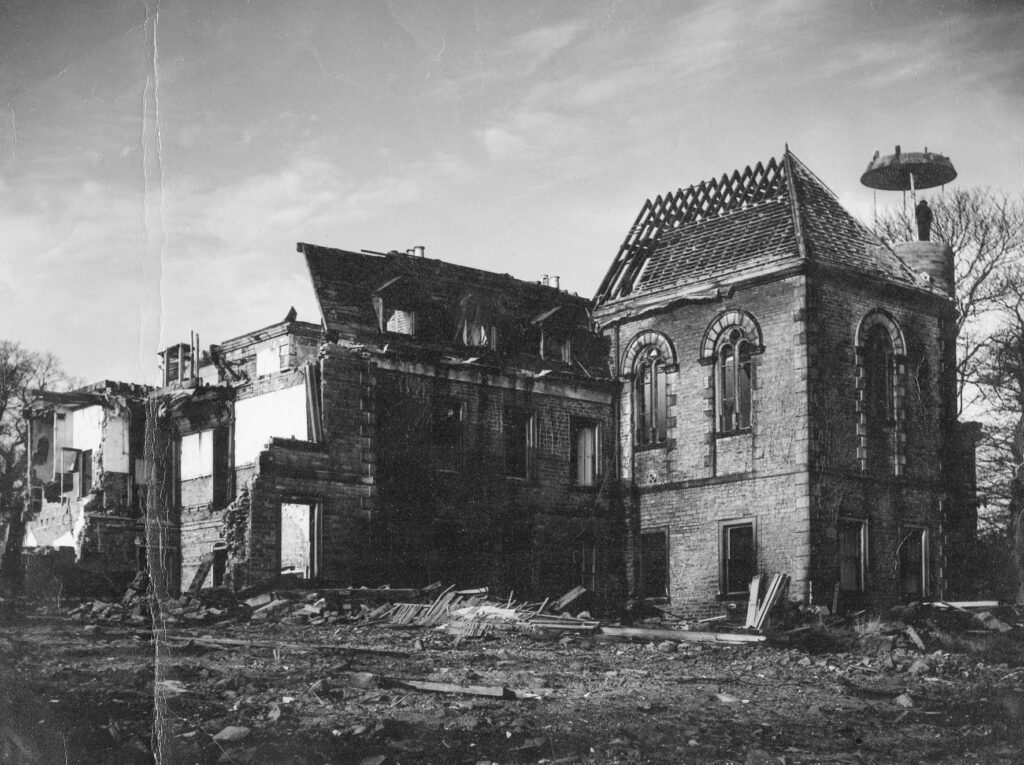
It was finally sold to housing developers, then demolished over a few years in the late 1950s-1960. It was replaced by the bungalows that stand there now with some of the stone from the Hall used to build them. You can see how the Hall fit the current site on the National Library of Scotland maps website.
DIRECTIONS – Follow the path ahead until you reach a clearing with the shed for the miniature railway.
Manor Park Miniature Railway
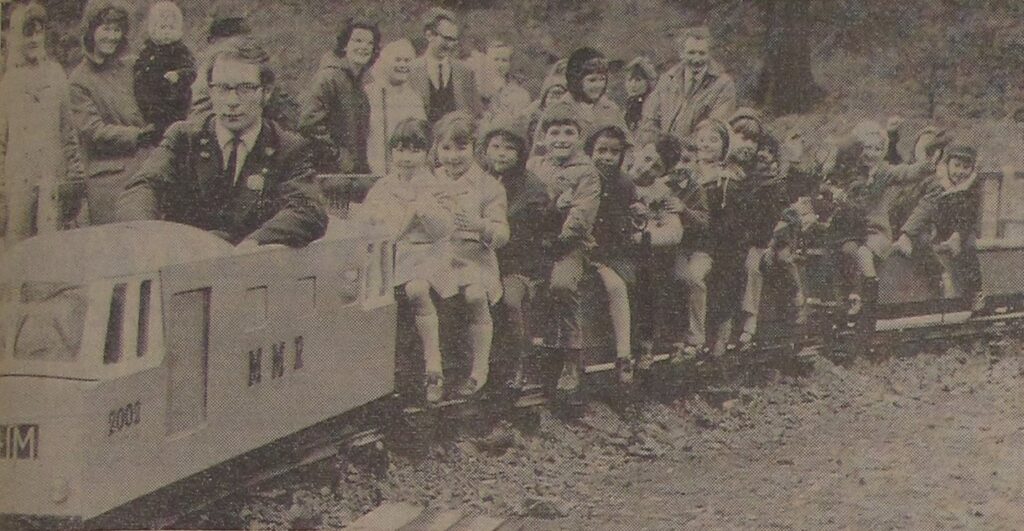
On Good Friday 1970 the miniature railway was first opened for children to enjoy. It had been considered for over a decade, but not constructed due to lack of space.
DIRECTIONS – Walk into the park area and look across to the football fields.
First Ice House, 1850s-1870s

In 1975 an archaeological dig took place in the far corner of the woodland that uncovered a large brick lined pit. Further research has suggested this was an ice house. The 1857 Poor Law Map shows that there was a pond in this area and the ice house was on the edge of this.

The pit had been filled with sand and bottles mostly dating from 1870s. This may have been an ice house from when Glossop Hall was enlarged in 1852, but filled in around 1870s when a new ice house was built in the woodland higher up closer to the Hall.
DIRECTIONS – Turn around and look at the buildings in front of you.
The Farmery
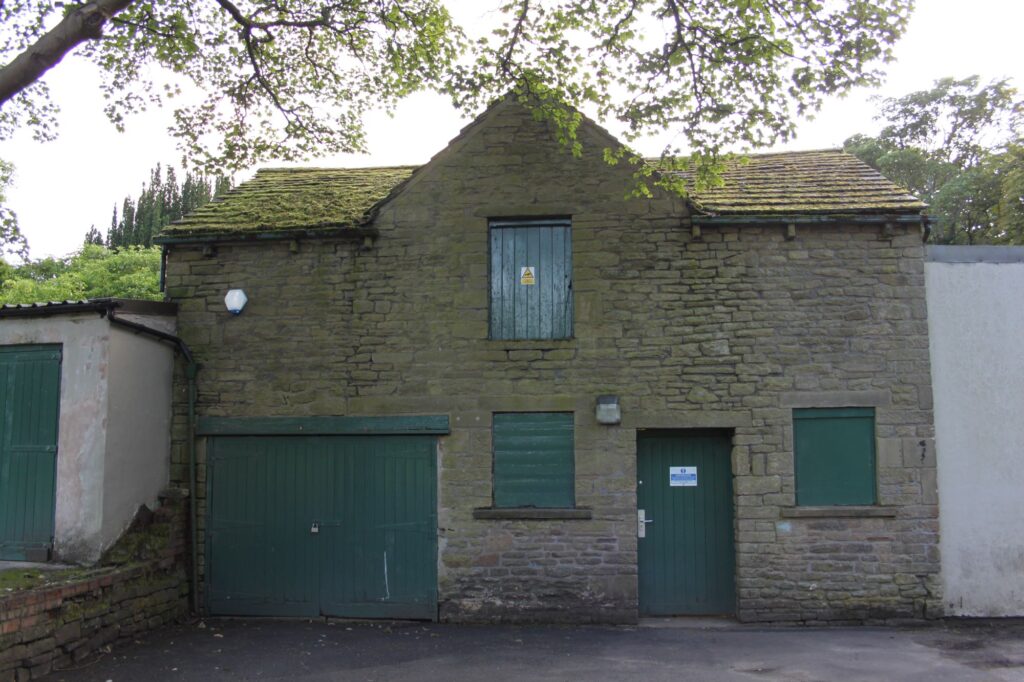
This is probably the oldest surviving building within Manor Park. This building formed part of The Farmery according to the 1925 sale catalogue of the Glossop-Dale Estate. The Farmery dates from around the late 18th Century and consisted of a shippon (cow shed), forage room, bothy (which this building is sometimes referred to), pig cotes, poultry run and hen cotes.
The Farmery would have been important to the estate and used to supply eggs, bacon and milk to the residents of Glossop Hall.
DIRECTIONS – Enter the Rose Garden to your right and admire the beautiful flower displays.
Glossop Hall Kitchen Garden
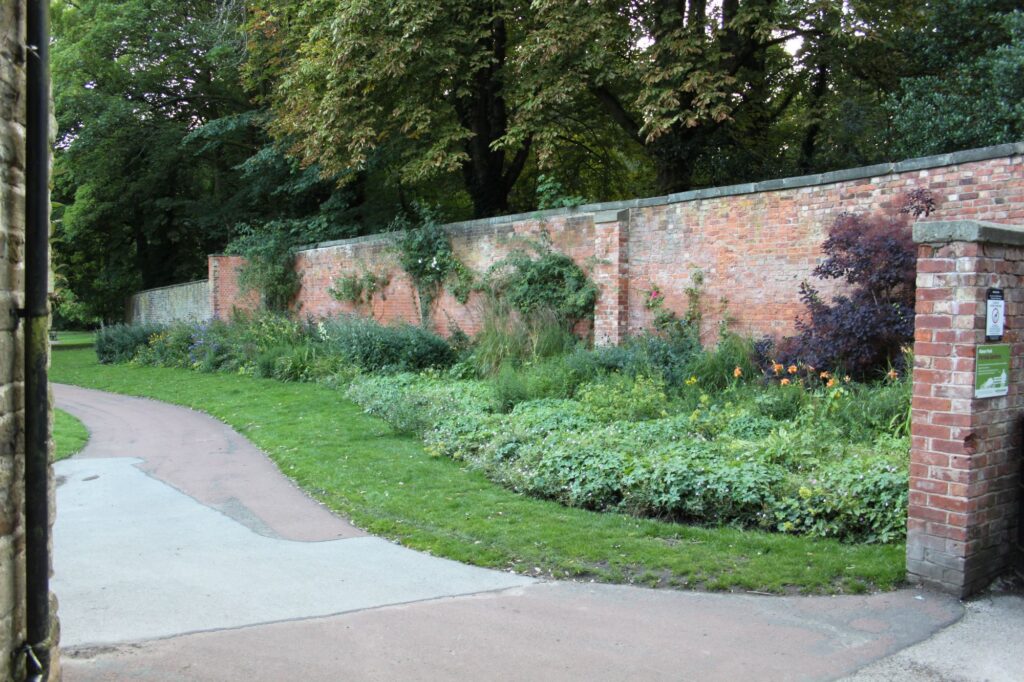
What is now the Rose Garden was the kitchen gardens to Glossop Hall. The area by the wall had greenhouses all along it in the 19th Century.

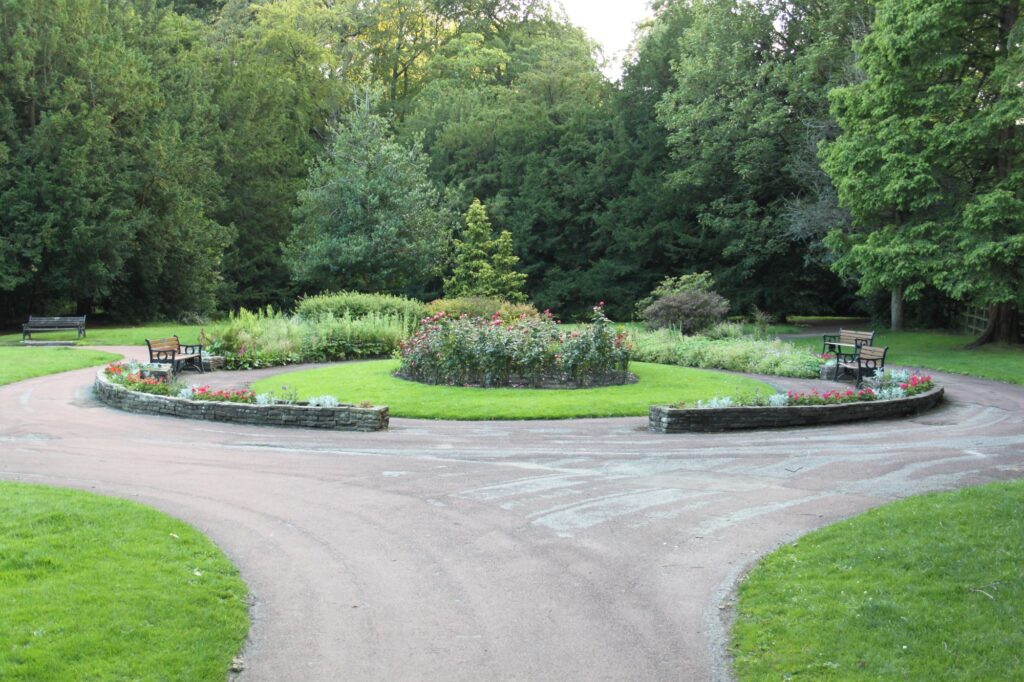
DIRECTIONS – follow the path ahead until you reach the circular Garden of Remembrance.
Garden of Remembrance, Rose Garden
The newly formed Glossop Branch of the Royal British Legion dedicated the Garden of Remembrance, for those that had lost their lives in World War One, with a Drumhead Service in July 1931.
Members of the Legion had worked hard creating the garden in their spare time. The garden contained about 1000 red roses. Irish yews had been planted around them to represent mourning. The seats in the garden were made of wood from HMS Powerful that had just been broken up in Northumberland.
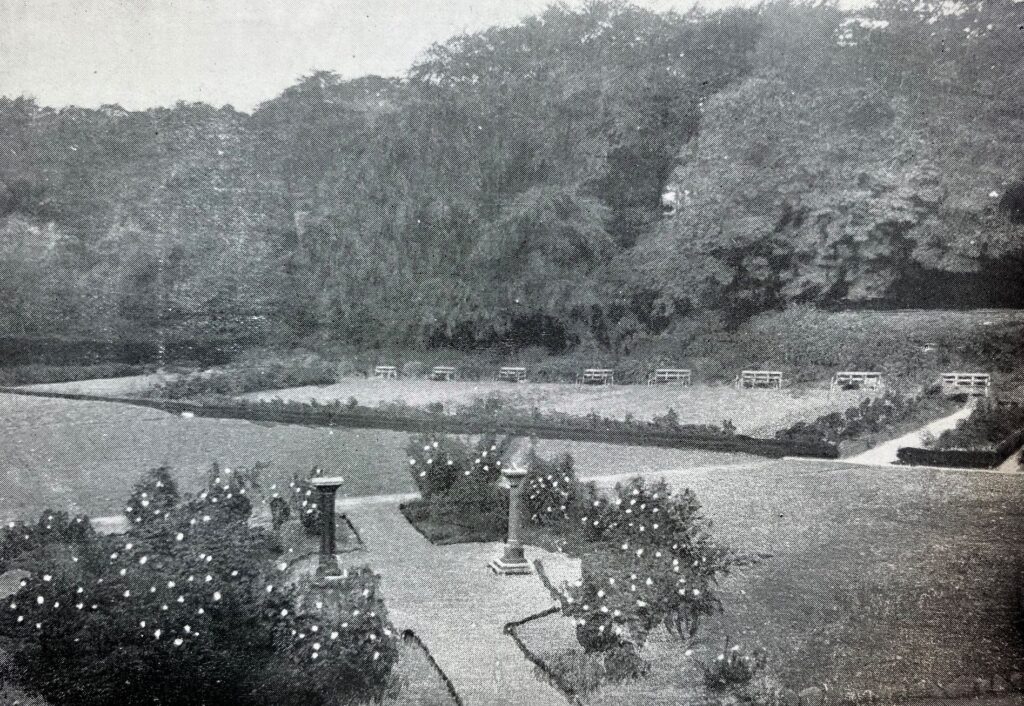
The Rose Garden was severely damaged in the floods of 1944 during World War Two. After the War gifts and public subscriptions were raised to restore the gardens in honour of those that had died in both Wars.
The Glossop Branch of the Royal British Legion have held Drumhead Services in the Garden from the 1930s-1980s and then in 2014 to mark the centenary of the outbreak of World War One and 2023 in thanksgiving of the Coronation of King Charles III.
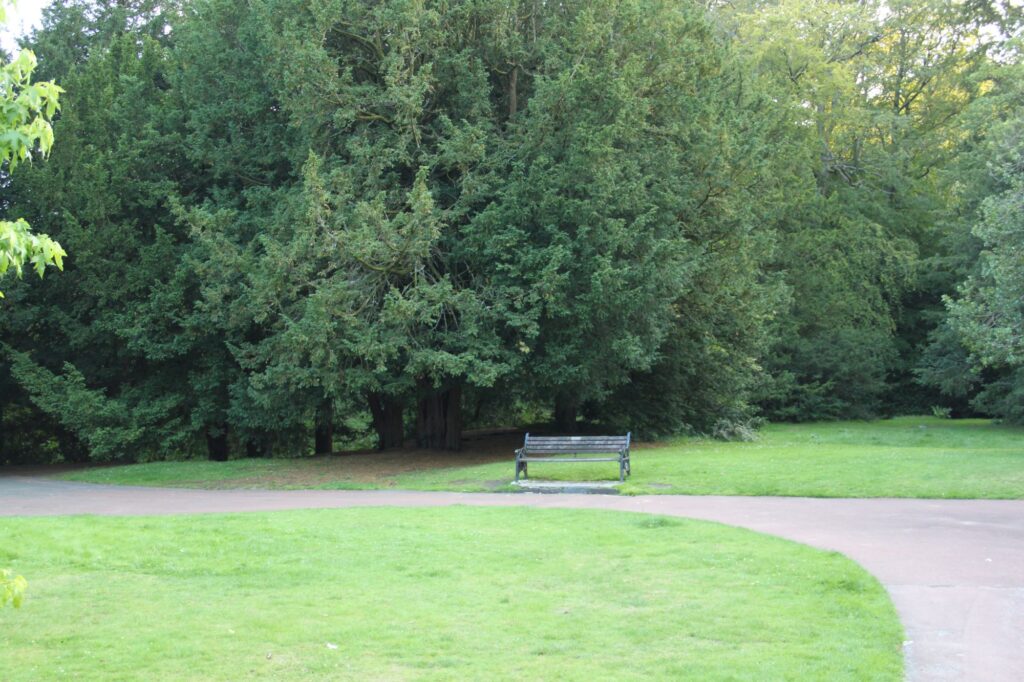
DIRECTIONS – Follow the path around. Near the bench before the bridge you will see the remains of a building.
Folly
You can see on the OS map the remains of a small building and a wall. The building most likely dated from the late 18th Century. This area was a flood plain and at this time the brook was lowered and realigned. There was also a fish pond created nearby.
The building was most probably a folly. In 1945, the Glossop Chronicle reported that the tiny stone building had lost its diamond paned light leaded windows and its oaken door through vandalism. It had a slated roof and a cross on top. It was surrounded by a wall and was obscured from view by yew hedges.

It may even have been the ‘Nun’s Retreat’ summer house mentioned in the 1925 sale catalogue. The nuns at the convent at Town End (now Church Close) and the Vicar at The Vicarage had access to the grounds of Glossop Hall. Near the building were some dog’s graves, one-time residents of the Hall.
Some may remember the little building in later years, when it was used to store some of the paddle boats that were used on the lake. It was eventually demolished with just the few remains you see today.
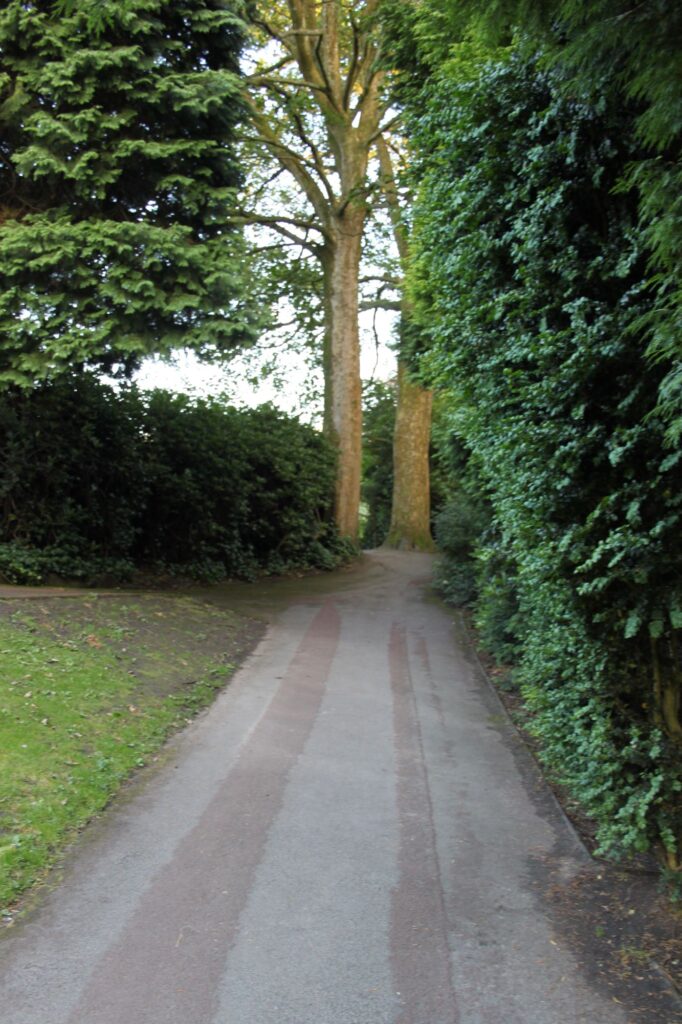
DIRECTIONS – follow the path to the left. Go up the steep path between the two trees into the main park.
Putting Green and Tennis Courts
When Glossop Borough Council purchased and laid out Manor Park, they did their best to create a place of leisure for the people of Glossop. They had purchased the grounds of Manor Park for £8,200 and over the next few years into the 1930s they spent another £4,500 on development of the Park (nearly £1 million today).
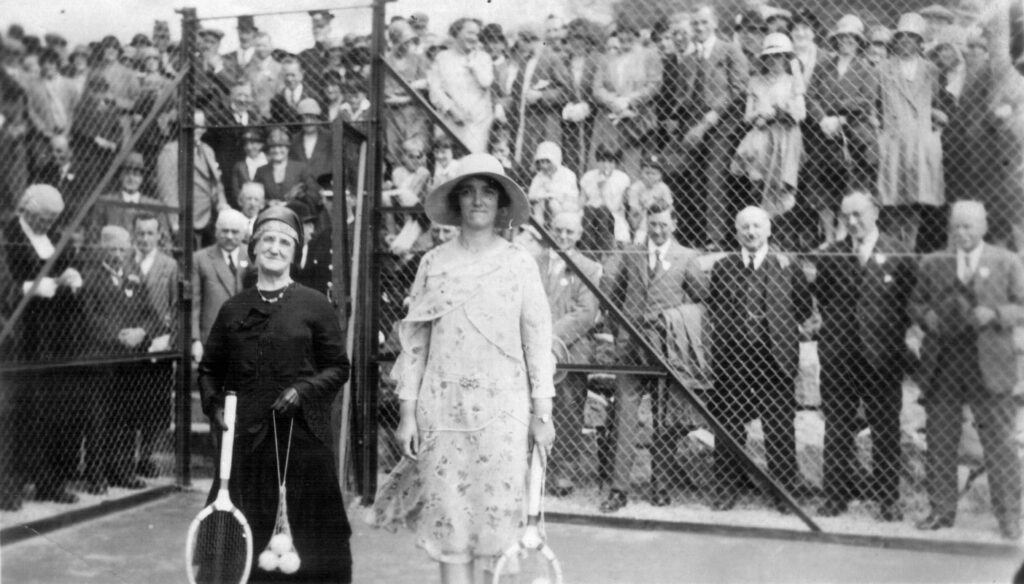
One of the first things to be built were four tennis courts in 1927. These were very popular and there was a Glossop Tennis Championship held for many years.
The putting green was opened in 1930 and later became the crazy golf course you see today.
DIRECTIONS – walk along the path towards the lodge with the tennis courts on your right. Just before the lodge is the where the aviary once stood.
Aviary
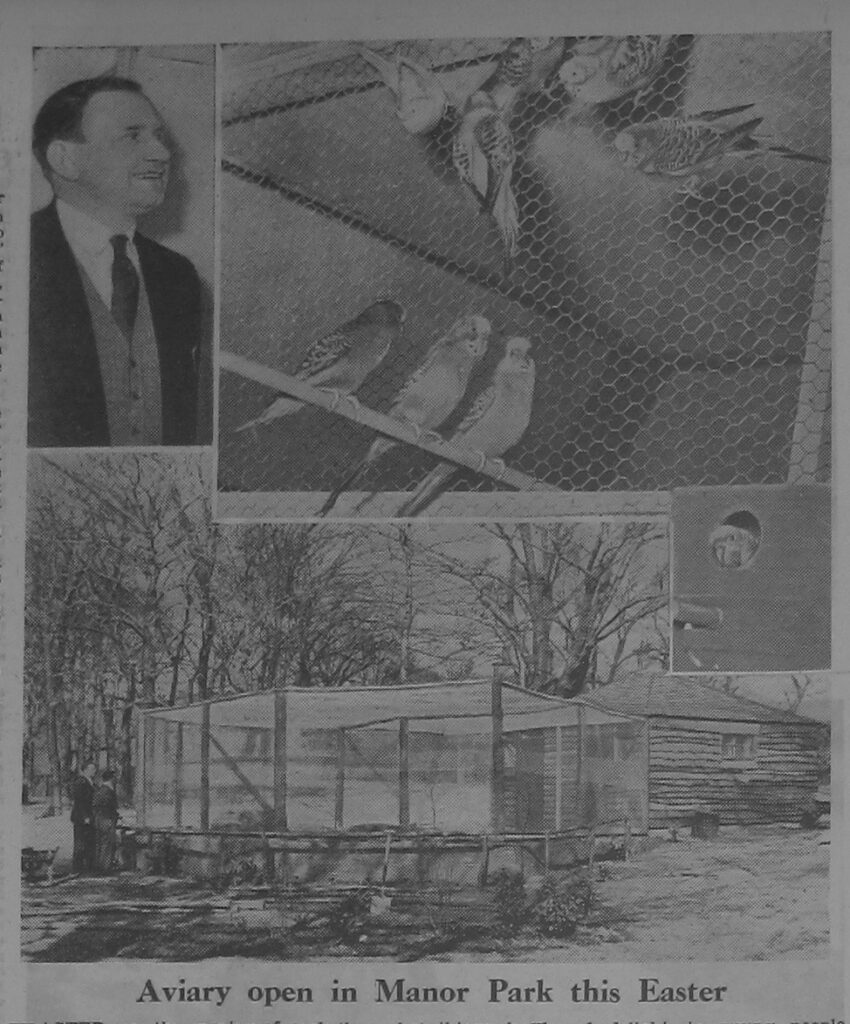
At Easter 1955, an aviary was opened in Manor Park. This had been built with money from the Isaac and Harriet Jackson Trust. The trust had been set up by the owners of Jackson’s Belt Fasteners to benefit the town even after their deaths.
Many local residents supplied birds including budgies, pheasants, zebra finches, barbary doves, as well as rabbits and guinea pigs.
A star of the show was a myna bird called Ringo, who had learnt some undesirable words from younger visitors. Local resident, Ivan Bell, also told us the tale of Fred the monkey. Ivan had brought Fred back, as a baby, from his travels in Africa in the merchant navy. After staying at Ivan’s home and then Howard Park, a home was made for Fred in the aviary. He rapidly grew into a 3 ft 6 teenager and after a fight with a peacock ended up being transferred to Chester Zoo.
The aviary provided much enjoyment for many years. In 1995 it was showing the signs of age with poor cladding and the roof in danger of collapse. It was decided there was too much to repair and the aviary was closed and demolished.
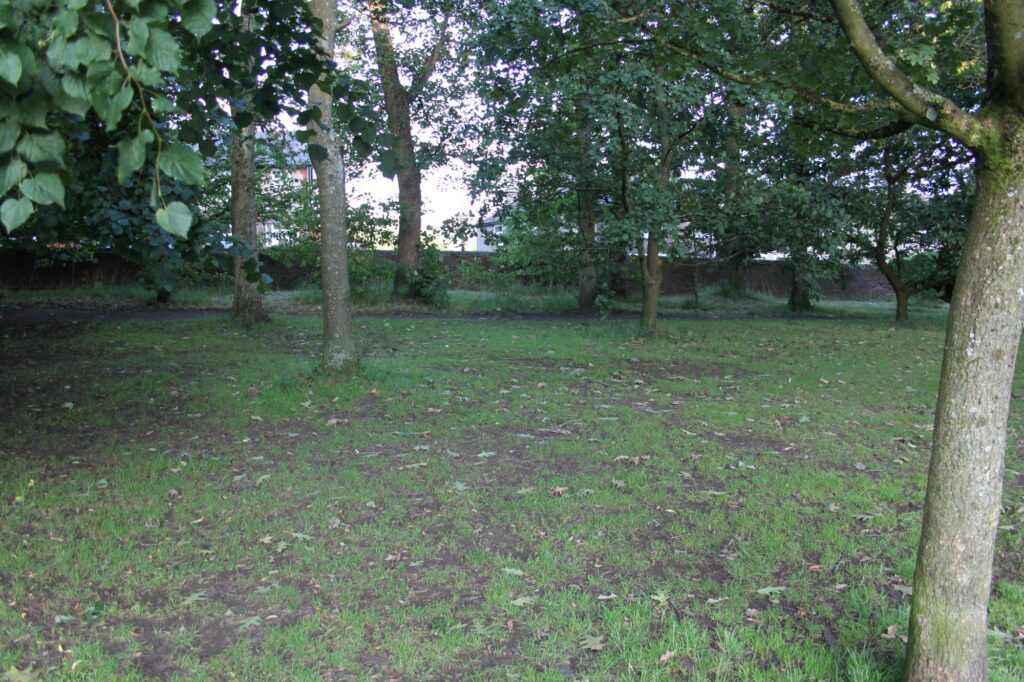
Boundary Wall
The wall you can see along the edge of the park was the wall that was built in the 1850s to surround the Glossop Hall estate. At that time, the wall was much higher and outsiders could not get a view into the grounds.
It was seen as a privileged space when on the outside. One memory from the walk was of a lady’s grandmother that remembered being allowed into this part of the grounds on May Day for celebrations. These events were the only times locals would see in, until the grounds were purchased in 1927.
A comment made after the purchase was utopia would only be achieved “when the wall along Manor Park Road is demolished and replaced by railings so that we can admire the park as we go along”. The wall, as you see it today, was reduced in height around late 1950s/early 1960s.
Wishing Well

The cobbled area on you left by the lodge once contained a wishing well.
DIRECTIONS – A little way forward on your right is the opening plaque for Manor Park.
Manor Park Opening Plaque
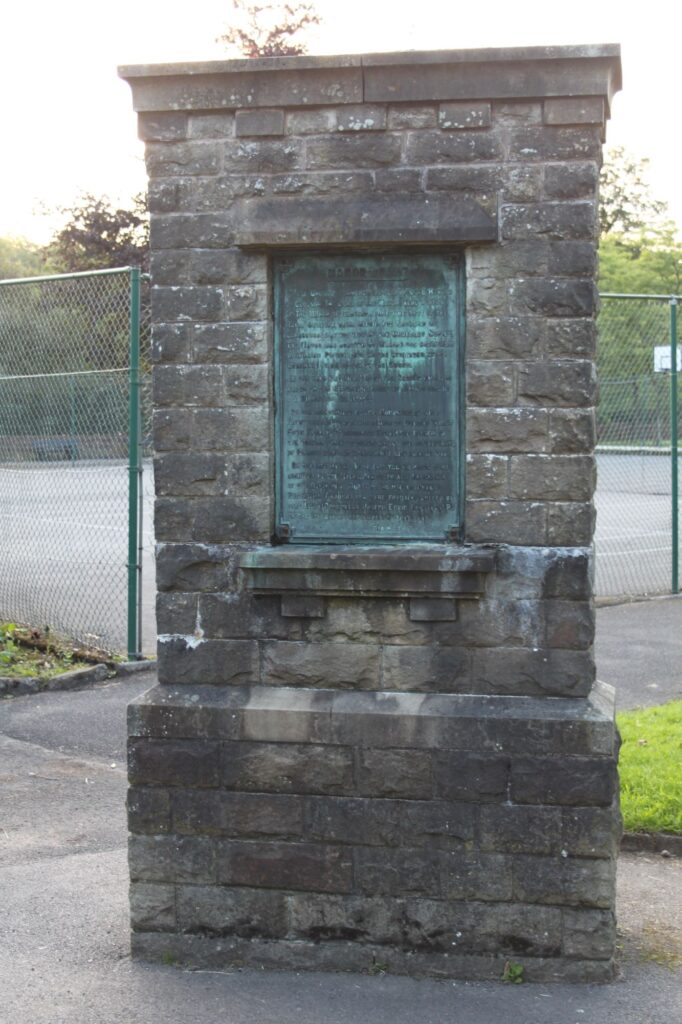
“Manor Park
These grounds formerly the seat of Lord Howard
of Glossop (The Lord of the Manor) were portion
of The Manor of Glossop at one time part of the
Royal Demesne being within the Lordship of
Longdendale at the time of the Domesday Survey
the Manor was granted by William the Conqueror
to William Peveril but on the attainder of his
grandson it reverted to the Crown.In the year 1157 King Henry the Second gave the
Manor to the Cistersian Abbey of Basingwerk in
the Diocese of St Asaph.On the dissolution of the monasteries King
Henry the Eighth gave the Manor to Francis Talbot
Fifth Earl of Shrewsbury. The Manor passed to
the Howard Family through one of the co-heiresses
of Gilbert Earl of Shrewsbury who died in 1616.On the 29th day of April 1927 the grounds were
acquired by the Mayor, Aldermen and Burgesses
of the Borough of Glossop, for use as public
recreation grounds and were formally opened by
the Mayor (Councillor Joseph Edwin Buckley, J. P.)
on the 17th Day of September of that year.Geo. H. Lea, Town Clerk”
Manor Park was opened amid grand celebrations on 17 September 1927. On the same day was the opening of a renovated Norfolk Square, the Rose Queen Pageant in Old Glossop and Whitfield Well Dressing.
There was a procession to Manor Park and then an opening ceremony unveiling the plaque in front of you. This was followed by competitions and entertainments including the most humourous character on a horse or donkey and coconut shies, a helter skelter and a treasure hunt.
DIRECTIONS – With your back to the plaque, Manor Park Pavilion is on your right.
Manor Park Pavilion
The pavilion was a big feature of the park. It had been opened on 19 March 1932 and contained a kitchen and tea room for refreshments. There were also changing rooms for the tennis courts and bowling green. The pavilion is built of stone some of which came from local quarries.
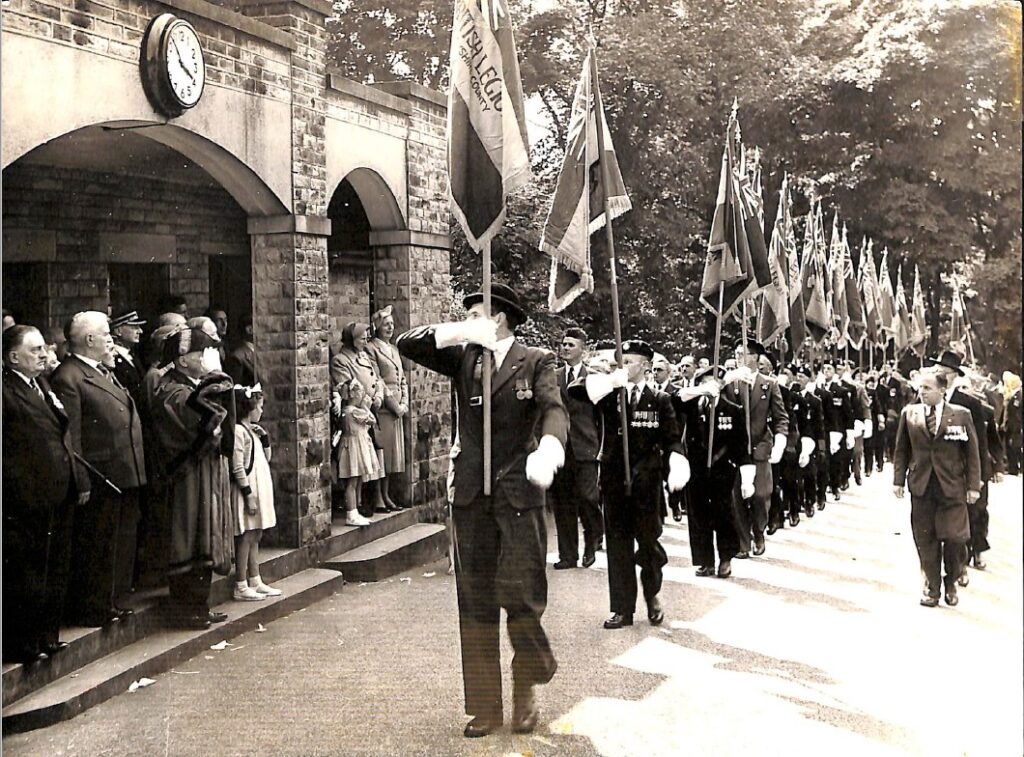
At the Coronation of Queen Elizabeth II in 1953 the Townwomen’s Guild gifted an electric clock to be placed on the pavilion. It can be seen in this picture of a parade of the Drumhead Service of the Royal British Legion.
The Manchester Parks Superintendent, Mr Pettigrew, who had been advising the Council on the layout of the park, called Manor Park ‘a perfect paradise’. He added that there was nothing in Manchester to compare with what we have here.
DIRECTIONS – with your back to the plaque, the lodge and gates are on your left.
Lodge and Gates
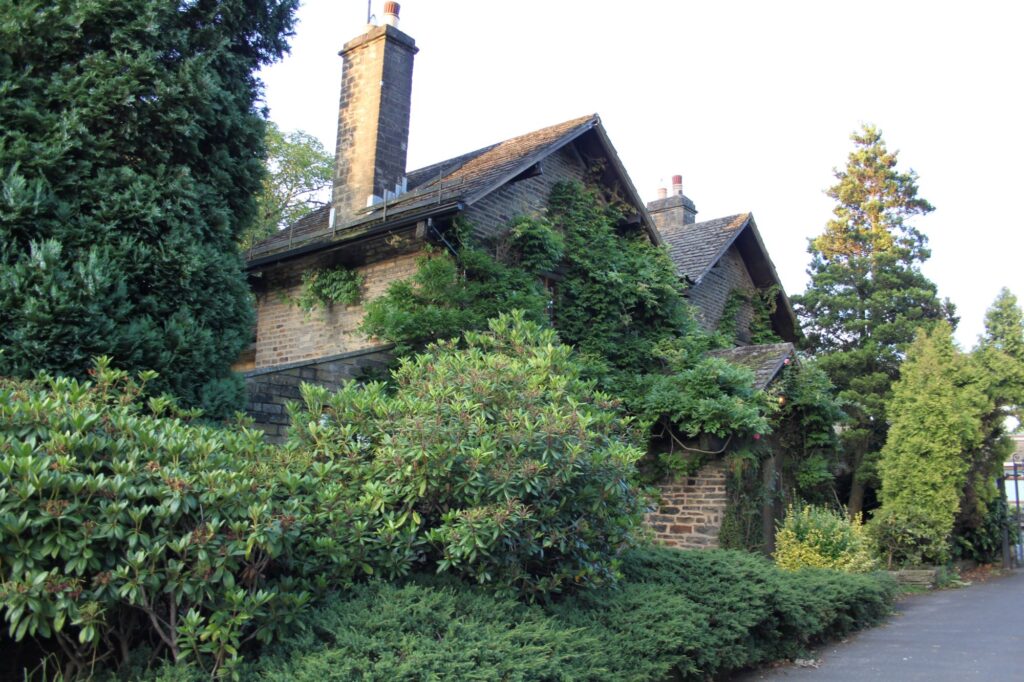
There were still many remnants of the former Glossop Hall. The lodge that was built for the Hall was lived in by the Parks Superintendents. Walter Waterworth kept a big greenhouse at the back of the lodge, where he grew a variety of plants including some exotic ones.
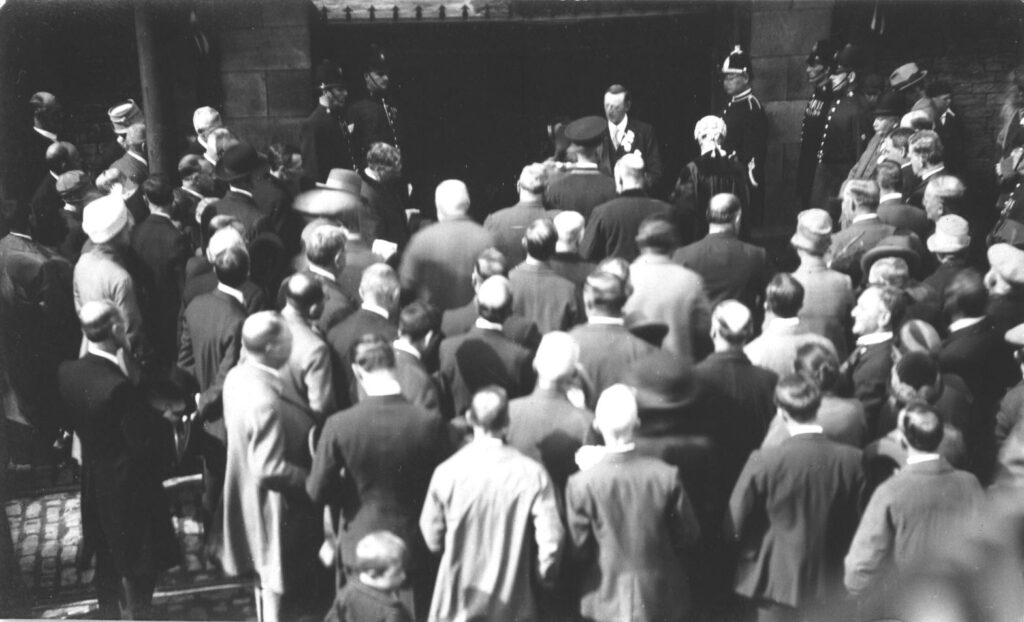
In 1927 the huge ‘barn gates’ by the lodge were another feature of the old Hall that many were eager to change.
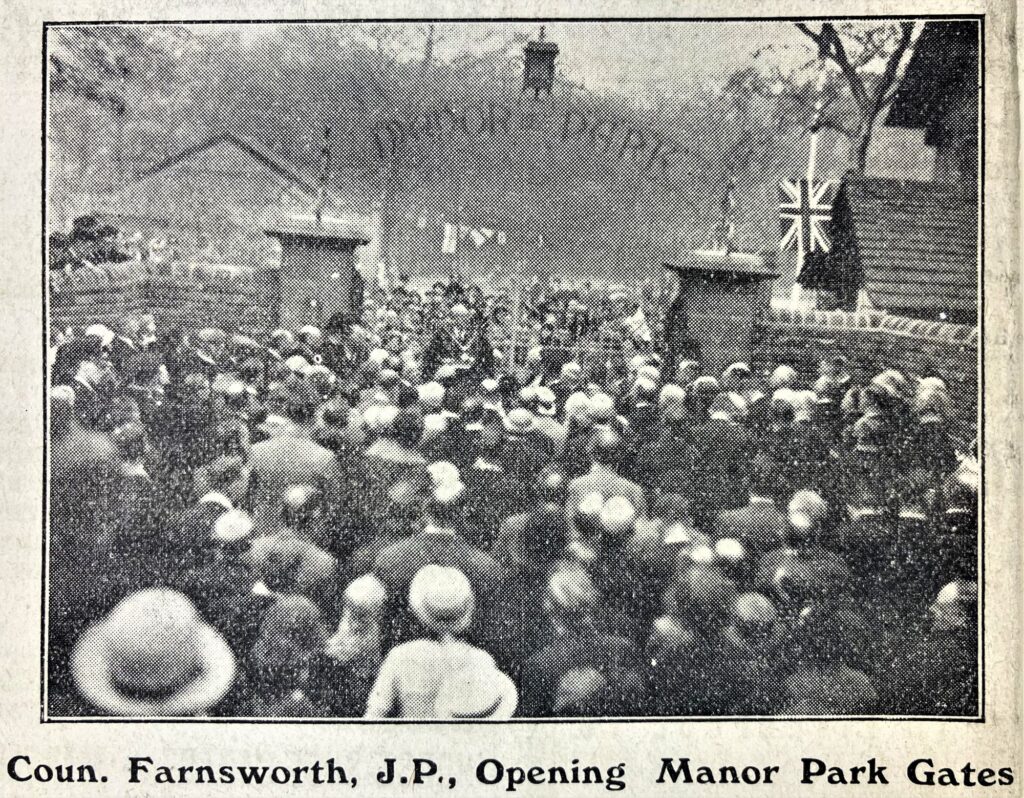
At the Silver Jubilee of King George V in 1935 new iron gates were constructed. The gates which had an arch over the top with “MANOR 1935 PARK” were opened in a ceremony by the Mayor Tom Farnsworth.
Several decades later the gates mysteriously disappeared and there were many rumours as to their fate. A retired Council worker, Jack Robinson, eventually cleared up the mystery. They were knocked down by a horse box going into the park for a gymkhana in 1967. They were so badly damaged they couldn’t be repaired and had to be scrapped.
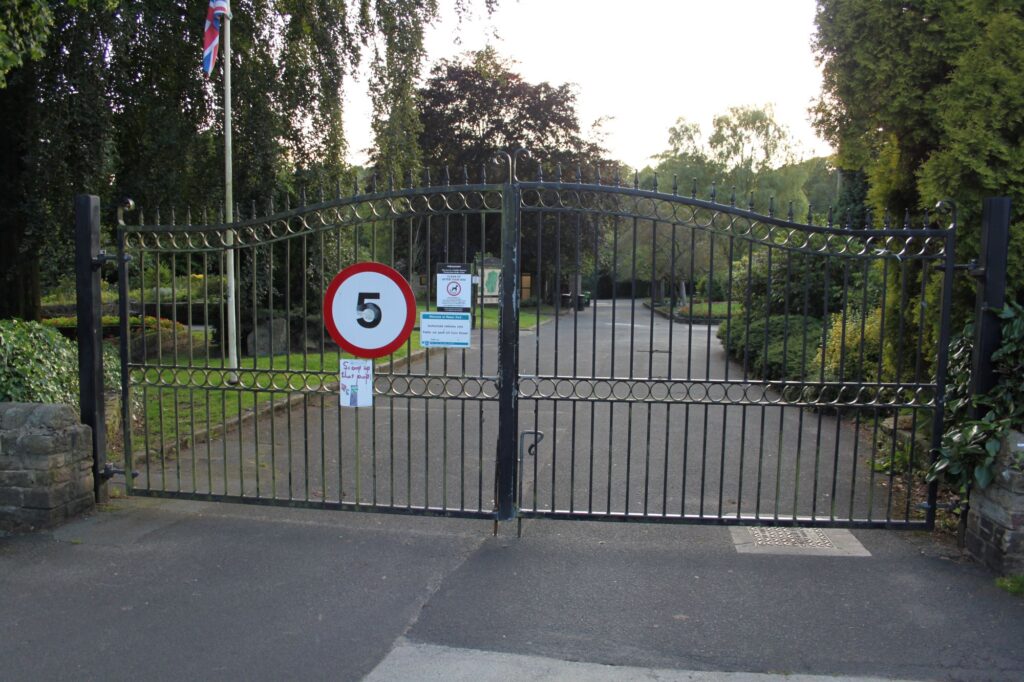
In 2007 new gates were unveiled that had been constructed locally by Brotherton Engineering in Dinting.
DIRECTIONS – Follow the path to your left to enjoy the sensory gardens.
Sensory Garden
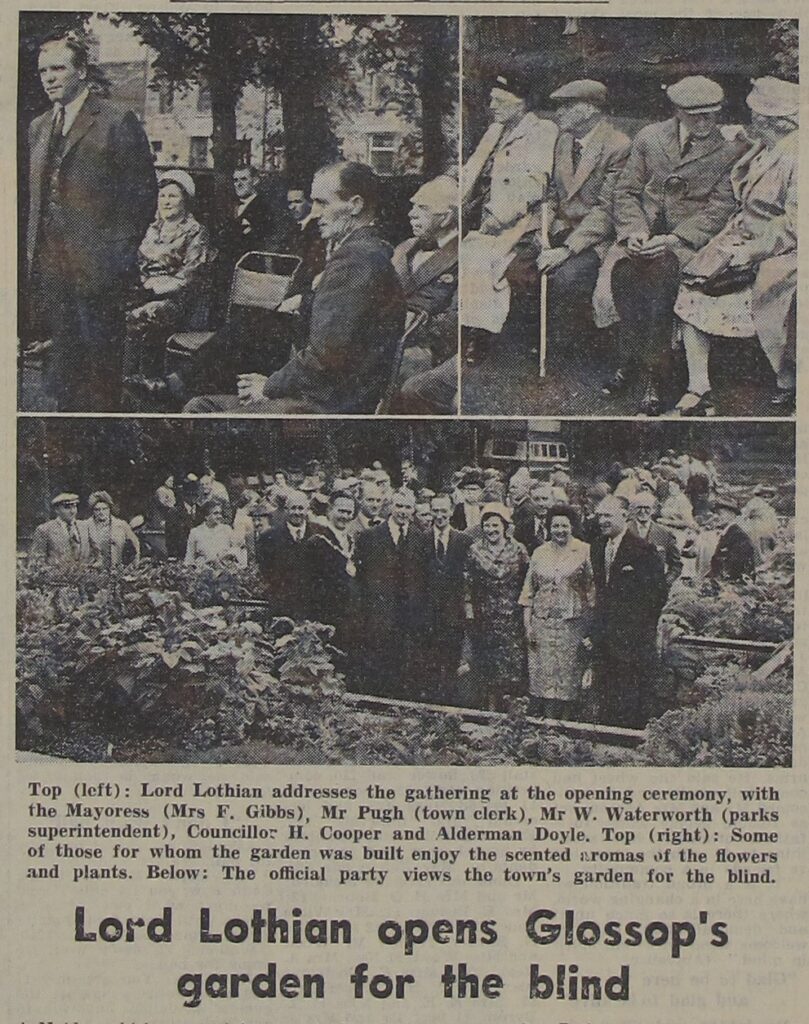
These gardens were opened as gardens for the blind in July 1960. They were opened by Lord Lothian, Chairman of Derbyshire Association for the Blind.
The garden was designed by Parks Superintendent, Walter Waterworth. It contained over 300 plants including roses, herbs, tobacco plants and geraniums.
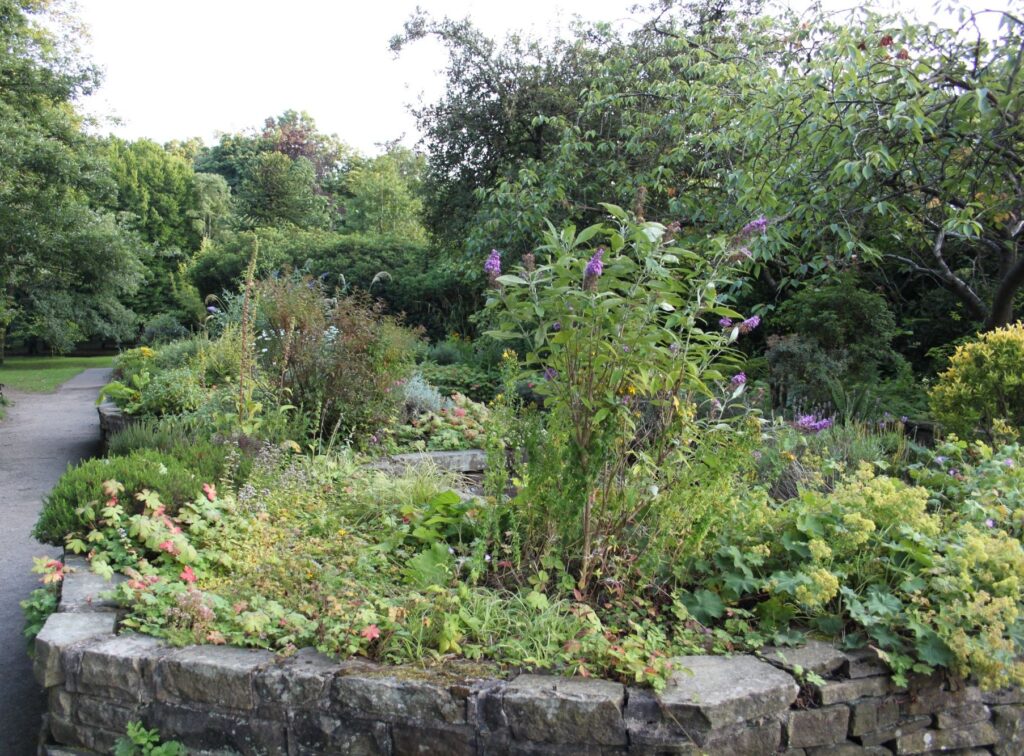
The garden is still maintained as a sensory garden with sweet smelling herbs and flowers at an accessible height.
DIRECTIONS – Turn right and go down the steps to the bowling greens.
Bowling Greens
The bowling greens were opened in May 1931 as part of the initial development of the Park. The greens were laid out by Messrs. Conway of Halifax.
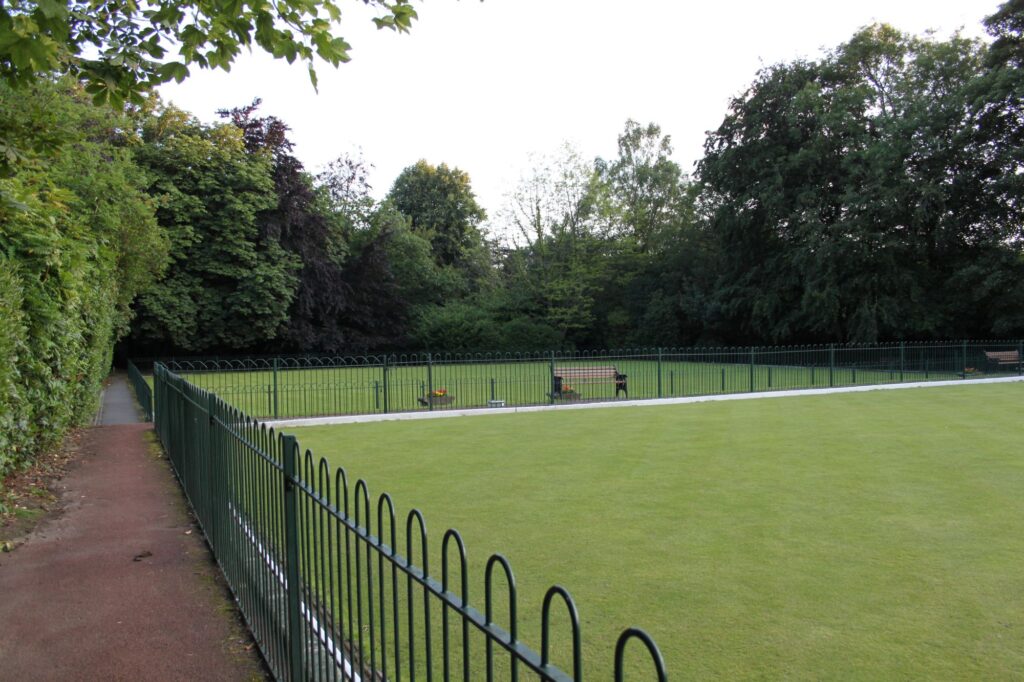
It was hoped that the “people of Glossop who patronise these greens, derive much pleasure and happiness therefrom for many years to come.” The Council back then would be pleased to know that these greens are still well used 92 years on.
Just beyond the corner of the lower bowling green, a commemorative oak was planted by Councillor Beckmann for the Coronation of King George VI. The exact tree has not been identified. Many commemorative trees have been planted in the parks around Glossop over the years.
DIRECTIONS – walk on the path between the two bowling greens. Turn left and follow the path down towards the brook. At the fork in the path look over to the playgrounds.
Playgrounds

There were spaces for children in the new Manor Park. This photograph from 1928 shows children enjoying a paddling pool, witch’s hat and a very steep slide.
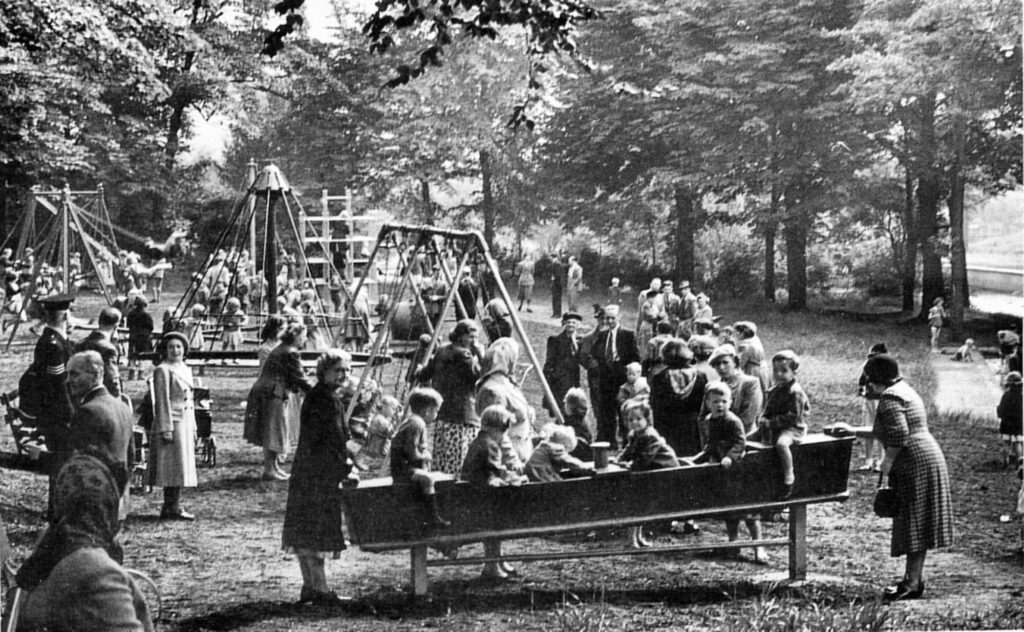
In 1950/1 a new much larger playground was laid out. This had been the idea and project of Alderman Sellars, who had spent a few years fundraising to bring it about.
In 2006 the current playground was laid out and across the car park a skate park was built for older children and teenagers.
DIRECTIONS – return to the bridge where you began the walk.
END OF WALK
We hope you enjoyed the walk. Please consider supporting us to help us preserve and share more of Glossop’s stories and history.