
Glossop High Street
Then and Now
This page tells the story of the images that Glossop Heritage Trust displayed as one of the exhibitions of Dark Peak Photo Festival in Victoria Hall from 22-25 February 2024.
High Street Map
Hunters the Teamen, Grocers, 4 High Street East
Then
Now
George Ollerenshaw had been born and brought up in Glossop on Queen Street. His father, Robert Ollerenshaw was a Cotton Weaver and later a Slater and Plasterer.
In 1871, at the age of 14, George was working as a Cotton Weaver. Many of those born in Glossop in the mid 19th Century started their youth in the cotton mills before becoming successful tradesmen.
George moved to Blackburn, Lancashire in the 1870s and learnt the trade of a tea dealer. He was very successful and made his fortune in the ‘wilds of Lancashire’. By 1891, he employed two servants in his house in Blackburn.
He returned to Glossop just before 1900 and lived in a grand house on Talbot Road. By this time he was the Managing Director of a limited company – Hunters the Teamen, which he set up in 1897. In 1903 he gifted the building of Whitfield Library (where Whitfield recreation ground is now).
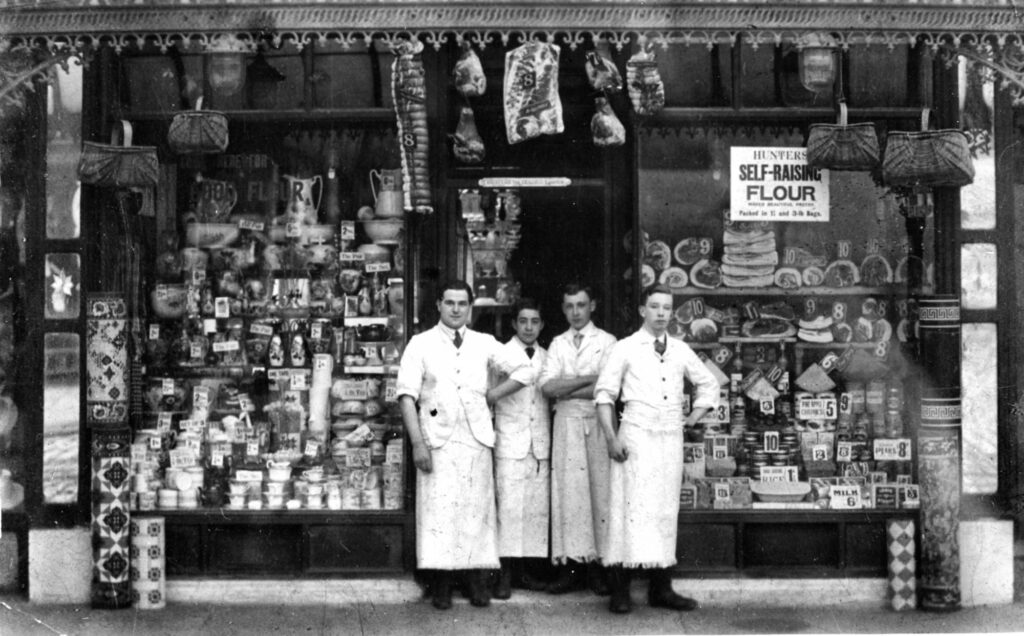
Hunters the Teamen had branches all over the North of England in the early 20th Century. They specialised as tea dealers, as well as being grocer and provision dealers. You can see from the number of products in the window that they sold a bit of everything.
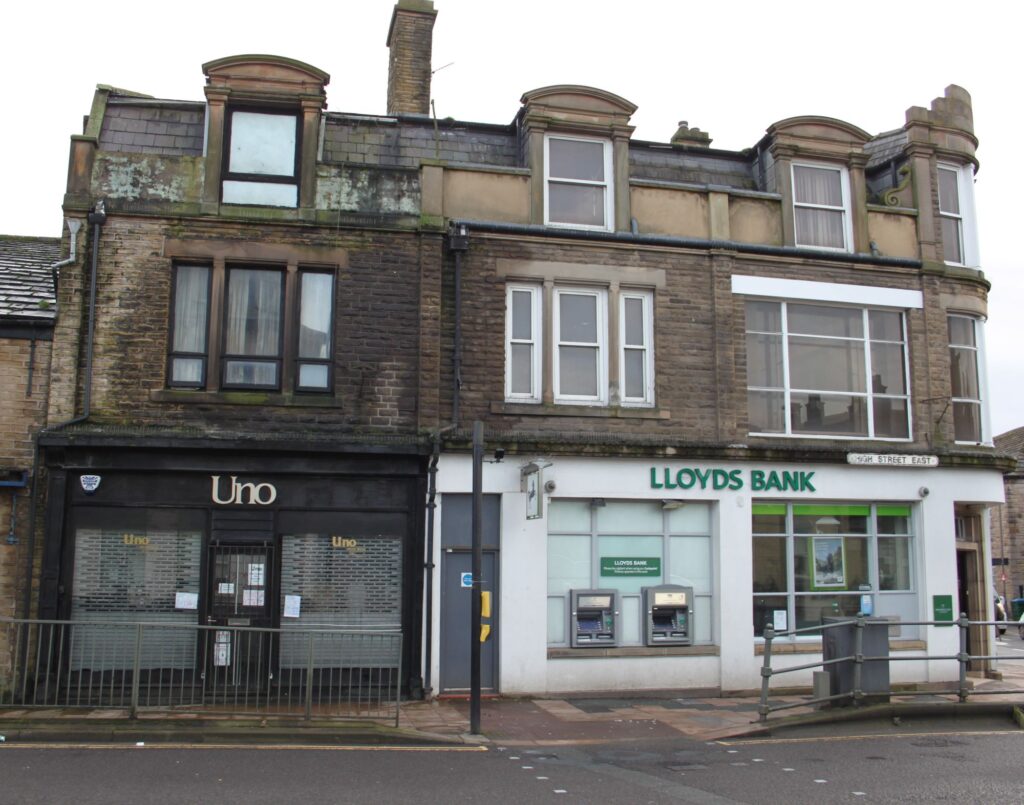
Hunters the Teamen moved to 4 High Street East in 1900, after Isaac Jackson had renovated the buildings to the shops known as Jackson’s buildings. They stayed in this shop until the mid-1920s when they moved to 38-40 High Street West. George Brownsons, Tailors, at number 2 then expanded into number 4.
James Merry, Ironmonger, 34 High Street East
Then
Now
Charles Greaves ran an Ironmonger business in Milltown that had been established for many years. When Charles retired the business was taken over by James Merry.
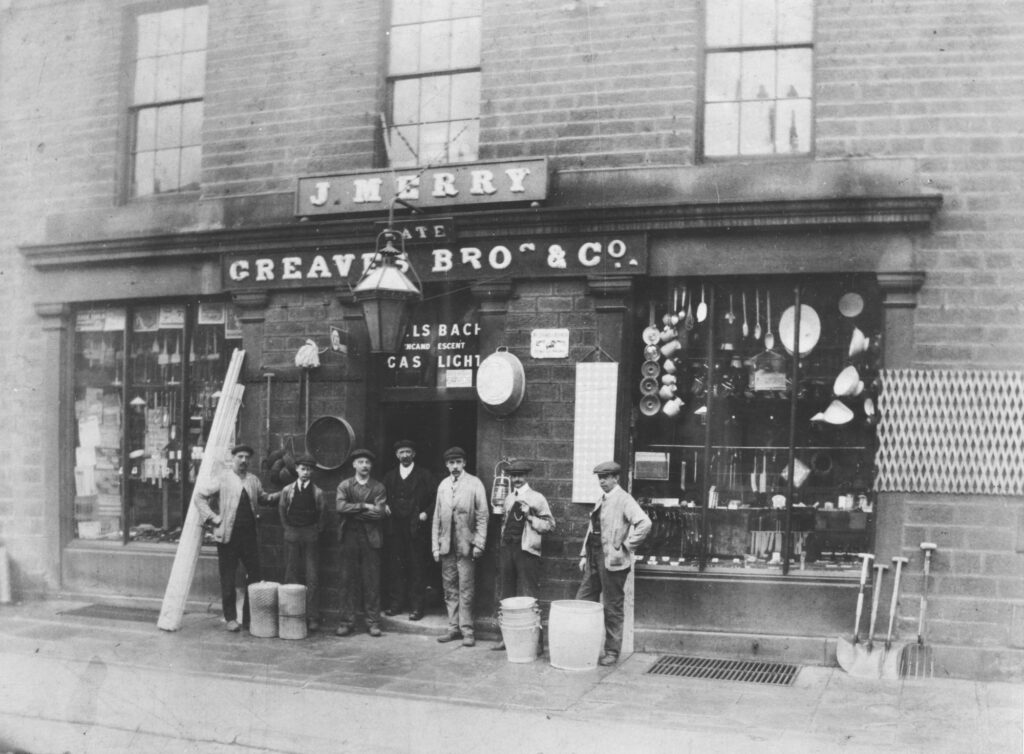
In a trade directory of 1900, James Merry was described as an Ironmonger, Plumber and Gas Fitter. In 1881 he employed seven men and five boys in his shop and business. The Ironmonger shop was at 34 High Street East, next to Yorkshire Street (which now no longer exists). The shop had a large yard behind for other work, which was accessed through an arch next to the shop.
The photograph shows some of the staff standing outside the shop with all their wares in the windows, including buckets, spades, tin baths and gas lamps.
In 1920 James Merry passed away and the business was taken over by another popular Ironmonger, J. Oliver, who had a shop on High Street West. They moved out in 1928 when it briefly became a motor garage. In the 1930s, there was a complete change of business when it was turned into a dance studio.
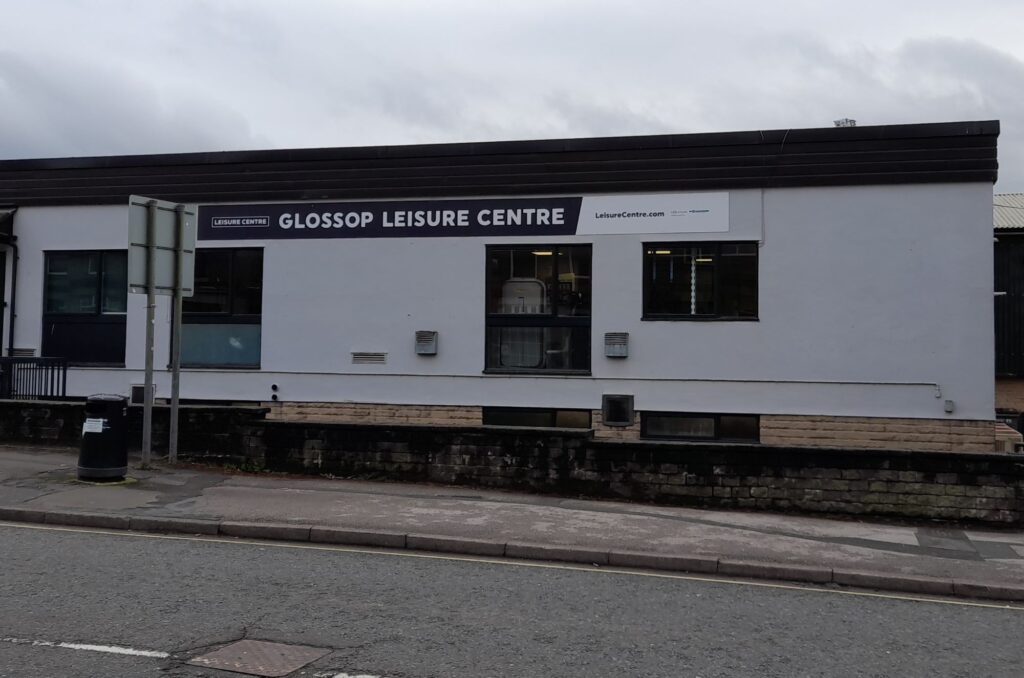
In the 1970s the buildings in this area and Yorkshire Street were demolished to build the leisure centre.
Walter Hyde, Hatter, Gentlemen’s Outfitters and Tobacconist, 32 High Street West
Then

Now
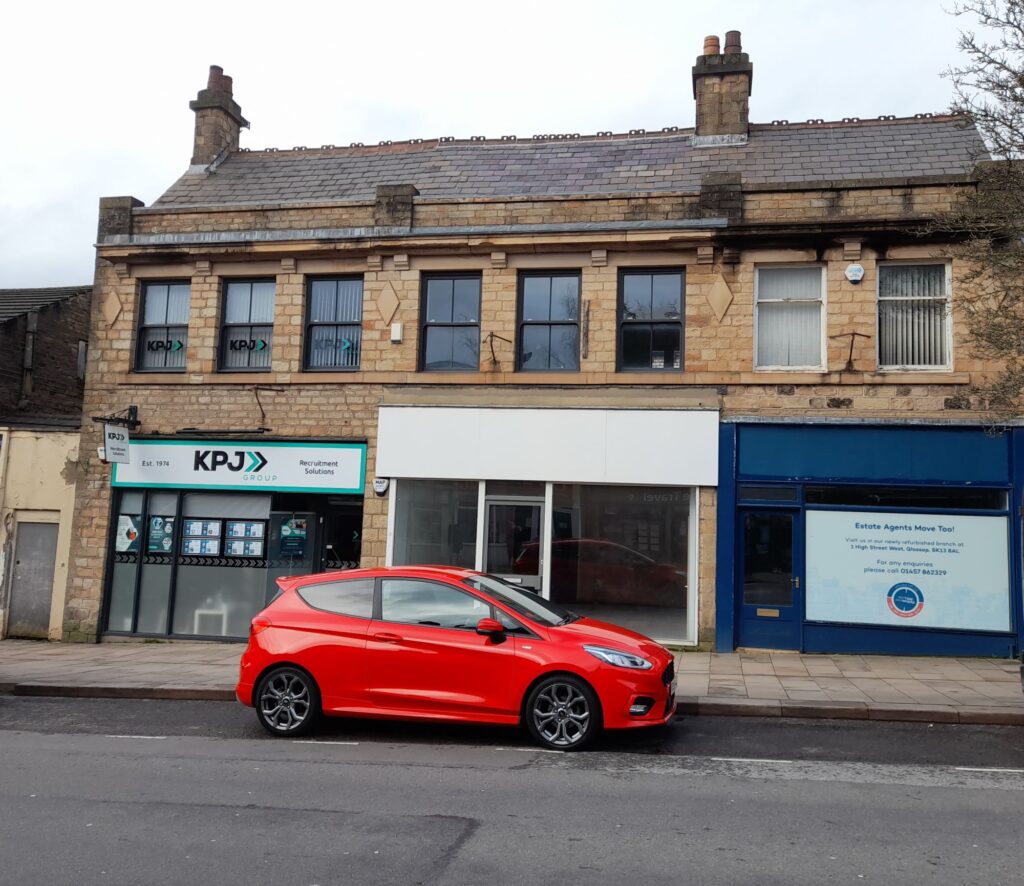
Walter Hyde was born in 1874, the son of William Hyde, a Cotton Loom Overlooker and later a Commercial Traveller.
In 1891 his elder brother, George Hyde, had a milliners and fancy drapery shop at 7 High Street East. Walter was working as an Assistant Gent’s Hatter, maybe at his brother’s shop.
By 1895 Walter, at the age of 21, was running a hatter and tobacconist shop at 34 High Street West. In the same year he also married Florence Hurst, the daughter of a tailor and outfitter of Denton.
Walter and his family were at 32 High Street West in 1908. He claimed, in an advert, to be the oldest established hatter in town, stating “we invite comparison and defy competition”. He sold every requisite in the gent’s line – hats and caps, ties and collars, belts and braces.
Florence’s brother, Walter Hurst, had been running a tailor’s shop at 9 High Street West since 1911. By 1921 Walter and Florence Hyde had left Glossop and their business for Canada.
In 1921 the shop was being run as the established business, Walter Hyde, by Albert and Maud Hurst. Albert was the younger brother of Florence and Walter Hurst. Walter Hyde’s Gentlemen Outfitters remained on the High Street until at least the 1940s.
We do not know the reason why the very dapper looking gentlemen were being photographed in this picture. Apart from the shopfronts and canopy, the building has not changed.
High Street West
Then

Now
John Swire (1816-1888) had a boot and clog making business in Hyde in the 1850s. Clogs were worn by mill workers in the mills so were in high demand. He moved to Glossop in 1859 with his young family and set up business on High Street West near the Market Hall.
In 1870 he moved over the road to 8 High Street West and over the years expanded into number 6, next door. The business of John Swire and sons remained on the High Street for over 100 years. The shop eventually closed after the decline and closure of the local cotton mills in the 1950s and the rise in pre-manufactured shoes, which resulted in less call for boot, shoe and clog making businesses.
Most of John’s sons followed their father in the shoe making trade with shops around the Glossop area. His business was prosperous, and he passed away in 1888 in his house in Spire Hollin. The late iconic fashion designer, Vivienne Westwood, was the 2x great granddaughter of John Swire.
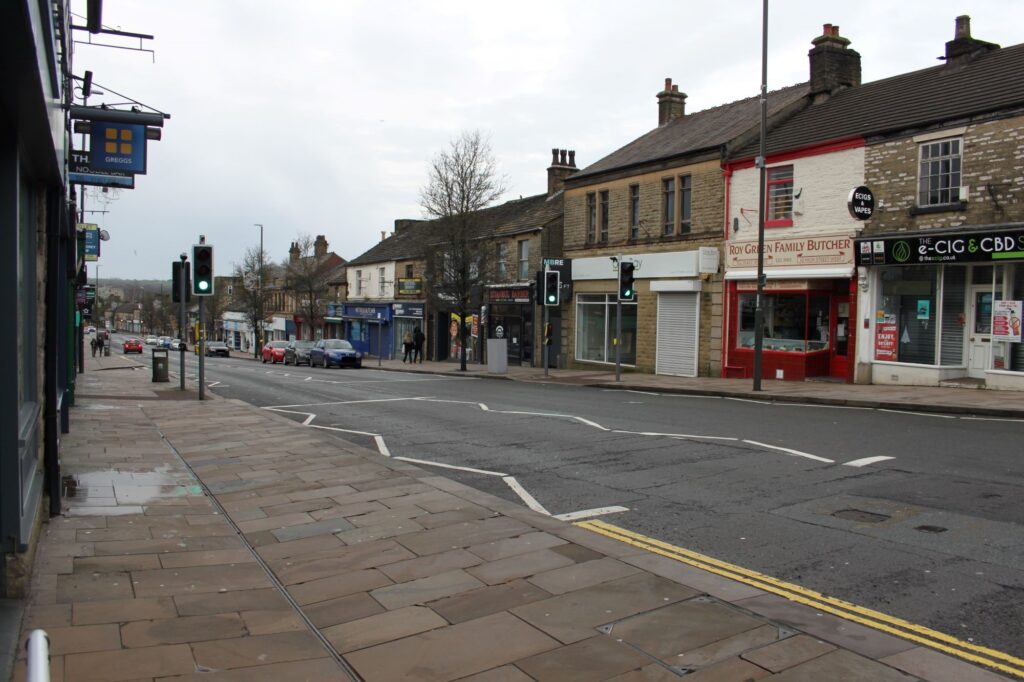
In the photograph from the early 1920s, you can see the tram lines along High Street West and the chimneys of Wren Nest Mills. You can also see many of the buildings have stayed the same, but further down the High Street there have been significant changes such as the Co-op café, the houses near were the Empire Cinema used to stand and the demolition and replacement of the Wesley Chapel.
Squire Sellers, Draper, 3-7 High Street East
Then
Now
Squire Sellers was born in 1871, the son of William Sellers an Oat Cake Baker. His younger brother, Richard (Dick) Sellers, followed in their father’s footsteps and ran a bakery and became Mayor of Glossop twice.
Squire followed a different path and in 1891 he was a Master Draper at 7 High Street East. His business continued to expand and by the early 1900s he was running his drapery business from 3, 5, and 7 High Street East and a furniture shop at 6 High Street East opposite.
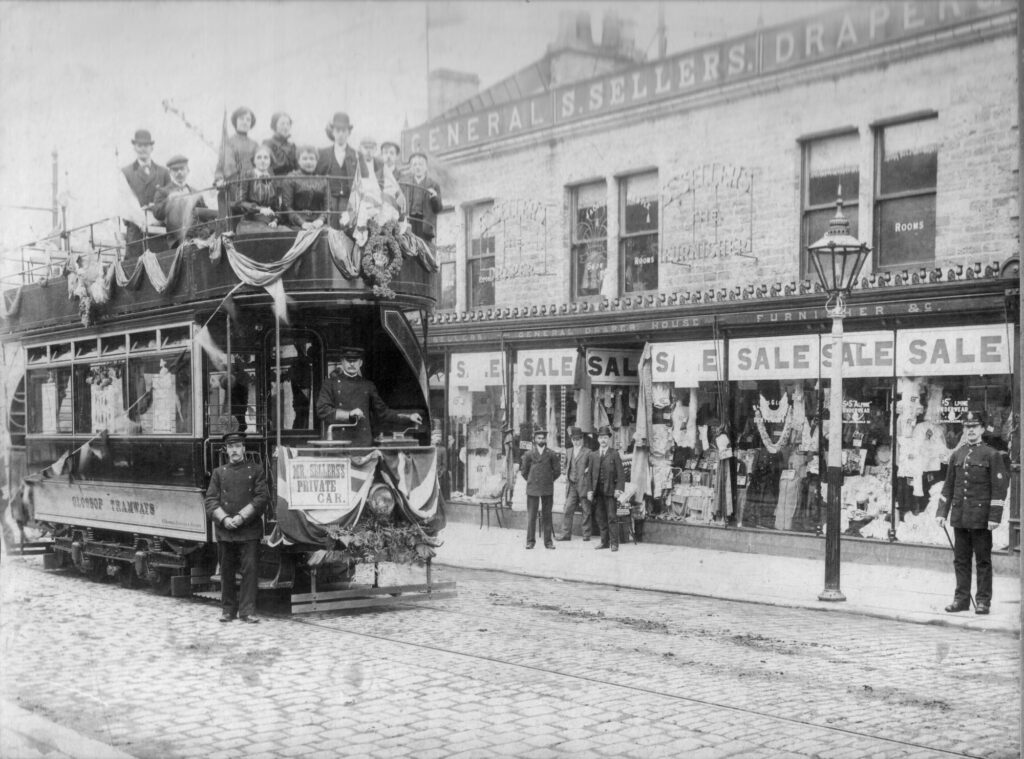
His success is shown in the picture. This photograph was taken on the opening day of the tramway service 20 August 1903. Trams ran past all the mills from Old Glossop along High Street East, High Street West, down Dinting Vale and up Woolley Bridge Road to Hadfield from 1903-1927.
This tram was specially engaged by Squire Sellers to run on the first day. He is in the photograph standing on the pavement in front of the shop with Mr H Crossley, the first salesman, and the chief inspector of the tramways.
Around 1910, Squire Sellers sold his business and moved away from Glossop. In 1911 he was working as a Manager at Glotts Manufactory that made furniture in Stockport. He later moved down to London and became a Manufacturer’s Agent until he passed away in 1937.
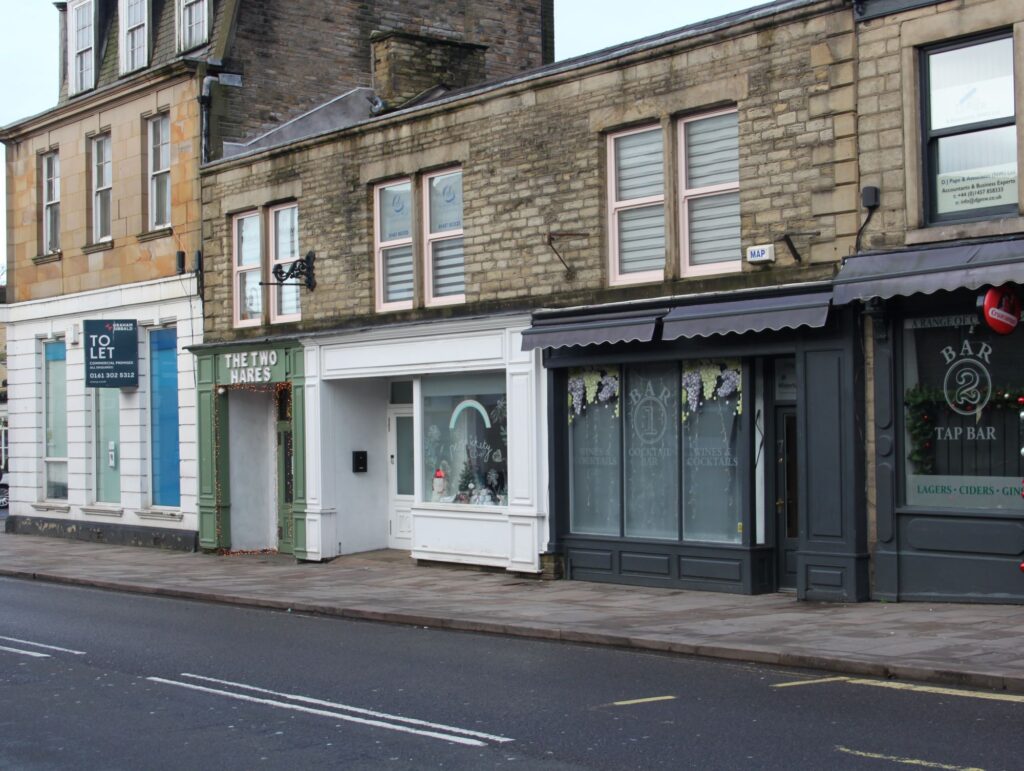
The shop at 3, 5, and 7 High Street East was taken over by William Thompson, a Draper. By 1925 the business had reduced in size and the shop was run from 3 and 5 High Street East. By 1928 the shops were three separate businesses again – Sheargolds Ltd, Pianoforte Warehouse at number 3; William Bolton, caterer at number 5; North Western Car Company Ltd, Motor Bus Proprietors at number 7.
Procession on High Street West
Then
Now
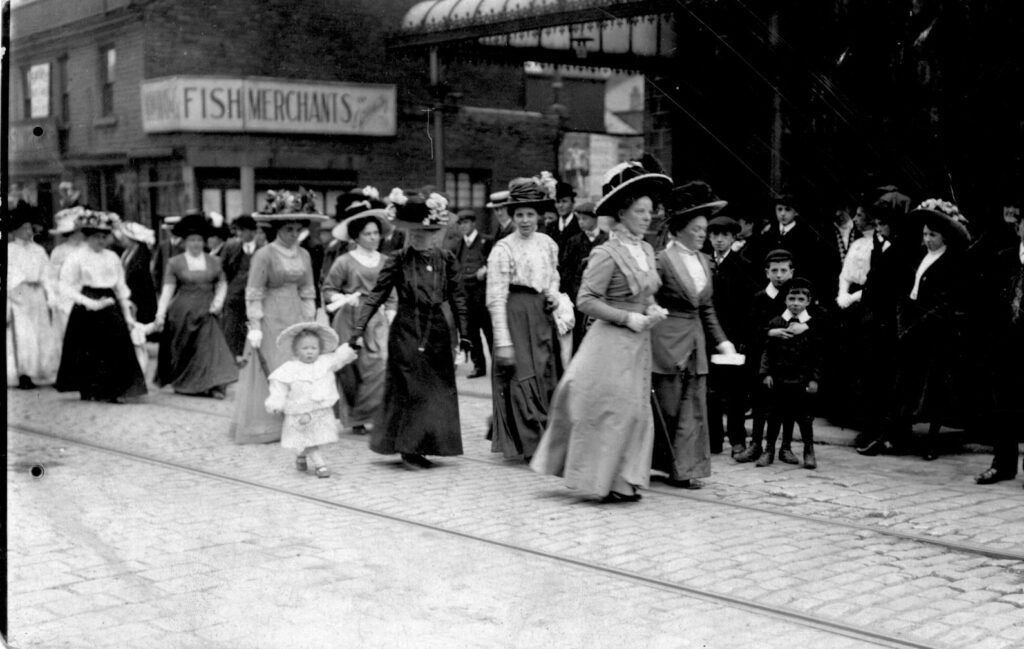
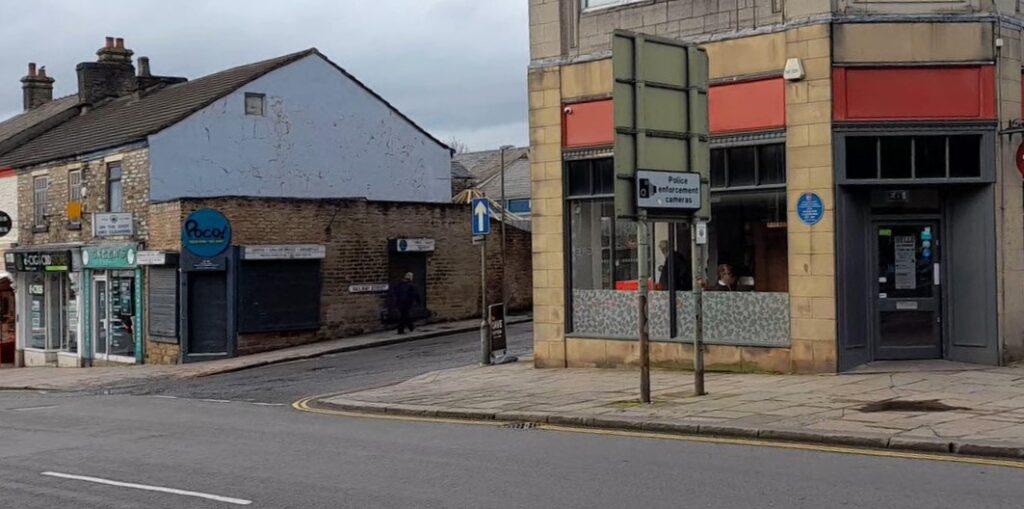
The little corner shop where Poco now stands has seen many different businesses. In 1870 John Swire, boot and shoe maker, moved into the extensive premises near the corner of Railway Street and High Street, Glossop. They remained at 6-8 High Street West for many years.
In 1891 there were two number 6 High Street Wests listed in the census. One was inhabited by Arthur Patchett, butcher. A few years later at 6a was Alfred Crannage, a watch and clock maker.
In 1909 Mowbray & Co announced that they were opening a fish merchants at no. 6 selling “North Sea fish direct from Grimsby Docks”. This may be the fish merchants in the picture, which was taken at a similar time.
The ladies in procession in their ‘Sunday best’ were part of one of the many church related walks that took place on the High Street during the early 20th century. In the background you can see the canopy that was installed in 1908 around the Glossop Dale New Industrial Co-operative Society shops and headquarters.
In 1913 the little shop was being let as a separate lock up, number 4. In the 1920s it was occupied by a fruiterers and a creamery business.
Manasseh Turner, Green Grocer, 26 High Street East
Then
Now
Manasseh Turner was born in 1855, the son of William Turner, a stonemason. By 1881, he had established a Green Grocer business, at 26 High Street East.
In 1901 he lived at 26 High Street East with his wife, Mary Jane, their five children and three servants.
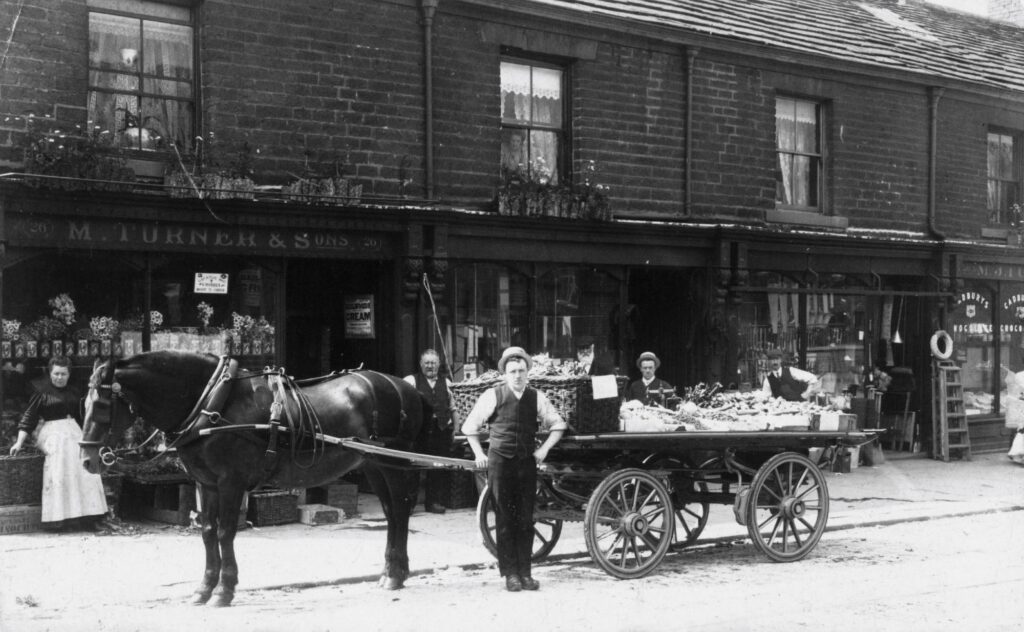
In the picture you can see the shop, the delivery horse and cart with Manasseh standing in front of the cart and probably Mary Jane standing in front of the shop. His business was successful enough that he could afford to hire a photographer to take an image of his shop.
Manasseh passed away in 1925. By 1928 the shop had been taken over by Leonard Frederick Norman, a Fruiterer.
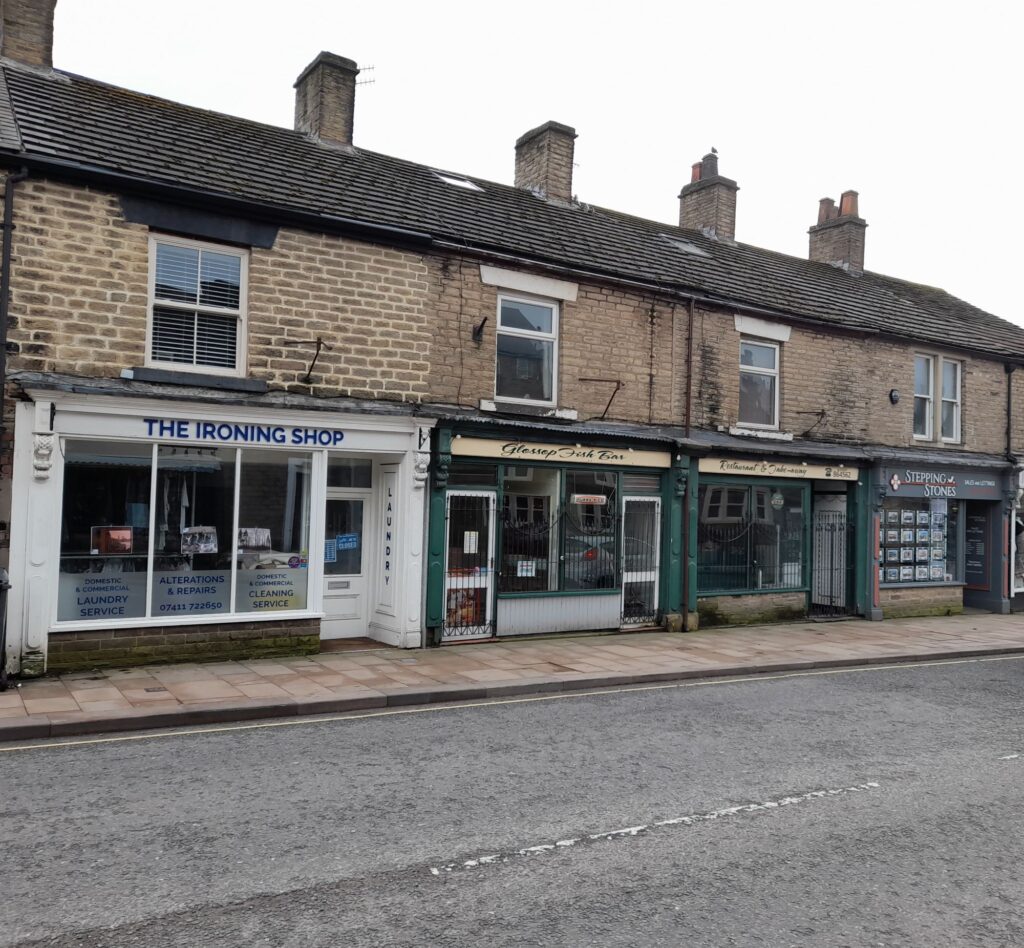
You can see these buildings have changed very little from the days of Manasseh’s shop.
Crossroads – High Street West, High Street East, Victoria Street and Norfolk Street
Then
Now
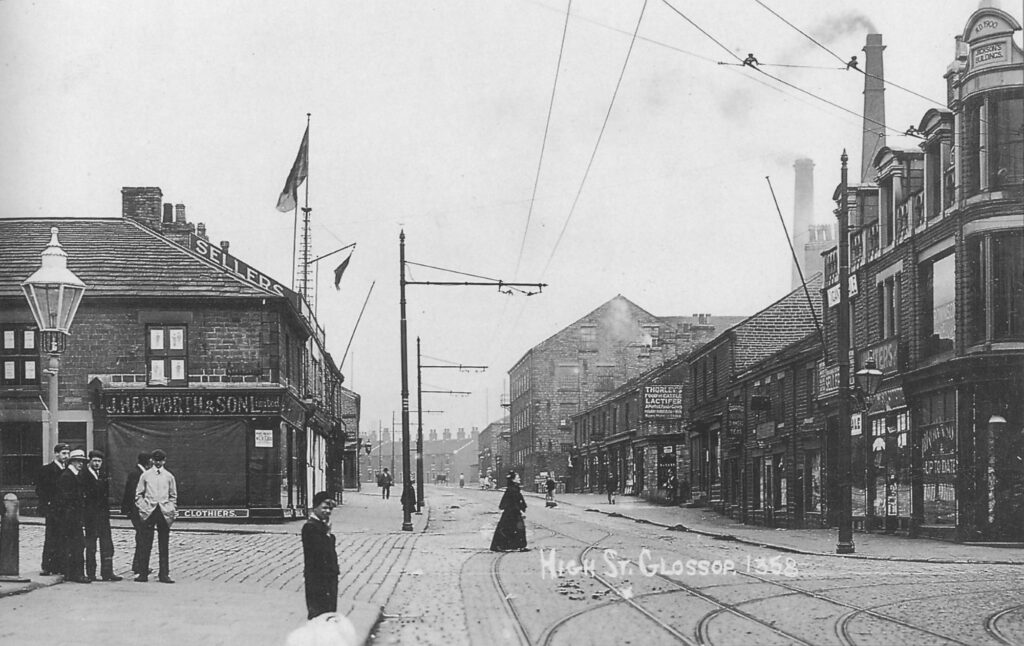
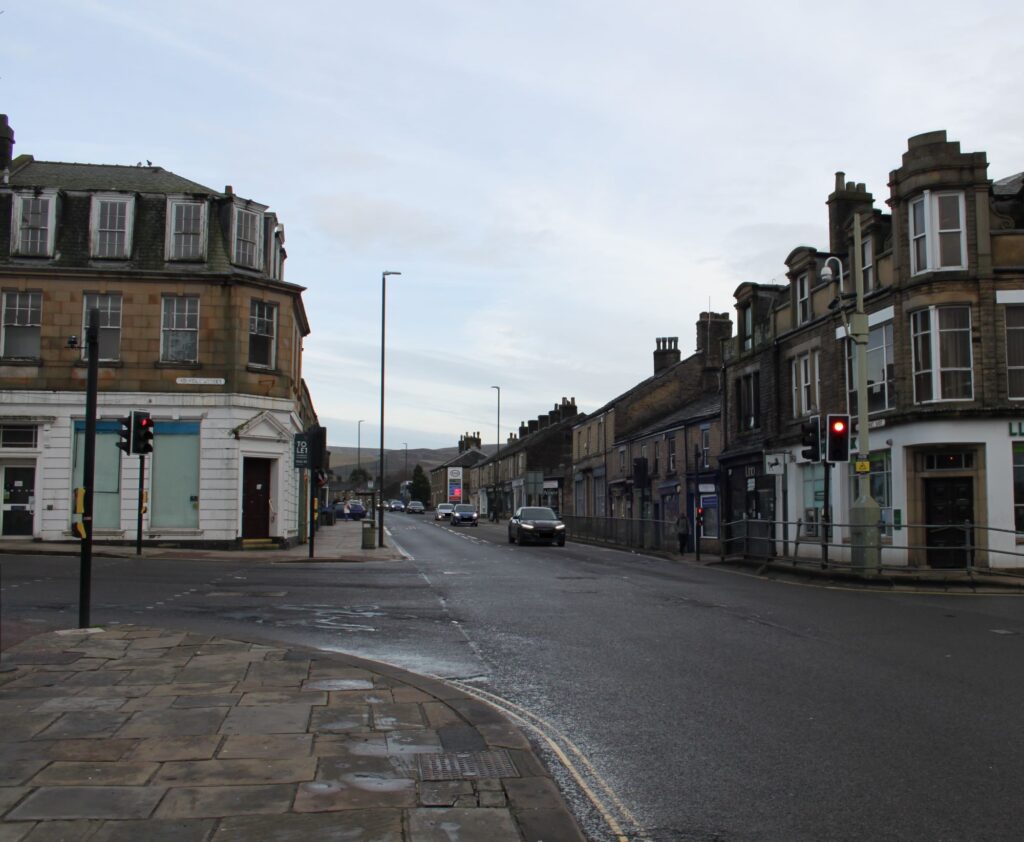
The crossroads at High Street West, High Street East, Victoria Street and Norfolk Street has always been busy. They mark the crossing of two of the main roads that ran through Glossop from Chapel en le Frith to Woodhead and Manchester to Sheffield.
The photograph dates from between 1903 when the trams began and Hepworth’s moved to 1 High Street East and 1910 when Squire Sellers sold his business and a canopy had been added to Jackson’s Buildings. Many of the buildings remain much the same today, including the row of shops from 8-12 High Street East, which were built in the 1820s.
Also, Jackson’s Buildings, which were built as ‘palatial business premises’ by Isaac Jackson, the inventor of Jackson’s belt fasteners that held together the drive belts in mills and factories. Notice the date stone ‘A.D. 1900. Jackson’s Buildings’ on top of the corner building. You can see Brownsons Tailors on the corner at number 2 and Hunters The Teamen at number 4 next door.
There are some significant changes. The trams finished running in 1927 and the lines were removed. The chimneys from Howardtown Mills were demolished after the mill closed. In the distance is a large building where the Esso garage now stands. This was Fireproof Mill, which was part of the Howardtown Mills complex and demolished around the 1960s.
In the foreground on the corner on the left hand side is J. Hepworth & Sons Ltd, Clothes and Outfitters. They opened their shop here some time after 1903 and were still there in 1925. Some time after this date the building was sold to Barclays Bank. They rebuilt 1 High Street East as the grand building we see today and took over 2-4 Norfolk Street. Barclays Bank opened by 1928 and closed in 2021.
Can you spot any more changes?
Matthew Woodcock, Boot Maker, 57 High Street West
Then

Now
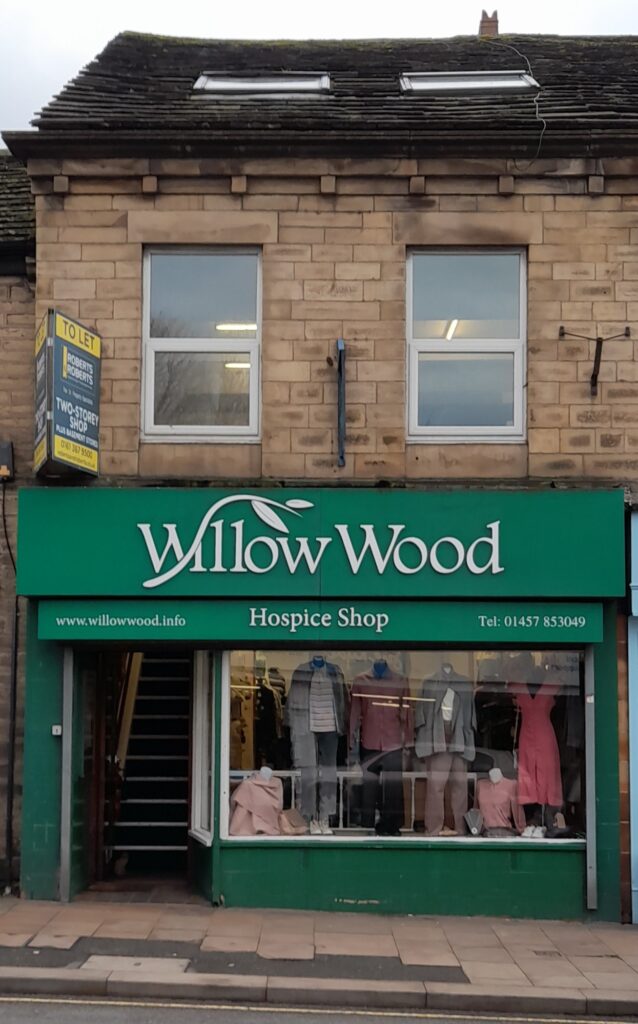
Matthew Woodcock was born in Glossop in 1855 the son of a cotton weaver. At the age of 19 he started working on the railways until his marriage in 1880.
In the 1881 census he was working as a shop man in a shoe warehouse. By 1891 he had his own boot & shoe shops at 34 High Street West and 44 Station Road, Hadfield. By 1901 his Glossop shop had moved to 57 High Street West.
The picture shows the shop decorated for the Coronation of King Edward VII in 1902. Matthew and his wife Ellen are standing outside the shop with two of their four children.
You may notice the grilles on the floor at the bottom of the shop. These covered the lower windows of the cellars. Many properties down the High Street have cellars, but the windows have been covered over with modern pavements. There is still evidence of one or two cellar windows or grilles on High Street East and West today.
By 1911 Matthew was living and running a shop at 49 Station Road in Hadfield. He passed away, at the age of 63, in 1918 a year after his wife Ellen.
The shop at 57 High Street West was taken over by Squire Taylor, a Baker and Confectioner, who ran a dining room there until he passed away in 1945.
Cuthberts, Tobacconist, 80 High Street West
Then
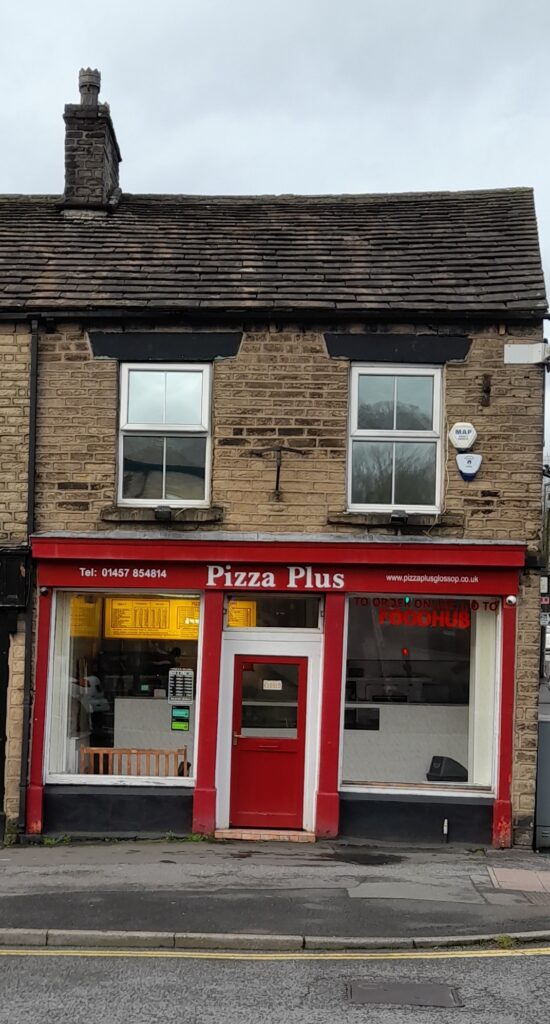
Now
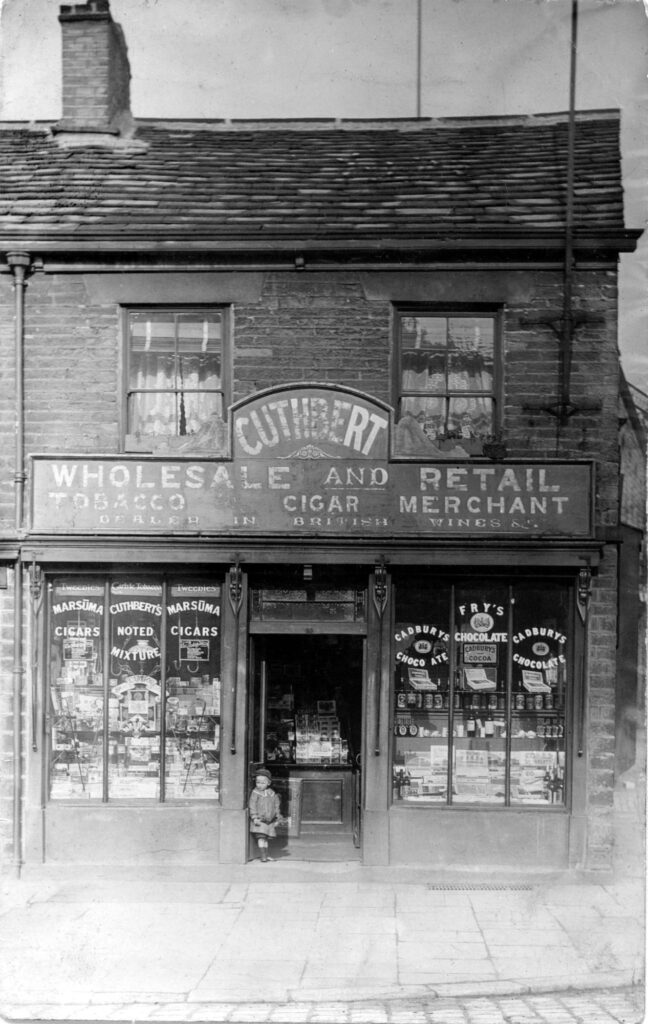
John Cuthbert was working as an engraver at Dinting Vale Print Works in 1881. He was living at 80 High Street West with his wife, Mary Elizabeth and a boarder. He was recorded as a Tobacconist, 10 years later in 1891, at 80 High Street West. Sadly, John passed away a year later at the age of 39.
Mary took over the running of the shop, later with her niece Mary Ellen Leech. It was very common for widows to take over their husband’s businesses.
In the 1911 census, Mary Elizabeth is living in the shop with her niece, Mary Ellen, her husband George Bowden and their five children, aged 9-4 months. It could be one of the Bowden children standing in the doorway of this photograph. Both women were recorded as Tobacco Merchants.
In 1922 Mary Elizabeth Cuthbert passed away. The shop was then run by Mary Ellen, her niece, into the 1930s. The shop remained a Tobacconists into the 1940s with new owners, the Goddards then James Broughton.
Glossop Heritage Trust
Glossop Heritage Trust was created in 1985 to preserve and promote Glossop and District’s long and vibrant history.
The Trust is an entirely voluntarily run, not for profit charitable organisation, covering the whole of the Glossop area. Its knowledgeable volunteers promote the history of Glossop on its website, Facebook and through talks and events that run throughout the year. We hold an extensive archive of documents, artefacts, memorabilia, and photographs, which have been collected over many years.
We are pleased to be a part of the inaugural Dark Peak Photo Festival to display some of these interesting photographs and tell their story.
Please see our support us page to discover ways you can help support our work.