
An Italian Job
Architects’ pitches to their clients often border on fantasy, but Matthew Ellison Hadfield did actually deliver most of his 1837 proposal to the Duke of Norfolk for a Town Hall and “Town Hall Buildings”. The end block on the right was altered, destroying the symmetry but creating, for his uncle Thomas Ellison, the Duke’s Glossop agent, a town-centre office; and the single-storey block along Victoria Street, where the Post Office was relocated in the 1920s, never materialised, but otherwise this is largely as was built and as still is. The dome on the right lasted till 1937, when Burtons arrived with their Art Deco; the planners would never allow it now.
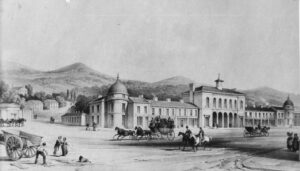
However, for a state-of-the-art, cutting-edge new industrial town the design was remarkably old-fashioned. The Town Hall itself was straight out of the 17th or 18th century, a large room above with an open arcaded area below, and the shops either side had long narrow plots like the “burgage plots” of a mediaeval borough. Hadfield shows them without shop windows, which may or may not be how they were actually built, but behind their narrow fronts they had a great deal of space, much more than the little shops of which there were already over 120 in the area, plus access from the rear. Although other big shops would soon follow as Norfolk Square was developed, for Glossopians in the early 1840s this would have been a whole new retail experience.
There was also a Savings Bank, and a Post Office at which they could buy, for a penny each, the new postage stamps introduced in 1840. By 1860 the shops included Charles Collier’s Family Grocery and Tea Warehouse – “the 4s black or mixed tea is the best and cheapest ever offered to the public” and George Woffenden’s Linen and Woollen Drapery Establishment – “funerals completely furnished”. The Victorians were big on funerals, but those wishing to avoid them could visit H.C Hardman, agent for Dr Lewis’s French Specific Pills – “save doctors’ fees – ready relief and certain cures.” The Duke, if he took ill on his summer visits, preferred T.P Wreaks a few doors away, and awarded him a Ducal Warrant, which sat above the successor firm Finlay McKinlay until 2014. It’s now in the custody of the Heritage Trust, with a view to its being placed somewhere in the Town Hall complex once the refurbishment is complete.
What’s most surprising, though, about Hadfield’s design is the style he chose. Most town halls of the period were Classical (like Ashton and Oldham) or Gothic (like Manchester and Rochdale) and he had used Classical for All Saints RC Church in Old Glossop and was one of the pioneers of the “Gothic Revival”. Here, however, he turned for inspiration to the Italian Renaissance, and gave Glossop its own little palazzo, with a neat clock tower to match, until in 1897 somebody stuck a Baroque hat on top of it.
But more about that in a few weeks time. Coming up next, having just shelled out the equivalent of £1 million in today’s money, the Duke down in Arundel received another expensive proposal…
NEXT – Part 3: The Market Act