
The Market Act
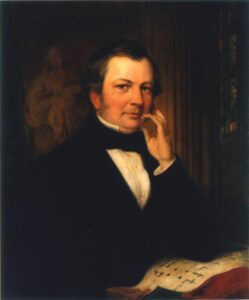
This series could just as well be entitled “The Ellisons’ Legacy.” For 122 years from 1797, when Matthew Ellison was appointed as the Duke of Norfolk’s agent, to 1919 when his great grandson Theodore, “Theo Walter”, retired as Town Clerk, the family played a major part in the running of Glossop, working in succession for the Duke, his son Lord Howard, and the Borough Council. They even built one of the biggest mills, Wren Nest, and in 1866 supplied the first Mayor; and the Glossop-born, Sheffield-based architect Matthew Ellison Hadfield (pictured), Matthew’s grandson, designed much of the new town.
The 12th Duke, “T’Owd Duke”, son of Henry Howard of Glossop, would have spent some time here as a boy, but he died whilst the Town Hall was being built, and the new Duke in Sussex would have been even more reliant on the agent to tell him what was going on and what he ought to be doing. The senior agent in 1843 was Michael Ellison, and just a few months after the Town Hall was finally completed, after 4 ½ years of stops, starts and rethinks, he sent the Duke a long letter which was probably not entirely well received.
The new hall wasn’t big enough. It had already been extended at the back, but even so, the arcade under it, which served as a covered market, was too small for all the traders who wanted space, and the town was growing rapidly. What was needed was a separate Market Hall, and a Market Act to regulate it.
Oh, and a branch railway. And a station. With a goods depot. All for ten grand, or about £1.28 million, on top of the million or so just spent.
The Duke agreed to it all. He may have felt he had little choice. The Corn Laws, which protected the income from his vast rural acres, were under threat of repeal, and although the cotton industry had its ups and downs it was looking a much better investment than farming. A Market Act was obtained, Uncle Michael sent again for his architect nephew, hall and station were built in tandem, the soil dug out for the station being used to level up the site for the hall, and it was all done by July 1845.
The Market Act had another consequence, in that it defined “the town of Glossop” as being the area within a mile radius of the Town Hall – and a brass plate was put in the floor of the arcade to mark its centre. The name of the village was therefore transferred to the new town, which up to then had been just “Howardtown.”
The Market Hall wasn’t the building we see now – it was only a quarter of the size, and within a few years Michael Ellison would be writing another letter, and sending yet again for his nephew. In the next episode we will look at how the market was run, and what it sold. There may have been another reason why Ellison didn’t want market stalls under the new court house…….
NEXT – Part 4: Tongues, Trotters and Tripe
PREVIOUS – Part 2: An Italian Job