
A Most Commodious Hall of Justice
It’s almost certain that Matthew Ellison Hadfield originally designed the Town Hall with just one large room, but by the time it was finished in late 1842 it had a rather clumsy cut-price extension on the back, ruining the symmetry at least from the rear. Perhaps Hadfield, or his uncle Michael Ellison, the Duke’s agent, had realised that a single room couldn’t easily serve as court, meeting room and “assembly room” for big social functions.
The courts and meetings were therefore consigned to the back room. However, this didn’t work. In March 1849 the Derbyshire Courier reported that as there was “but one door for the entrance of judges, magistrates, witnesses and audience, it was very inconvenient, especially when any case of particular interest brought a large number of spectators. The constant noises, arising from the opening and shutting of the door, and parties having to make their way through the closely-packed crowd often attending, amounted to a positive nuisance.”
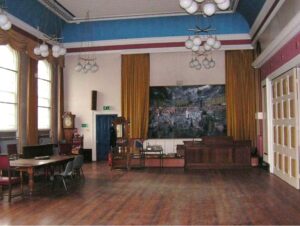
Now, however, “the assembly room has been elegantly fitted up as a court room, and having an entrance at each end, and a considerable unoccupied space behind the bar, as well as a gallery capable of containing two or three hundred persons, it is one of the largest and most commodious local halls of justice in the kingdom.”
Although the caretaker would have to shift heavy Victorian furniture every time there was a booking for a ball or a concert, it did solve the problem. There were others, though. In April 1860 the Glossop Record complained that “a few weeks ago, persons having business before the magistrates were kept waiting several hours, because only one was in attendance, before the arrival of a second, for whom a messenger was despatched. On Thursday last, no magistrate appeared upon the bench until nearly two hours after the time appointed for the opening of the court.”
There were six magistrates, four of whom – William Sidebottom, Edmund Potter, Francis Sumner and John Wood – were the town’s largest millowners. They were busy people – they would spend part of the week on business in Manchester, and Potter was MP for Carlisle. However, the Record pointed out that they would think nothing of fining their employees for being just a few minutes late. “It is true that they are not paid for their attendance, but if they undertake the magistracy, they are in honour bound to be punctual. If they are unable, or unwilling, to fulfil the duties with punctuality, let them resign.”
One did, however, later redeem himself. Saltersbrook, at the head of Longdendale, was a popular place for illegal prize-fights, being at the junction of three counties so the fighters and their audience could quickly move to another county if the police showed up. On 12th November 1867, though, they showed up from two sides, and after “a spirited run of several miles” apprehended the pugilists near Crowden station. As they “required medical attention” the Superintendent didn’t want them in his cells overnight, so Francis Sumner, by then the town’s first Mayor, attended “at great personal inconvenience” to grant bail, being thanked by the mens’ lawyers “for his patience in taking the case at so late an hour in the evening.”
To come, two more cases which packed the gallery and made the national press, but first, a very topical subject….
NEXT – Part 10: A Shot in The Arm
PREVIOUS – Part 8: Fair Game