
A Shot in The Arm
Smallpox was a dreadful disease, which spread quickly in the overcrowded, insanitary conditions found in many industrial towns. It killed about a third of those infected, most survivors were permanently scarred, and many went blind. It was especially lethal to young children.
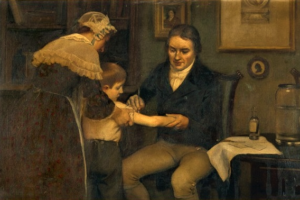
However, Edward Jenner (see pic) had shown it could be prevented by an injection of the similar but milder cowpox, hence “vaccination.” The government made it free in 1840, and in 1853 compulsory for all children in their first three months, but enforcement was weak and the law was tightened in 1867. Public opinion was divided, though; its effectiveness was unclear, unsterilised needles could transmit other infections, and there were concerns about infringement of liberty.
It was also unpopular because the 1867 Act gave the job of administering and enforcing the jabs to the Poor Law Guardians. They were the only local public bodies which employed doctors, but any contact with them carried a stigma.
By January 1869 the Glossop Guardians were meeting resistance. They sent warning letters threatening prosecution, but by March there were 22 non-compliers, and the Chairman, Francis Hawke (who was also Lord Howard’s agent) “did not know what would be the best thing to do.” In the great tradition of English local government, they adjourned the matter till the next meeting.
And the next, and the next. Finally, in August 1870, they decided to do something. But what? They balked at prosecuting every defaulter, but Mr Hawke said that “it was necessary to make an example of some of them, as it would not do to allow the law to be trifled with.” Eventually they decided to choose four who were “best able to pay, as they were likeliest to know the requirements of the Act.”
That then passed the buck to the magistrates at the Town Hall. Their Worships were, however, as ambivalent as the Guardians. They would impose only nominal fines, the Guardians were reluctant to prosecute again in less than 12 months, and so those “best able to pay” just went on paying, year after year.
The chief resister was Josiah Mellor, coal merchant of Whitfield and entertainer noted for “comical refrains”, although Thomas Rhodes, on the bench in December 1874, wasn’t amused; “they were there to administer the law, and he was bound to obey; if he did not wish to be under the laws, the sooner he quitted the country the better.”
He was fined 20 shillings, plus costs. Not that he cared, as it would be paid by the Sheffield Anti-Vaccination Society, which commended “the bold and manly stand you have taken; the brave manner in which you have, in a town where compliance is the fashion, and resistance the exception, dared the authority and the law.” In November 1875 three Guardians voted against prosecuting him again, Luke Darwent saying that he had been summoned four times “which was very odious, and it was beginning to look something like tyranny.”
He made three more court appearances, the last in January 1878 when he complained that he had been fined the usual 20 shillings “before he had pleaded or spoken a word”. After that, the Guardians appear to have given up, and eventually the government did too, and permitted “conscientious objection.”
Our final two court cases will feature scandals of a peculiarly Victorian nature, both of which ended up in the national press.
NEXT – Part 11: The Teetotal Bigamous Schoolmaster, the Piano, and the Coffee Palace
PREVIOUS – Part 9: A Most Commodious Hall of Justice