
Owd Fussy, Madam Mayor, and a generous munitions magnate
In 1897, to celebrate Queen Victoria’s Jubilee, Lord Howard gave the Town Hall a new clock, plus a silly hat – a big Baroque dome on top of Michael Ellison Hadfield’s Italianate clock tower. Now grey, for much of its life it has been gold. Within a month or two the clock was “misbehaving”, and one of the town’s multi-skilled policemen had to be paid a shilling a week to restore order.
This didn’t, however, solve the pressing problem of office space, which got worse during World War 1 as the Council took on extra responsibilities. 13 staff were crammed into six “ill-ventilated and insanitary” rooms at the back of the Arcade, where the record shop was until recently, with others scattered around the town centre in five locations. The Town Clerk, Theo Walter Ellison, erstwhile defender of “Buffalo Bill”, and known as “Owd Fussy” for his pompous, pedantic manner and meticulous attire, said that “this does not conduce to efficient administrative work”.
The Council was also unable to police weights and measures whilst Lord Howard did so within a mile radius of the Town Hall. The Howards, though, were clearly on their way out; Lord H was in his late 50s, rarely in Glossop and reclusive when he was, and his newly-married heir had set up home at Carlton Towers in North Yorkshire.
And in May 1916 the town got a new Mayor, when Mary Alice Partington succeeded her husband Herbert after he died in office. A formidable fundraiser and organiser, she was not one to tolerate inefficient administrative work, and in September 1918 Ellison sent the government a plan and a request for a loan.
They wanted to purchase the Town Hall, Market Hall, market rights and ground from Lord Howard, and the Norfolk Arms from Gartsides Brewery, and to turn the latter into offices. Ellison was already there, running the town from his legal firm in Norfolk Chambers. Total cost nearly £22,000 – about £1.5 million in today’s money.
The government said no – didn’t they know there was a war on? There was then a quick rethink – the drill hall, now the local base of the Cheshire Regiment, took up a third of the Market Hall, but as The War To End Wars was clearly drawing to a close, it would soon be redundant. Ditto the Fish Market – there were only two traders there.
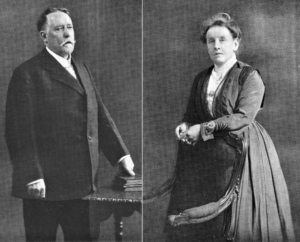
And one Glossop industrialist had had a good war. Isaac Jackson (see pic, with his wife Harriet) started as a saddler in High Street West, then moved to Victoria Street, making patent fasteners for the drive belts used in mills and factories. As the business grew he moved to Norfolk Street, then in 1905 to Hawkshead Mill in Old Glossop.
In 1914 many of the army’s shells failed to explode, but Jackson designed and made a reliable fuse, and business boomed. In November 1918, just before the Armistice, he and Harriet offered, “in memory of the men of Glossop and district who served in the Great War” the sum of £12,000 to enable the Council to complete the purchase of the Town Hall, Market Hall, ground and rights. Whether “Mrs Herbert” did any arm-twisting is not recorded, but she didn’t raise, for the war effort, a total of £2 million in today’s money just by rattling tins.
And once it was all done and dusted, Owd Fussy stood down as Town Clerk and returned to his private practice, bringing to an end over 120 years of Ellison family involvement in the town’s affairs which had begun with the arrival of his great-grandfather Matthew as the Duke’s agent in 1797. The new Town Clerk would soon have a spacious modern office, although perhaps with a faint whiff of fish…….
NEXT – Part 17: Decline, Decay, and Revival
PREVIOUS – Part 15: A multi-use space, multi-tasking policemen, and a Marks and Sparks